

Introduction
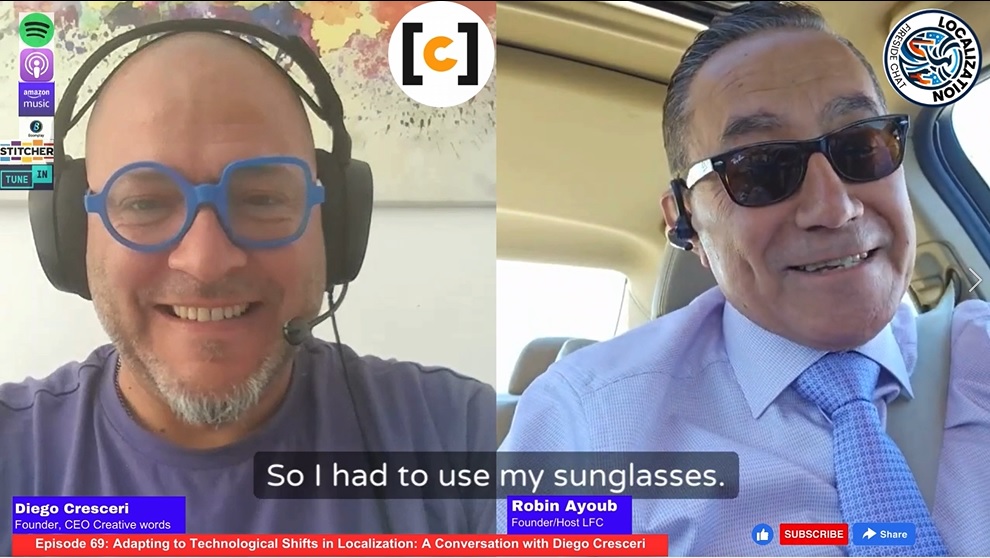
The localization industry is undergoing a significant transformation due to technological advancements and evolving market demands. In a recent fireside chat, Robin Ayoub and Diego Cresceri discussed the current state of the industry and shared their insights on the challenges and opportunities that lie ahead. This blog post aims to summarize their conversation and provide valuable takeaways for professionals in the localization industry.
Embracing Change
One of the key themes that emerged from the discussion was the need for companies to embrace change and adapt to the evolving landscape. While some organizations are hesitant to adopt new technologies, Diego emphasized the importance of taking action and not waiting for the perfect solution to emerge. He encouraged companies to develop a vision for the future and invest in training their teams to stay ahead of the curve. The message was clear: in a rapidly changing environment, inertia is not an option.
Diego pointed out that many companies are still in a “wait-and-see” mode, which can be detrimental. Instead, he advocates for proactive engagement with new technologies, stressing that CEOs and leaders in the localization industry must replace fear with vision to guide their teams through this period of transformation.
The Role of Linguists
Diego highlighted the value of linguists in shaping the future of the industry. Contrary to the misconception that AI will replace human translators, he emphasized the need for linguists to work hand-in-hand with technology to provide high-quality translations. By leveraging their expertise and collaborating with AI tools, linguists can enhance the efficiency and accuracy of translation processes.
He shared examples from his own company, where linguists have transitioned into roles involving AI and programming, illustrating that with the right training and mindset, linguists can significantly contribute to and thrive in a tech-driven industry. This collaboration not only preserves the linguistic quality but also integrates the nuanced understanding that only human linguists can provide.
Business Leakage and Revenue Generation
Robin and Diego discussed the concept of business leakage, where companies are experiencing a decline in orders due to clients finding alternative ways to handle their translation needs. This trend underscores the urgency for companies to diversify their services and explore new revenue streams. By offering additional services such as consulting, training, and content generation, companies can offset the decline in traditional translation projects.
Diego shared that his company has been successful in expanding their service offerings beyond traditional translation, venturing into consulting and content generation. This diversification strategy not only mitigates the impact of reduced translation volumes but also opens up new business opportunities and strengthens client relationships.
The Role of Academia
The conversation also touched upon the role of academia in preparing the next generation of linguists. While some universities are adapting their curricula to include technology-focused courses, others are lagging behind. Diego stressed the importance of universities keeping pace with industry changes and equipping students with the necessary skills to thrive in a technology-driven environment.
He noted that universities need to balance traditional linguistic education with modern technological skills, ensuring that graduates are well-prepared for the current demands of the localization industry. Diego’s involvement with universities and the European Commission highlights the ongoing efforts to bridge the gap between academic training and industry needs.
The Future Outlook
Looking ahead, Diego predicted that there may be more companies going out of business as they fail to adapt to the changing landscape. However, he also expressed optimism about the industry’s expansion and the potential for mergers and acquisitions to create stronger and more innovative companies. He urged companies to focus on providing value to their customers and to communicate their evolving services effectively.
He anticipates that those who embrace change and invest in innovation will thrive, while those resistant to adaptation may struggle. The industry is poised for significant growth, driven by technological advancements and an increasing demand for diverse language services.
Conclusion
The localization industry is at a critical juncture, with technology reshaping traditional practices and market dynamics. Companies must embrace change, invest in training, and diversify their services to remain competitive. Linguists play a crucial role in shaping the industry’s future, and their expertise should be leveraged alongside AI tools. Academia also has a responsibility to equip students with the skills needed to thrive in a technology-driven industry. By navigating these changes with a vision and a focus on providing value, companies can position themselves for success in the evolving localization landscape.
In summary, the insights shared by Robin Ayoub and Diego Cresceri provide a roadmap for the localization industry to not only survive but thrive amidst technological shifts. Their conversation is a call to action for all stakeholders to engage proactively with the changes, ensuring that the industry continues to grow and evolve in the right direction.
Until next time this is Robin Ayoub Signing off

 Robin Ayoub
Leave a comment