
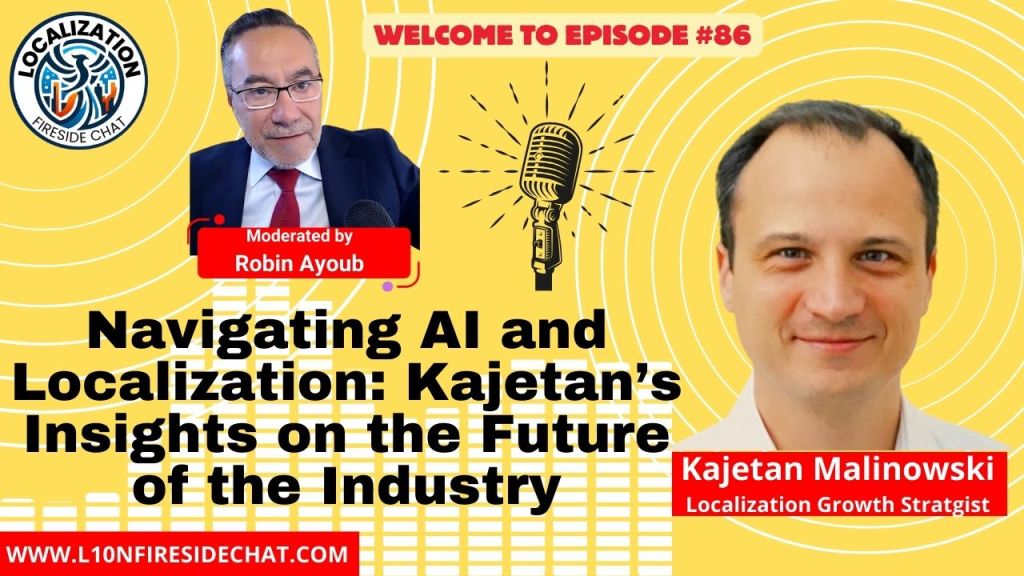
The intersection of AI and localization is becoming increasingly important in a rapidly evolving global economy. In Episode 86 of the Localization Fireside Chat podcast, host Robin Ayoub sat down with Kajetan Malinowski, a veteran of the localization industry and founder of consulting firm biangle. digital. With 17 years of experience at Lionbridge under his belt, Kajetan now helps companies reposition themselves for the AI era. Their conversation covered the challenges and opportunities AI presents for the localization industry, as well as the lessons Kajetan learned while transitioning from a corporate role to running his own business.
AI and Localization: A Happy Accident
Both Kajetan and Robin share an interesting similarity in how they entered the localization industry: by accident. Kajetan reminisced, “I got into this industry in 2006, and, like many others, it was by accident. I never planned to be in localization; a friend mentioned Lionbridge was hiring for what was supposed to be a summer job. Seventeen years later, I was still there.” Robin echoed this, sharing his own story of falling into localization in a similarly unexpected way.

This “happy accident” resonates with many in the industry, but it’s no longer just a niche field for linguists. As AI has increasingly made its presence felt in every sector, localization has been thrust into the spotlight as a vital function for global companies. “We’ve been talking about machine translation since 2007 or 2008,” Kajetan noted, “but what AI is doing now is changing the game on a massive scale.”
The Role of AI in Localization: Productivity and Scale
Kajetan emphasized how AI can drive productivity in localization. “AI is just another productivity tool in a line of different productivity tools we’ve had in this industry. It helps companies scale their

operations faster, whether it’s through machine translation or AI-enhanced workflows,” he explained. The industry has evolved from relying on translation memories and computer-assisted translation tools to now incorporating neural machine translation and generative AI.
Yet, AI’s impact goes far beyond just automating the translation process. Kajetan believes that AI is pushing localization to become more strategic. “AI isn’t just about linguistic quality anymore,” he said. “It’s about how well content serves its purpose. It forces us to think about the entire content lifecycle and how language plays a strategic role in driving business outcomes.”
Robin pointed out that this shift could elevate localization teams in large organizations: “Localization departments have often been seen as a side service, but AI is now giving us the tools to show how integral we are to growth, customer engagement, and even revenue generation.”
Strategic Opportunities in AI
One of the key takeaways from their discussion was how AI offers localization teams a unique opportunity to contribute more value to their organizations. Kajetan explained, “Think about it: with AI, you can generate content at scale, but what will matter is the quality and the relevance of that content. It’s about outcomes—how much growth, clicks, or engagement your content brings in.”
Robin agreed, adding, “Localization isn’t just about the number of words translated anymore. We’re moving into a space where it’s about building multilingual experiences and ensuring that these experiences drive strategic goals for businesses.”
The conversation also explored how AI allows for greater personalization of content. Kajetan shared his excitement about the future: “Imagine going to a website where the content is tailored specifically for you, based on your location, preferences, and previous interactions with the brand. That level of extreme personalization is becoming possible thanks to AI. And it’s localization teams who will be instrumental in making that happen.”
The Risks and Rewards of AI
While both Robin and Kajetan are optimistic about AI’s role in localization, they also touched on the need for caution. “One of the biggest challenges for companies adopting AI is understanding its limitations,” Kajetan warned. “Yes, it can generate content, but it’s not perfect. Companies that rush into replacing their content or localization teams with AI are quickly realizing that it’s not a magic bullet.”
Robin echoed this sentiment, highlighting the need for a balanced approach: “It’s not about AI replacing human roles. It’s about finding the right balance between technology and human expertise. The challenge now is figuring out how much human input we need to maintain quality and nuance.”
Final Thoughts: The Future of Localization in the AI Era
As their conversation wrapped up, both Kajetan and Robin expressed optimism about the future. “AI is a tool, but it’s the people who know how to use it effectively that will thrive,” Robin said. Kajetan agreed, adding, “The localization industry is in a unique position to harness the power of AI. If we embrace it strategically, we can elevate our value and make a significant impact on global businesses.”
This insightful conversation underscores how AI is not only reshaping localization but also offering new opportunities for those who are ready to adapt and grow in this rapidly changing landscape.

Until next time this is Robin Ayoub signing off!
Robin
 Robin Ayoub
Leave a comment