
An Inspiring Father-Son Story and the Role of Multilingual Communication in Faith-Based Communities
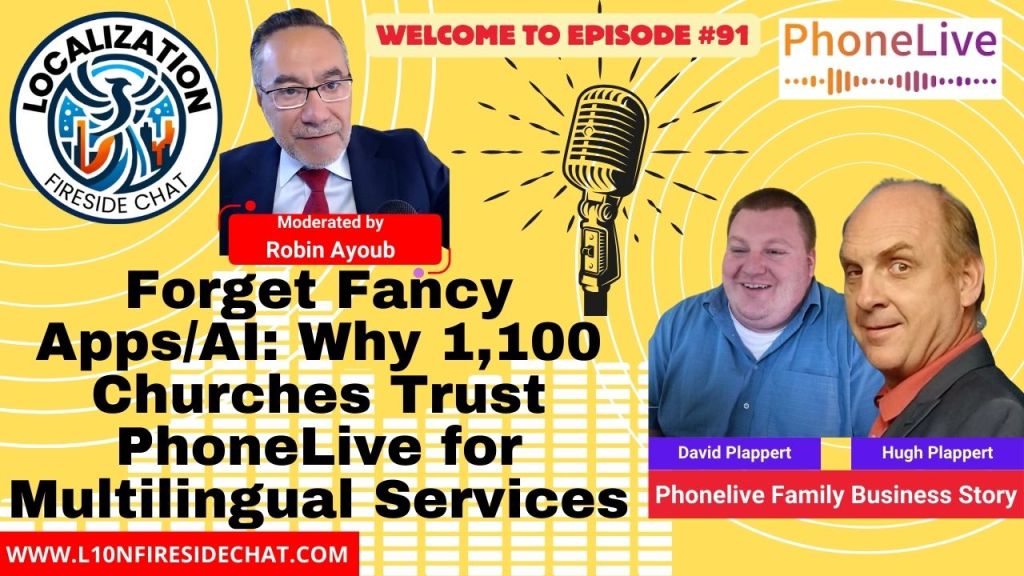
In the latest Localization Fireside Chat episode 91, I had the pleasure of speaking with David and Hugh Plappert, the father-son duo behind PhoneLive, a groundbreaking company delivering church broadcasts to congregations using phone lines—yes, phone lines! At a time when AI, apps, and streaming dominate the tech industry, PhoneLive proves that old-school technology can still thrive and solve modern challenges. you can listen to the interview here
Who Is PhoneLive and How Did It Start?
David, the technical brains of PhoneLive, introduces himself with refreshing humility:
“I don’t know what I’m doing, and I may be a little bit crazy.”
His background is rooted in cloud computing, starting with Amazon Web Services as early as grade school. Growing up in small- and medium-sized churches, David developed a knack for solving AV and tech problems on a shoestring budget.
Hugh, David’s father, brings 41 years of experience in ministry and back-office work. Together, they complement each other: David focuses on innovation, while Hugh manages operations and marketing.
The story of PhoneLive begins with a simple idea to help senior members of congregations connect to church services over the phone. However, as David recounts, the real catalyst for growth was the: you can listen to the interview here
COVID-19 pandemic:
“We wanted to create a phone system that became an active contributor to ministries. Then COVID hit, and this idea shot to the top of the list.”
In March 2020, David wrote the first version of PhoneLive overnight in his parents’ basement. The next day, a simple Google form circulated, and by the end of the first month, PhoneLive crossed $10,000 in monthly recurring revenue—without a website, branding, or marketing strategy.
Today, PhoneLive serves 11,000 churches, connecting over 22,000 people weekly and delivering 65 million minutes of church broadcasts.
What Makes PhoneLive Unique?

At its core, PhoneLive is a broadcasting platform. Churches use it to deliver audio-only streams of their services over dedicated phone numbers. Each congregation gets a toll-free number, ensuring ease of access for their audience.
What sets PhoneLive apart? Scalability, simplicity, and multilingual capabilities. David explains:
PhoneLive also allows churches to serve multilingual congregations. While they don’t provide interpretation, churches can assign dedicated phone numbers for each language. For example, one number may broadcast the English stream, another Spanish, and another French. This capability has opened doors to new opportunities:
“We didn’t create this for translation, but our customers showed us the need. Churches started using our platform for multilingual broadcasts.”
A Customer-Driven Journey
One of the most compelling moments in the interview was David recounting how PhoneLive’s multilingual feature was born:
This accidental innovation reflects PhoneLive’s philosophy of “following the customer.” Their users, many of whom serve diverse communities, showed them the market need for scalable, affordable translation broadcasting.
Why Churches Are Choosing PhoneLive
For many churches, expensive translation systems and video streaming aren’t viable options. David and Hugh outline several benefits that make PhoneLive the go-to solution:
- Scalability: Churches can serve 10 or 1,000 people without investing in new equipment.
- Accessibility: Works with any phone—cell or landline—making it ideal for seniors, rural areas, or tech-averse users.
- Cost-Effectiveness: At a fraction of the cost of traditional systems, PhoneLive removes barriers for smaller congregations.
- Multilingual Support: Churches can offer services in multiple languages, reaching more people in their communities.
- Analytics: PhoneLive provides actionable data—who called, when they called, and how long they stayed connected.
Hugh highlights an unexpected benefit:
From Church Services to Broader Applications
While PhoneLive focuses primarily on churches, the technology has found its way into other markets:
- Prison Ministries: Parolees, often barred from using the internet, can still access church services.
- Accessibility: PhoneLive is being used for the blind and hearing impaired.
- Local Governments and Schools: Broadcasting important information to underserved communities.
What’s Next for PhoneLive?
The Plapperts are committed to growing PhoneLive through word-of-mouth and exploring partnerships—especially in the language industry. Hugh adds:
“We’re learning about the translation market and figuring out how to market to it effectively.”
David also mentions experimenting with AI for translation, though most customers still prefer human interpreters for accuracy.
Final Thoughts
The PhoneLive story is a testament to problem-solving and the power of legacy technology to address modern challenges. It’s a niche solution that continues to grow organically, driven by customer needs and a commitment to accessibility.
David sums it up humbly:
“I’m a problem solver first, and then I use technology to solve problems. If old tech works, let’s use it.”
For churches, ministries, and multilingual communities, PhoneLive is more than just a broadcasting platform—it’s a tool for connection, growth, and inclusivity.
Until next time this is Robin Ayoub Signing off
connect with me at @rsayoub or by email at L10NFiresideChat@rsayoub
 Robin Ayoub
Leave a comment