
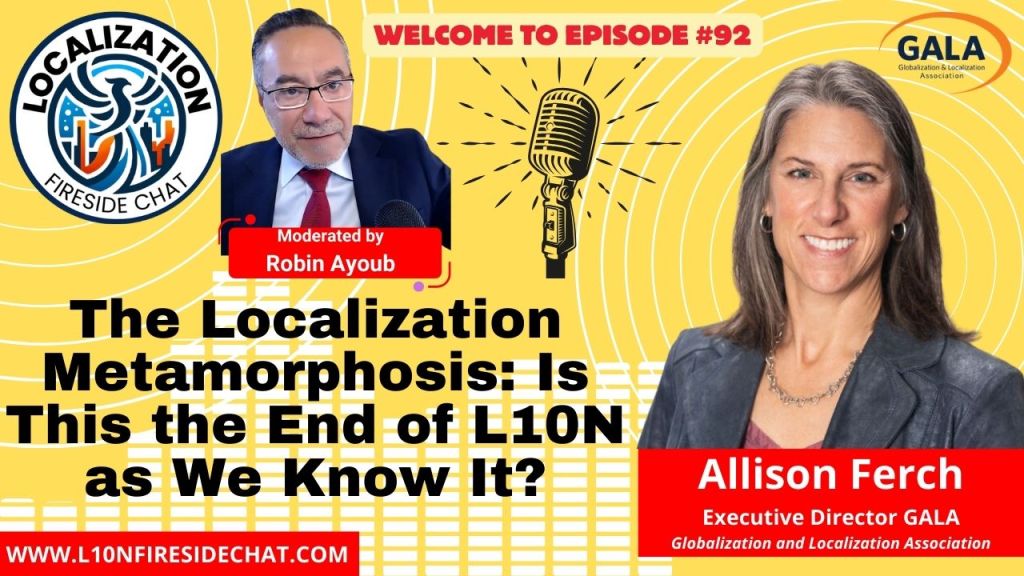
Welcome to LFC Episode #92 a conversation with my guest Allison Ferch, Executive director of GALA
In the ever-evolving landscape of globalization, localization has long served as the bridge between content and audiences across the world. However, as technology, specifically artificial intelligence (AI), reshapes the industry, one question looms large: How long will we continue to call it “localization”? In this thought-provoking episode of the Localization Fireside Chat, I sat down with Allison Ferch Executive Director of GALA to delve into the industry’s transformation—or should we say, metamorphosis—and explore what the future might hold for this crucial field.
From Localization to Multilingual Content Operations?
Allison, Executive Director at GALA, highlighted a fascinating trend: “We may stop calling it the language industry within a couple of years.” This statement is not just speculation—it reflects the seismic shifts driven by AI and the growing complexity of the industry.

This approach could mark a turning point, where we transition from “localization” to a more comprehensive term like multilingual content operations or global communication management. The change in terminology signifies a broader evolution—an industry no longer confined to translation but seamlessly integrated into the global content ecosystem.
AI as Catalyst and Disruptor
As with most industries today, Artificial Intelligence is both a catalyst for growth and a source of apprehension. Allison shared insights into how AI has amplified the industry’s potential: “AI can help people with business operations in dozens of ways beyond translation, creating efficiencies across the entire content lifecycle.”
AI-powered tools, such as large language models, offer unprecedented capabilities for content generation, multilingual communication, and even market research. But Allison was quick to caution against overestimating AI’s autonomy: “It’s not ready to just push a button and walk away.” The human element remains critical—not only to ensure quality but also to preserve cultural nuances that AI cannot yet grasp.
Community and Collaboration: The GALA Effect
One of GALA’s standout contributions to the industry is fostering a sense of community. Allison emphasized, “GALA is a professional community where people share what they’re learning, what they’re succeeding at, and even what they’re failing at.”
This openness is vital in an industry undergoing metamorphosis. Buyers and service providers alike face steep learning curves as AI reshapes expectations. GALA’s initiatives, such as their AI-focused special interest groups and GALA Innovates program, create spaces for members to share use cases, implementation strategies, and lessons learned.
For instance, the “GALA Business Barometer” surveys provide valuable insights into industry trends, from economic performance to AI adoption rates. As Allison explained, these efforts help to demystify emerging technologies, bridging the gap between hype and practicality.
This spirit of community will be on full display at GALA 2025 in Montreal, happening in April. The event promises to bring together localization professionals from around the world to explore cutting-edge trends, share strategies, and strengthen the bonds within this ever-evolving industry. Whether you’re a seasoned professional or new to the field, this is an unmissable opportunity to engage with the brightest minds shaping the future of localization.
Challenges Ahead: Balancing Human and Machine
While the opportunities are immense, the localization industry’s metamorphosis is not without its challenges. Buyers often expect AI-driven solutions to drastically cut costs, a misconception Allison called out as a “pipe dream.” Educating clients about the realities of AI—its strengths, limitations, and the continued need for human oversight—remains a critical hurdle.
What’s Next for Localization?
The localization industry stands at a crossroads, where its very identity is under review. As Allison noted, “We’re living in a post-localization era.” Whether it becomes multilingual content operations, global communication management, or something entirely new, the industry’s evolution is undeniable.

At the heart of this transformation lies a dual focus on technology and humanity. GALA embodies this balance with its mantra: “Future-oriented, but human-focused.” The upcoming GALA 2025 in Montreal will provide a platform for these conversations to continue, giving attendees a glimpse into the future of localization and the tools they need to navigate it.
What do you think the industry will be called in the next five years? Join the conversation in the comments below, and don’t forget to register for GALA 2025 in Montreal—the event where the future of localization will unfold!

Until next time this is Robin Ayoub Signing off.
Email: L10NFiresidechat@gmail.com
 Robin Ayoub
Leave a comment