
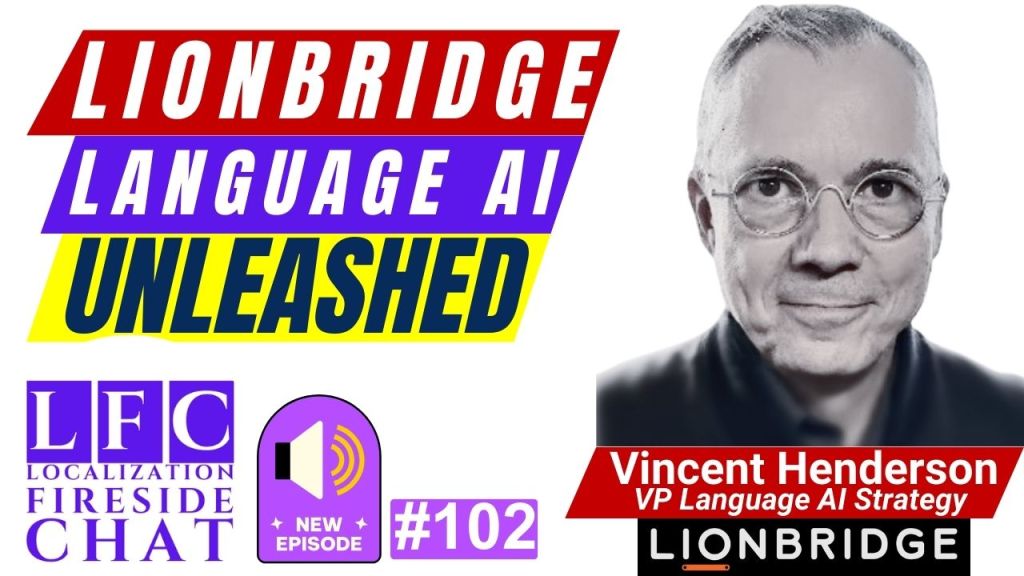
In the latest episode of the Localization Fireside Chat, I had the privilege of speaking with Vincent Henderson, Vice President of Language AI Strategy at Lionbridge, one of the leading global companies in localization and AI-driven language solutions. Our conversation focused on how Lionbridge is leveraging AI to revolutionize localization processes, transforming efficiency, quality, and scalability in ways previously unimagined. Vincent’s deep expertise in AI, coupled with his strategic vision, illuminated the transformative potential of AI within the localization industry. Watch the full interview here.

Vincent Henderson, with his extensive background in both technology and languages, is uniquely positioned to guide Lionbridge through the rapidly evolving landscape of artificial intelligence. As VP of Language AI Strategy, his role is pivotal in directing AI integration to optimize localization workflows, reduce inefficiencies, and enhance overall linguistic quality. His insights during our discussion underscored the critical importance of embracing AI not merely as a supportive tool but as a foundational component reshaping the localization industry.

One of the primary highlights of our conversation was Lionbridge’s proprietary Aurora AI platform. Vincent explained how Aurora AI has been meticulously crafted to transform localization processes through iterative and precise AI prompting combined with real-time human-AI interactions. This innovative platform goes far beyond traditional post-editing paradigms by automating routine tasks and enabling humans to focus strategically on refining and enhancing linguistic output.
Vincent introduced two critical frameworks that guide Lionbridge’s AI strategy: TRUST and REACH. The TRUST framework emphasizes Transparency, Reliability, Usefulness, Scalability, and Timeliness, ensuring that every AI-driven localization task meets high standards and delivers practical value. The REACH framework further emphasizes strategic AI implementation by considering ROI, Engagement, Audience, Control, and the critical Human factor, ensuring solutions are economically viable and impactful for clients. Vincent emphasized, “Our frameworks are not just concepts but foundational guides that inform how we innovate, scale, and ensure quality.”
A particularly insightful segment of our interview revolved around the accuracy and reliability of AI compared to human translations. Vincent revealed that in certain specific contexts, Lionbridge’s AI-driven translations, particularly when validated by confidence metrics, could surpass average human performance in terms of accuracy. This provocative insight challenges conventional industry thinking that typically positions human translators as superior by default. Vincent’s data-driven perspective prompts us to rethink our understanding of quality and reliability in localization.

We also addressed the critical issue of data security, a common concern in AI deployments. Vincent clarified Lionbridge’s stringent measures, emphasizing robust security protocols, dedicated cloud infrastructure, and rigorous data governance practices designed to protect client confidentiality and integrity. This commitment to security reinforces trust, a foundational element in successful AI-driven localization.
Vincent also shed light on emerging AI technologies like DeepSeek and their relative applicability to localization. He provided clarity by pointing out that while these technologies excel in complex reasoning scenarios, localization requires specific and strategic AI model implementations such as those powered by GPT-4 and iterative prompting. This distinction highlights Lionbridge’s deep expertise in strategically selecting and implementing AI technologies tailored explicitly for localization needs.
In closing, Vincent offered a compelling vision for the future: a localization industry inherently driven by sophisticated AI solutions that automate routine tasks and strategically leverage human intelligence. This new AI-centric model will empower businesses, significantly enhancing efficiency, reducing costs, and delivering superior localization quality. As Vincent emphasized, “Embracing AI is no longer optional—it’s essential for remaining competitive and effective in global markets.” Watch the full interview here.
Connect With Us: For more insightful discussions and industry trends, subscribe to the Localization Fireside Chat:

- Spotify: Localization Fireside Chat Podcast
- Apple Podcasts: Localization Fireside Chat
Visit our website and follow us on LinkedIn to stay updated:
- Blog: Robin Ayoub
- LinkedIn: Robin Ayoub
 Robin Ayoub
Leave a comment