
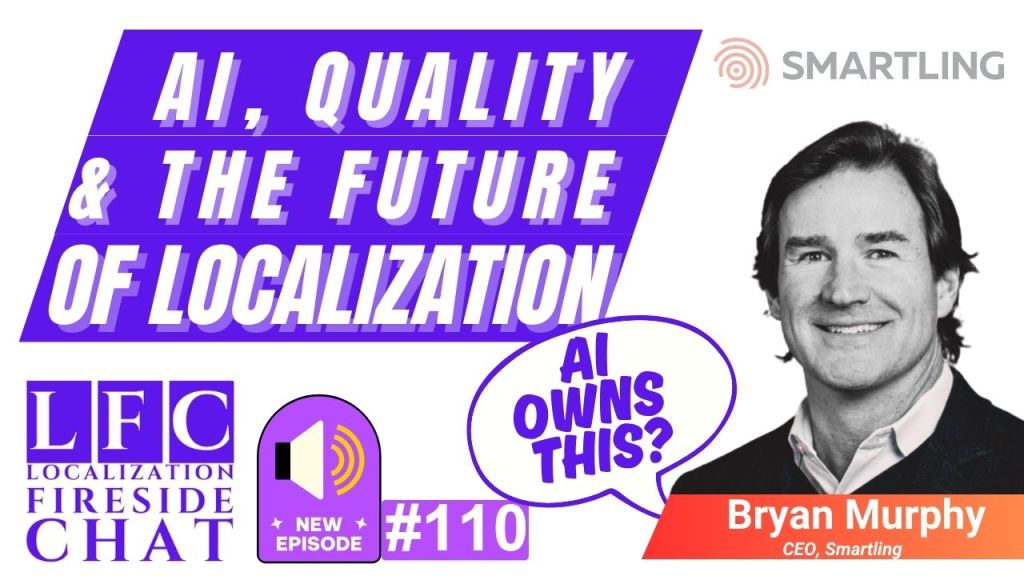
In a rapidly evolving landscape where machine learning, neural networks, and large language models are redefining the localization process, it’s rare to hear a voice that blends deep technical understanding with strategic clarity. That’s exactly what Bryan Murphy, CEO of Smartling, brings to the table.
In this episode of the Localization Fireside Chat, host Robin Ayoub sits down with Bryan to explore how AI is impacting translation, what true customer-centric localization looks like, and why the human element isn’t going away anytime soon.
🎥 Watch the full interview here:
https://youtu.be/jpP0auJ3lNI

The Evolving Role of AI in Localization
Bryan Murphy didn’t enter the localization industry through the traditional path. With a background in scaling software and e-commerce platforms at eBay and Serta Simmons, his first real immersion into translation came when he realized how outdated and manual the process still was for global content. “It was always a pain,” Bryan says, referring to the early days of manually uploading and downloading files just to get a site localized. That friction lit a spark.
Four years ago, when Bryan was introduced to Smartling through Battery Ventures, he saw a clear opportunity: an under-automated, fragmented $50 billion market that was overdue for transformation. The decision to acquire Smartling quickly became a personal one — he didn’t just want to be on the board. He wanted to lead the change.

Technology and Service — Not One or the Other
A major theme in the conversation is the ongoing debate across the localization industry: Is this a tech-driven or service-driven industry? According to Bryan, this is a false dichotomy.
“We’re a technology company that offers services,” he explains. “Sometimes a customer just wants the tech. Sometimes they want everything done for them. The point is: it’s all about the outcome.”
Smartling’s hybrid approach allows clients to work with their own LSPs, use Smartling’s certified linguists, or simply plug into the AI tools built into the platform. This flexibility has helped them serve a wide spectrum of clients — from massive enterprises like Disney, Coinbase, and IBM to high-growth startups entering their first five markets.
AI is a Tool, Not a Replacement
While many companies are still trying to figure out what role AI should play, Bryan’s team at Smartling was already experimenting with GPT just days after its public release.
“We’ve built AI into every layer — from LLM-powered translations to promptable workflows that integrate with your style guide, glossary, and translation memory,” he says.
But that doesn’t mean AI is a silver bullet. Murphy is quick to point out the challenges: LLMs hallucinate, are inconsistent, and don’t inherently follow brand guidelines. That’s why Smartling developed tools around quality assurance and introduced human-in-the-loop processes that support, not replace, professional linguists.
One of the boldest comparisons Bryan makes is to the internet itself.
“AI is as significant as the commercialization of the internet. Maybe even more,” he says. “It’s going to transform how we work, how we create, and how we communicate — especially across languages.”
Empowering the Real Heroes of Localization
Bryan also acknowledges the often-overlooked champions of localization: the managers, marketers, and engineers who hold global content together.
“They’re the ones who get yelled at when something goes wrong — even though they’re usually the only ones making it work,” he notes.
Smartling’s goal is to make their lives easier by increasing automation, reducing turnaround times, and helping them prove ROI in ways the C-suite can understand, like higher lead volume and improved international revenue.
It’s not just about faster translations. It’s about a smarter strategy.
Final Thoughts: The Future Is Scalable, But Still Human
As Bryan looks ahead, he sees more automation, higher translator productivity, and massive content growth. But he also sees a place for people, not just pushing buttons, but curating, refining, and ensuring linguistic nuance and brand fidelity.
His closing advice?
Whether you’re a language services provider, in-house localization lead, or tech executive exploring global expansion, this episode delivers grounded, forward-looking insights that matter.
📺 Watch the Full Interview
AI, Quality, and the Future of Localization | Bryan Murphy, CEO, Smartling
https://youtu.be/jpP0auJ3lNI
🔗 Stay Connected
Want more conversations like this one?
Follow the Localization Fireside Chat for candid, unscripted insights from leaders shaping the future of language, technology, and global business.
🌎 Read more interviews & insights: https://www.robinayoub.blog
🔗 Connect with Bryan Murphy: https://www.linkedin.com/in/bryanmurphy2/
🔗 Connect with Robin Ayoub: https://www.linkedin.com/in/robinayoub/
🎧 Listen on Spotify: https://open.spotify.com/show/5OoURgc29R31XPGzOWL9iX
🎧 Apple Podcasts: https://podcasts.apple.com/us/podcast/localization-fireside-chat/id1688770183
 Robin Ayoub
Leave a comment