
What if the future of language interpretation isn’t about choosing between humans and AI, but syncing them? In an industry racing to automate everything, a fresh approach is gaining traction: augmenting, not replacing.
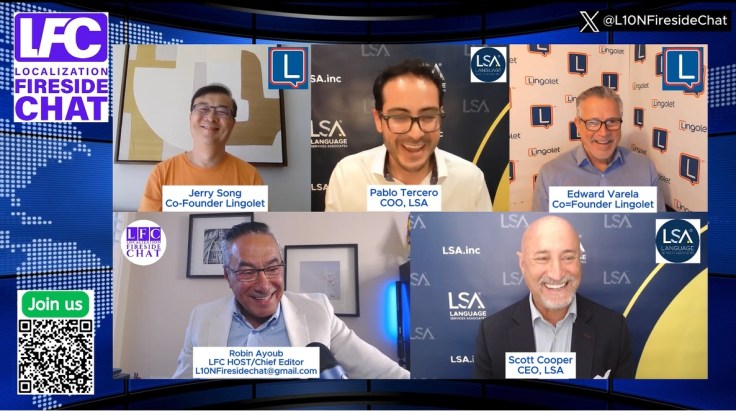
In this episode of the Localization Fireside Chat, I sat down with the executive teams from Language Service Associates (LSA) and Lingolet to explore a partnership that’s doing just that. Joining me were:
- Scott Cooper (CEO, LSA)
- Pablo Tercero (COO, LSA)
- Jerry Song (Co-Founder, Lingolet)
- Edward Varela (Co-Founder, Lingolet)
Together, they’ve built a model for real-time interpretation that’s grounded in both technology and trust, serving everyone from hospital networks to professional sports teams. If you’ve ever questioned whether AI is ready to take over live interpreting, this episode will change how you think.
Fusing Tech and Trust: Why AI Alone Isn’t Enough
The conversation opened with a simple but powerful idea: customers don’t want to choose between AI and humans, they want solutions that just work.
LSA, a trusted name in the interpreting space for over 35 years, recognized a critical moment in the industry. As Scott Cooper shared, “It’s not if AI is coming—it’s how much of it the client is comfortable with, and where it actually fits.”
Rather than build their own tech stack from scratch, LSA found alignment with Lingolet, a Silicon Valley-born platform already pioneering AI-driven interpretation tools. But this wasn’t just a tech integration, it was a cultural fit.
“Chemistry matters,” Pablo Tercero emphasized. “Clients feel it when the tech fits the workflow. This partnership helps us deliver what clients need, not just what’s possible.”
Real Use Cases, Real Results
One standout story shared during the interview highlights what happens when AI and human insight come together with precision. A U.S. soccer team facing a language barrier in its locker room needed help. A player was nodding through training sessions without understanding a word of the coach’s instructions.
LSA and Lingolet deployed a real-time solution using QR codes and AI-powered communication tools, allowing multilingual players to engage in side-by-side conversations with coaches discreetly and effectively. The result? A measurable improvement in team performance and player trust.
But this isn’t just about sports. In healthcare, education, and enterprise settings, the duo is proving that task-based AI routing, paired with interpreter escalation, creates faster, smarter, and more affordable access to language services.
As Ed Varela put it, “The real question isn’t whether AI can do it. It’s when it should—and when it shouldn’t.”
Rethinking Interpreter Roles in an AI World
Naturally, the rise of AI brings concerns about job loss, but this episode flipped that narrative.
Rather than replacing interpreters, the tech is expanding the pie. LSA’s COO, Pablo, shared how they use AI as a load balancer, helping cover gaps in availability, especially in rare languages or emergency overnight calls.
Jerry Song, Lingolet’s CEO, offered a technologist’s perspective: “We’re not building to replace professionals. We’re building to make them more efficient, more accessible, and more valuable.”
What stood out throughout the conversation was a deep respect for client choice. Each solution is designed to meet the customer where they are, not force them into an all-or-nothing tech stack.
What’s Next: Focus, Not Flash
While other startups chase the next shiny demo, this partnership is focused on core functionality and real client problems.
“We don’t build features just because they’re cool,” said Ed. “We build what our clients need, and we test it in real environments, not labs.”
That discipline is supported by a roadmap that stretches well beyond 2025, with clear boundaries between automation, compliance, and human escalation. Lingolet remains nimble and fast-moving, while LSA brings process depth, regulatory expertise, and client intimacy.
The secret sauce? Both sides stay in their lane while moving in sync.
Conclusion: This Is What AI Human Balance Looks Like
This episode wasn’t about buzzwords. It was about real-world execution and a refreshing humility from both companies about what AI can and can’t do.
The message is clear: AI doesn’t need to dominate to make a difference. It needs to be designed to fit and to respect the human element.
As language access becomes more urgent across industries, partnerships like LSA and Lingolet are showing what thoughtful innovation looks like. It’s not about being first. It’s about getting it right.
What do you think? Is your organization ready for the right blend of AI and human expertise?
👉 Watch the full interview here:
https://youtu.be/XoiVRlwCE54
🎧 Connect With Us:
Subscribe to the Podcast:
Spotify
Apple Podcasts
Follow Robin on LinkedIn:
https://www.linkedin.com/in/robinayoub/
Explore the Blog:
https://www.robinayoub.blog
Contact: L10NFiresideChat@gmail.com
 Robin Ayoub
Leave a comment