Most companies do not fail at AI because of technology.
They fail because they deploy it in the wrong places.
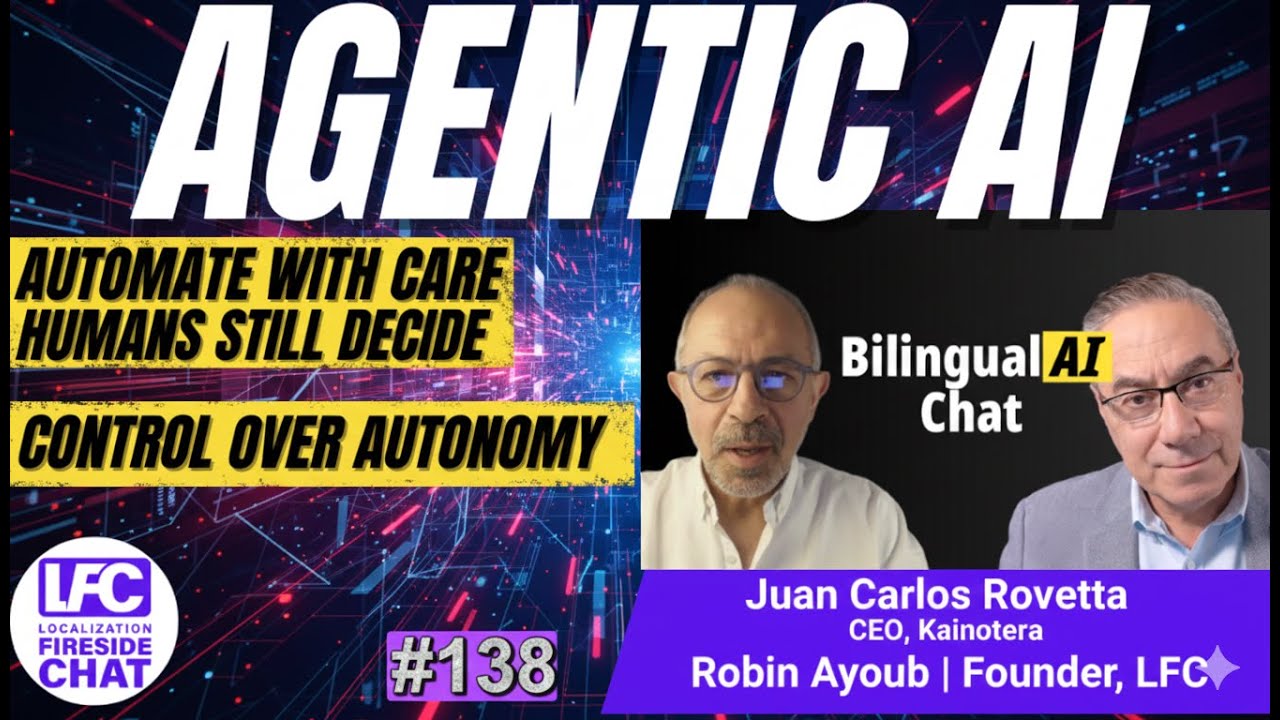
This episode of Localization Fireside Chat marked a milestone for the channel. It was the first bilingual conversation in the history of the show, conducted in both English and Spanish, opening the door to a much broader audience across Latin America and the Spanish speaking business world.
My guest was Juan Carlos Rovetta, President and CEO of Kenotera, an AI company based in Buenos Aires that designs custom agent based automation for real business processes. Juan Carlos brings over five decades of experience in systems architecture, regulatory consulting, and enterprise operations, including leadership roles in highly regulated industries like medical devices.
The conversation started with something personal.
Juan Carlos does not define himself first as an entrepreneur. He defines himself as a father and husband. That human grounding shapes how he approaches technology. AI, in his view, exists to serve people, not replace them.
That philosophy runs through everything Kenotera builds.
AI as a system, not a chatbot
Juan Carlos made a critical distinction that most AI conversations miss.
AI is not a single tool.
It is a node inside a larger system.
Most of the solutions his company delivers are not standalone models. They are hybrid workflows that connect artificial intelligence with CRM systems, ERP platforms, APIs, and human operators. The value comes from how information moves through those systems, not from the AI model alone.
A typical Kenotera project might involve automating the flow between a potential customer and a sales or technical team. Clients often describe what they need in vague, incomplete terms. AI agents interact with them through dialogue, refining the requirements, asking follow up questions, and structuring the information until it is precise enough for a system to generate a quote or trigger a workflow.
That is where AI becomes economically powerful.
Not by answering trivia.
By eliminating friction in decision making.
Human in the loop is not optional
Juan Carlos was blunt about one thing.
Full automation without human oversight is dangerous.
Kenotera designs systems where AI knows when it should not decide. When information quality is too low or when the impact is too high, the system escalates to a human. This is especially critical in areas like healthcare, regulatory compliance, financial decisions, or anything that could affect people’s safety, money, or legal exposure.
AI plus human judgment beats either alone.
That combination is the future.
Latin America and AI readiness
Because Kenotera operates across Latin America, Juan Carlos sees the regional reality clearly.
The biggest barrier to AI adoption is not technology.
It is leadership mindset.
Some companies believe AI is a miracle cure for every problem. Others believe it is irrelevant or too risky. Both positions are wrong.
The companies that succeed are the ones that start small, choose a real pain point, and prove value before expanding. That approach builds trust internally and creates momentum for larger transformations.
Where CEOs should start
Juan Carlos offered a simple framework for leaders who want to deploy AI.
Do not ask what AI can do.
Ask where it hurts.
Look for processes that are slow, expensive, repetitive, error prone, or overloaded with information. Start there. Pick one. Solve it. Let the organization learn from success.
That is how AI adoption becomes sustainable instead of chaotic.
Why this episode mattered
This was not just a technology conversation.
It was a cultural one.
It showed how AI is being built and deployed in Latin America, how human centered design creates better systems, and how bilingual conversations expand who gets to participate in the future of technology.
This is what Localization Fireside Chat is about.
Not just language.
But access.
Watch the full conversation
Localization Fireside Chat
Unscripted. Unbiased. Unfiltered.
https://www.l10nfiresidechat.com
 Robin Ayoub
Leave a comment