Most people say they want to make a difference.
Stephen Clarke built a system to do it.
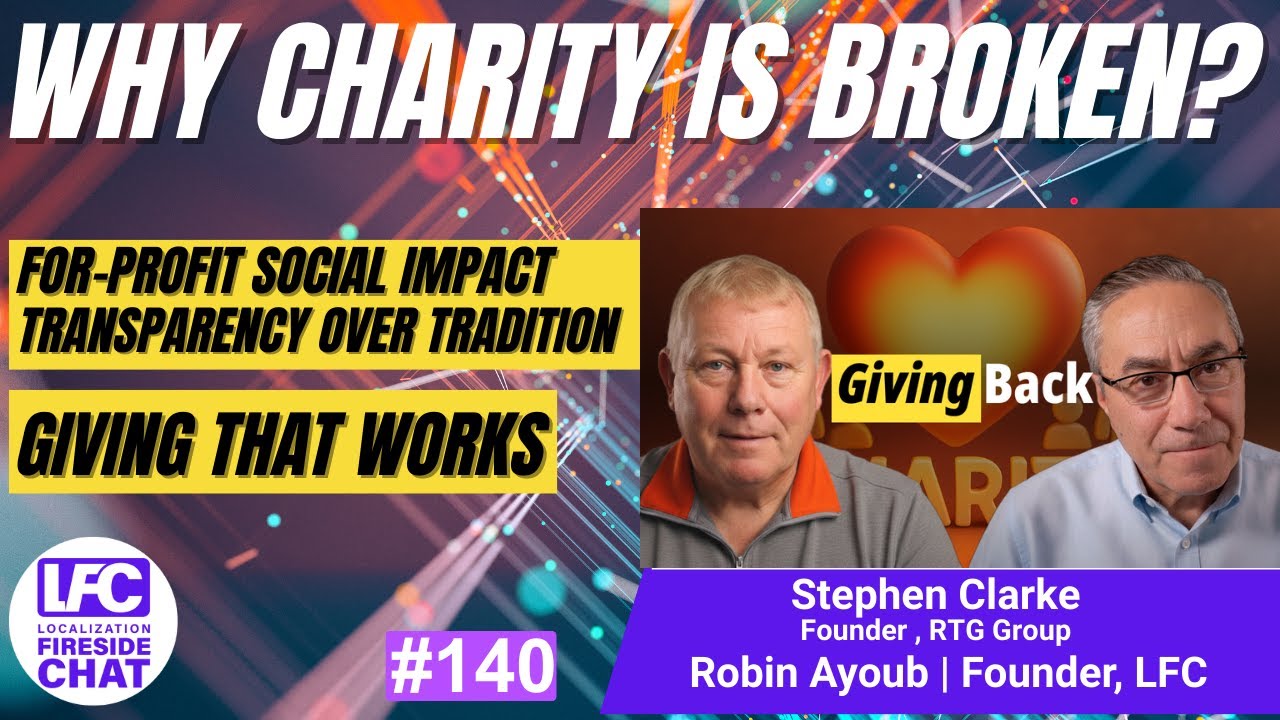
In this episode of Localization Fireside Chat, I sat down with Stephen Clarke for one of the most unconventional conversations the show has ever had. We did not talk about technology or localization. We talked about something much harder.
How to build a real, scalable system for doing good.
Stephen’s journey starts far from the nonprofit world. He was a professional hockey player who built a second career in advertising, working at the highest levels of corporate marketing. But a childhood shaped by poverty and a mother who lived by one principle never left him.
Receiving through giving.
That phrase became the foundation of everything he would later build.
After more than twenty years in advertising, Stephen did what very few executives do. He walked away from a lucrative career to design a new economic model for social impact. One that could attack the root causes of hunger, homelessness, and poverty rather than just managing the symptoms.
RTG Group, which stands for Receiving Through Giving, is a for profit social enterprise. That distinction matters.
Stephen studied the charity and nonprofit sector across Canada and the United States and found a hard truth. In the US alone, over 1.5 trillion dollars is donated annually across 1.8 million charities, yet hunger, homelessness, and mental health continue to rise
riverside_brian_& robin — take …
.
The reason is structural.
Over 13 million people are employed by the nonprofit sector, which means more than half of donated funds are consumed by payroll before reaching people in need. Corporations, meanwhile, contribute only a tiny fraction of what they spend on marketing. Venture capital cannot participate at all because nonprofits cannot offer returns.
Stephen flipped the model.
By building a for profit structure, RTG can tap into marketing budgets instead of donations. It can attract impact investors who receive a return. It can provide full financial transparency. And it can legally incentivize volunteers who raise money instead of forbidding them from sharing in the value they create
riverside_brian_& robin — take …
.
That unlocks scale.
RTG runs programs that do not just feed people. They provide subsidized housing, job training, and guaranteed employment. That is how you keep people off the street. Not temporarily, but permanently.
Stephen is blunt about it.
Affordable housing does not solve homelessness.
Subsidized housing combined with jobs does.
That is what his model delivers.
RTG is now rolling out city by city, with plans to reach one million members by the end of 2026. At that scale, the system will deliver over 30 million meals per month while also moving thousands of people into housing and employment.
This is not charity.
This is infrastructure for good.
Stephen also shares a personal leadership philosophy that drives everything he does. STF.
Shift the focus.
Most people fixate on problems. Leaders shift focus to solutions. That is how you build anything that lasts.
He also lives by a rule taught to him by Stephen Covey and Brian Tracy. Find what you are good at and love doing, then surround yourself with people who love to do what you do not. That is how real organizations scale.
Stephen’s story is proof that impact and economics do not have to be enemies.
When designed correctly, doing good becomes sustainable, investable, and scalable.
That is the future of social enterprise.
Watch the full conversation
Localization Fireside Chat
Unscripted. Unbiased. Unfiltered.
https://www.l10nfiresidechat.com
 Robin Ayoub
Leave a comment