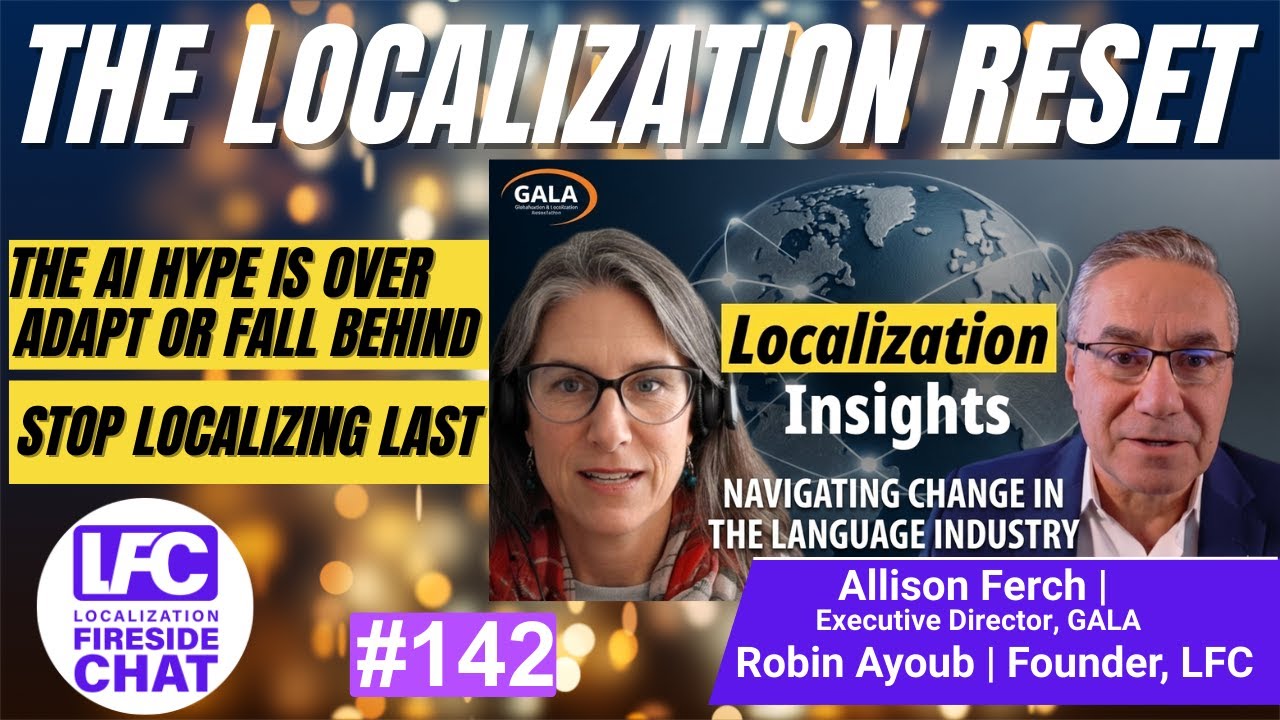
The localization industry has entered its most uncomfortable phase.
That is usually when real change begins.
In this episode of Localization Fireside Chat, I sat down with Allison Ferch to take a hard look at where the language industry stands in 2025 and why the next few years will separate companies that evolve from those that disappear.
We recorded this conversation fresh off the Gala conference in Montreal, a moment when the industry was forced to take inventory. The event brought together 325 attendees from 32 countries, which created something rare. Instead of noise, there was dialogue. Instead of sales pitches, there were real conversations about what is working and what is not.
Allison pointed out something many people feel but few say out loud.
The industry is splitting into three camps.
Those reinventing themselves.
Those making necessary adjustments.
And those pretending nothing has changed.
The third group is in trouble.
AI has not destroyed localization, but it has destroyed complacency. The hype cycle has burned off unrealistic expectations, and now companies are sitting in what analysts call the trough of disillusionment. That is where serious work begins.
Allison and I talked about how medium sized companies are often best positioned in this phase. They are large enough to invest but small enough to move. Large enterprises struggle to pivot. Small shops struggle to fund the transition. The winners will be the ones who use this moment to rethink how they create value.
One of the strongest themes of the conversation was the need for localization to move earlier in the content lifecycle.
Localization teams should not be fixing problems after content is built. They should be shaping terminology, tone, and structure before it ever ships. That is how you reduce cost, improve quality, and protect brand and compliance.
This is not a process tweak. It is a strategic shift.
We also talked about how external pressures are reshaping the industry. US tariffs, shrinking budgets in education, and economic uncertainty are forcing buyers to scrutinize every dollar. That makes it even more important for localization to prove its value as a growth and risk management function, not just a line item.
What makes this episode important is that it connects the dots.
Technology.
Economics.
Talent.
Process.
Community.
The Localization Fireside Chat itself has become part of that ecosystem, bringing together leaders who want to have these conversations in the open instead of behind closed doors.
Allison’s message is clear.
The industry will not survive on legacy models.
It will survive on collaboration, early engagement, and smarter use of technology.
That is what 2025 is demanding.
Watch the full conversation
Localization Fireside Chat
Unscripted. Unbiased. Unfiltered.
https://www.l10nfiresidechat.com
 Robin Ayoub
Leave a comment