Every fast-growing e-commerce company eventually hits the same wall.
Their ERP stops serving the business and starts slowing it down.
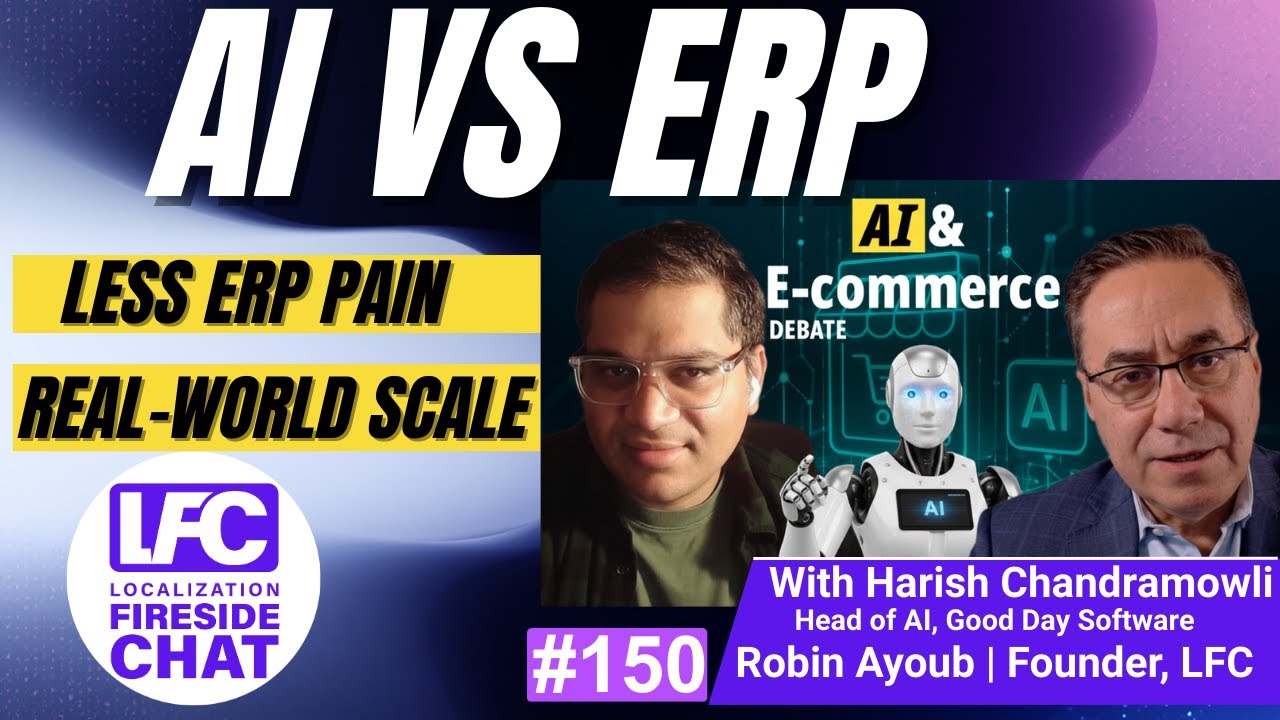
In this episode of Localization Fireside Chat, I sat down with Harish Chandramowli, Head of AI at Good Day Software, to unpack why the ERP layer has become one of the biggest hidden bottlenecks in modern commerce and how a new generation of platforms is rewriting the rules.
Harish did not come from retail. He came from systems that have zero tolerance for failure.
From cybersecurity at Johns Hopkins to engineering at Bloomberg and then MongoDB as their first cloud security engineer, Harish learned what it means to build infrastructure that must scale under pressure. That background shaped how he sees e-commerce software today.
And what he saw when he entered retail was alarming.
Most ERP systems were designed for a world that no longer exists.
They assume slow product cycles.
Predictable supply chains.
Linear order flows.
E-commerce runs on volatility. Flash sales, preorders, split shipments, returns, marketplace feeds, and real-time inventory changes. Traditional ERPs were never built for that reality.
Harish saw this first hand while working with fashion and retail operators in New York. Brands were spending hundreds of thousands of dollars on ERP implementations that still failed to give them real visibility into their own business.
The problem was not lack of software.
It was the wrong architecture.
That realization led him first to build Flag, and eventually to join Good Day Software, where the goal was not to patch old ERP systems but to rethink what the core should be.
At Good Day, Harish and his team focused on one uncomfortable truth.
Most ERP platforms optimize for accountants, not operators.
They track financials well, but they fail where real money is made or lost, in forecasting, inventory positioning, pre-selling, fulfillment timing, and cross-channel coordination.
One of the breakthroughs Harish explains in the episode is how Good Day allows e-commerce brands to pre-sell inventory intelligently. That means companies can capture demand before product even lands in the warehouse, using real data instead of guesswork. For seasonal and fashion-driven brands, this is the difference between profit and dead stock.
This is where AI becomes transformative.
Harish is not using AI for dashboards or buzzwords. He is applying it to the ugliest parts of operations.
• Reconciling orders that do not match
• Detecting inventory anomalies
• Identifying supply chain risks before they explode
• Forecasting demand with real behavioral data
Instead of teams drowning in spreadsheets, the system learns patterns and flags what matters.
That is what a modern ERP should do.
Not record history.
Predict reality.
What makes this conversation important for leaders is that Harish frames ERP not as a software purchase, but as a strategic decision about how your company senses and responds to the market.
If your ERP cannot adapt in real time, your business cannot either.
Good Day Software is betting on a future where operational intelligence is continuous, not quarterly. Where AI becomes the nervous system of commerce, not just another tool bolted onto outdated platforms.
Harish’s story is a reminder that infrastructure determines growth. And the companies that win will be the ones that stop tolerating systems that were built for yesterday’s economy.
Watch the full conversation
Localization Fireside Chat
Unscripted. Unbiased. Unfiltered.
https://www.l10nfiresidechat.com
 Robin Ayoub
Leave a comment