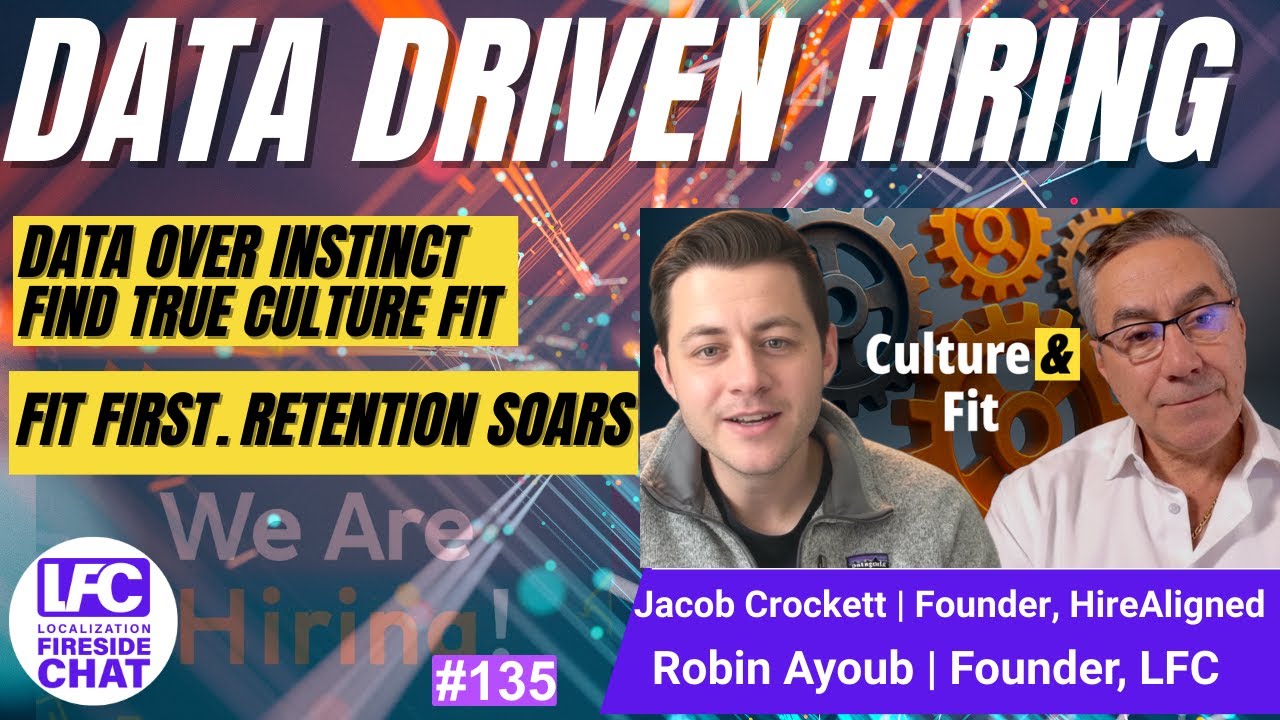
Hiring is not broken because of a lack of resumes.
It is broken because most companies do not understand their own culture.
In this episode of Localization Fireside Chat, I sat down with Jacob Crockett, founder of HireAligned, for a conversation that cuts straight to the heart of one of the biggest problems in modern business: why so many companies keep hiring the wrong people and then wondering why everything feels harder than it should.
Jacob’s background is in data science, healthcare, and building teams inside large organizations. Before launching HireAligned, he spent years inside big enterprises where sophisticated technology was often used to solve simple problems in unnecessarily complex ways. His favorite story from that era involved a multi million dollar AI project designed to predict when people should get a colonoscopy. The answer was forty years old. The system was a Ferrari engine mounted on a lawnmower.
That experience shaped how he thinks about technology and business.
Technology is only valuable when it removes friction.
Most of the time, it just adds more.
From corporate to founder
Jacob had a front row seat to what happens when small teams build real value and then get swallowed by corporate machinery. One of the companies he helped build reached a valuation of over a billion dollars in under two years. Shortly after, the founders and builders were pushed aside as layers of management and bureaucracy took over.
That was the moment the countdown started.
He realized he did not want to spend his life optimizing someone else’s structure. He wanted to build something that actually fixed a real problem.
The real hiring problem
Jacob’s core insight is simple.
Most hiring is done to minimize risk, not maximize alignment.
Companies write job descriptions, screen resumes, and look for people who can do the tasks. What they rarely do is ask whether the person will actually thrive inside the team they are joining.
That mismatch is expensive.
When people do not fit the culture of a team, even highly skilled employees create friction, slow everyone down, and often leave. The result is constant turnover, disengagement, and lost productivity.
Jacob decided to attack the problem at the root.
Measuring culture instead of guessing
HireAligned does something most companies have never done.
It measures culture.
Every employee is invited to have a private, anonymous conversation with an AI interviewer. The system asks about real experiences, moments of pride, conflict, recognition, and frustration. It listens to how people describe their work and how they feel about their team.
From that data, HireAligned builds a real picture of what the culture actually is, not what is written on the website.
At the same time, leadership defines the aspirational culture they want to build.
New candidates are evaluated against both.
That means companies hire people who fit the team they are joining and the future they are trying to create.
Real world results
One of Jacob’s customers was a multi location dental group struggling with extreme turnover. Each office had a different working style depending on the dentist running it. Some were warm and collaborative. Others were high pressure and direct.
By matching candidates to the actual culture of each location, not a generic corporate description, retention jumped dramatically. Revenue followed.
When people feel they belong, they stay.
When they stay, everything else improves.
AI with accountability
Jacob is not blind to the risks of AI. He is a heavy user and a healthy skeptic.
He compares AI to a six year old loading a dishwasher. If you watch closely and give clear instructions, it works well. If you walk away and assume it knows what it is doing, you will get dirty plates.
That is why HireAligned removes as much identifying information as possible from the evaluation process. No names. No demographics. No clues that could introduce unwanted bias. The system focuses on behavior, values, and working style.
Culture fit is not about who you are.
It is about how you work.
The hiring mindset that needs to die
Jacob believes most companies approach hiring with fear.
They look for people who are least likely to fail instead of people most likely to grow.
That mindset leads to slow teams, mediocre performance, and toxic stability.
The future belongs to companies that hire for alignment and potential, not just experience.
This conversation is a reminder that people are not interchangeable parts. When you design hiring around who people really are, not what their resume says, you build teams that actually work.
Watch the full conversation
Localization Fireside Chat
Unscripted. Unbiased. Unfiltered.
https://www.l10nfiresidechat.com
 Robin Ayoub
Leave a comment