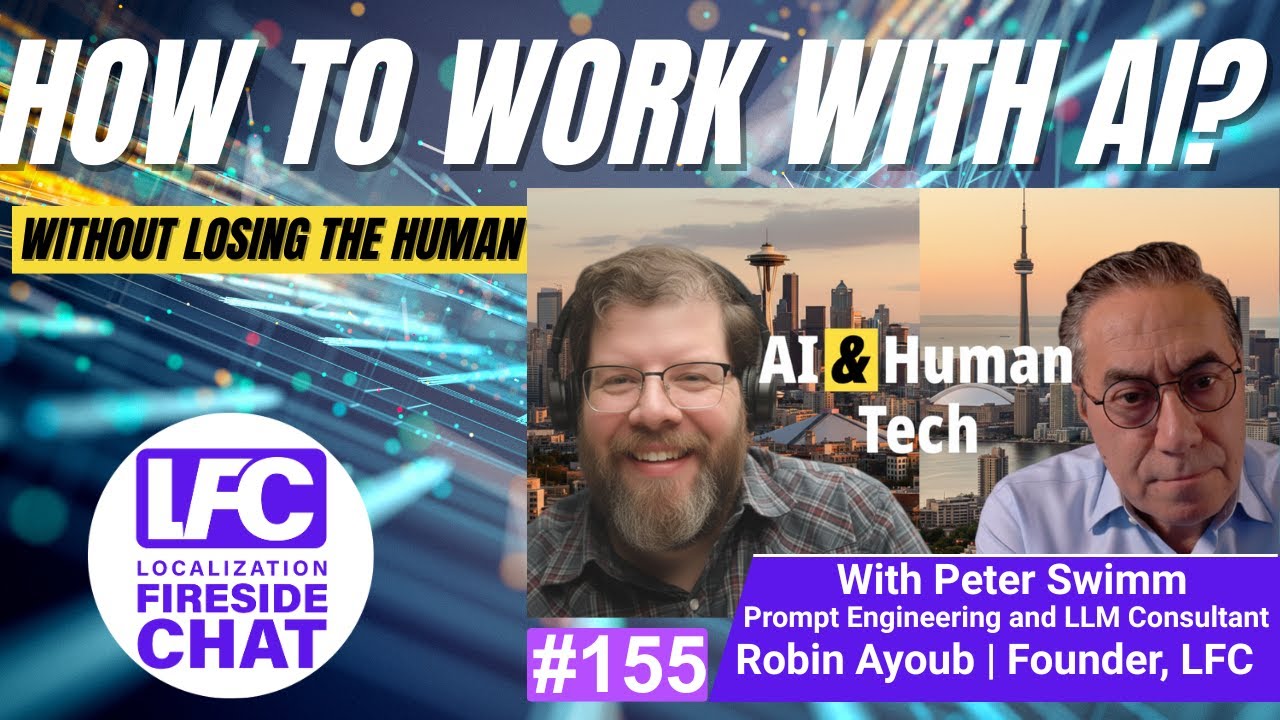
How to Work With AI Without Losing the Human
Artificial intelligence is everywhere right now. In boardrooms. In HR teams. In product meetings. In customer support. In content creation. In finance. In recruiting. In operations. And yet, for all the hype, a quiet frustration sits underneath most of it.
People keep saying the same thing.
“AI doesn’t give me what I need.”
“It feels dumb.”
“It gives shallow answers.”
“It doesn’t understand my business.”
The uncomfortable truth is that AI is rarely the problem.
The way we talk to it is.
In this episode of the Localization Fireside Chat, I sat down with Peter Swimm, a consultant specializing in conversational AI, prompt engineering, and large language models, to unpack what is really happening when humans interact with machines and why most organizations are already using AI the wrong way.
This was not a technical conversation. It was a thinking conversation.
AI is not smart. It is responsive.
One of the most important ideas Peter shared is also one of the most misunderstood.
AI does not think.
It does not reason.
It does not understand.
It responds.
Modern large language models are essentially very powerful pattern engines. They take what you give them, infer what you are trying to do, and generate a response based on probability. That means the quality of what you get back is directly tied to the clarity of what you give it.
When people complain that AI is useless, what they are really saying is that the system is faithfully responding to vague, incomplete, or poorly framed inputs.
This is why Peter says that prompting is not a technical skill. It is a communication skill.
The better you describe the problem, the better the system performs.
Why most people fail at using AI
In school, we were taught to write essays and answer questions using a simple structure: who, what, where, when, and why.
Those five words still matter. Especially with AI.
When people type a single vague sentence into a chat window and expect magic, they are doing the equivalent of walking into a room and saying, “Help me,” without explaining what they want.
Peter explained that most failed AI interactions fall into three traps:
Missing context
Unclear goals
No constraints
When you give AI context, define what success looks like, and set boundaries, it becomes dramatically more useful. Without those things, it feels random, shallow, or wrong.
This is not a limitation of AI. It is a reflection of how humans communicate.
Where conversational AI actually lives
Another powerful idea in this episode was how Peter frames conversational AI inside modern organizations.
It lives at the edge.
Call centers.
Kiosks.
Mobile apps.
Web chat.
Support desks.
These systems are not running the business. They are interfacing with humans. They take questions, requests, complaints, and needs, and they translate them into actions or information.
That makes them incredibly powerful and incredibly dangerous.
If they misunderstand what a customer or employee is asking, the entire experience breaks. That is why human-centered design matters more than model size.
AI should not replace judgment.
It should amplify it.
Prompt engineering is product thinking
One of the most useful reframes Peter offered was this:
Prompt engineering is product management for AI.
When you design prompts, you are designing how the system behaves. You are defining its role, its scope, its tone, its priorities, and its limitations.
That is product work.
Companies that treat prompts as throwaway inputs get throwaway results. Companies that treat them as part of their operating system start getting leverage.
This is why some organizations see massive gains from AI while others quietly abandon it.
The difference is not the model.
It is the thinking.
The future of work is human-centered AI
The biggest myth in the AI conversation is that machines are here to replace people.
They are not.
They are here to expose weak thinking, unclear processes, and broken communication.
The organizations that win with AI will be the ones that understand how to pair human judgment with machine speed. The ones that fail will be the ones that try to automate without understanding what they are automating.
As Peter put it, technology should serve humanity, not erase it.
Watch the full conversation
This conversation with Peter Swimm is one of the most grounded, practical, and honest discussions about AI I have had on the show.
You can watch the full episode here:
https://youtu.be/opPoh5256hw
Or listen on any major podcast platform via the Localization Fireside Chat.
About the show
Localization Fireside Chat is where AI, language, leadership, and the future of work collide in real, unscripted conversations.
Visit https://www.L10NFiresideChat.com
to explore more episodes.
If you are building, buying, or deploying AI inside a real organization, this is where you should be learning from.
 Robin Ayoub
Leave a comment