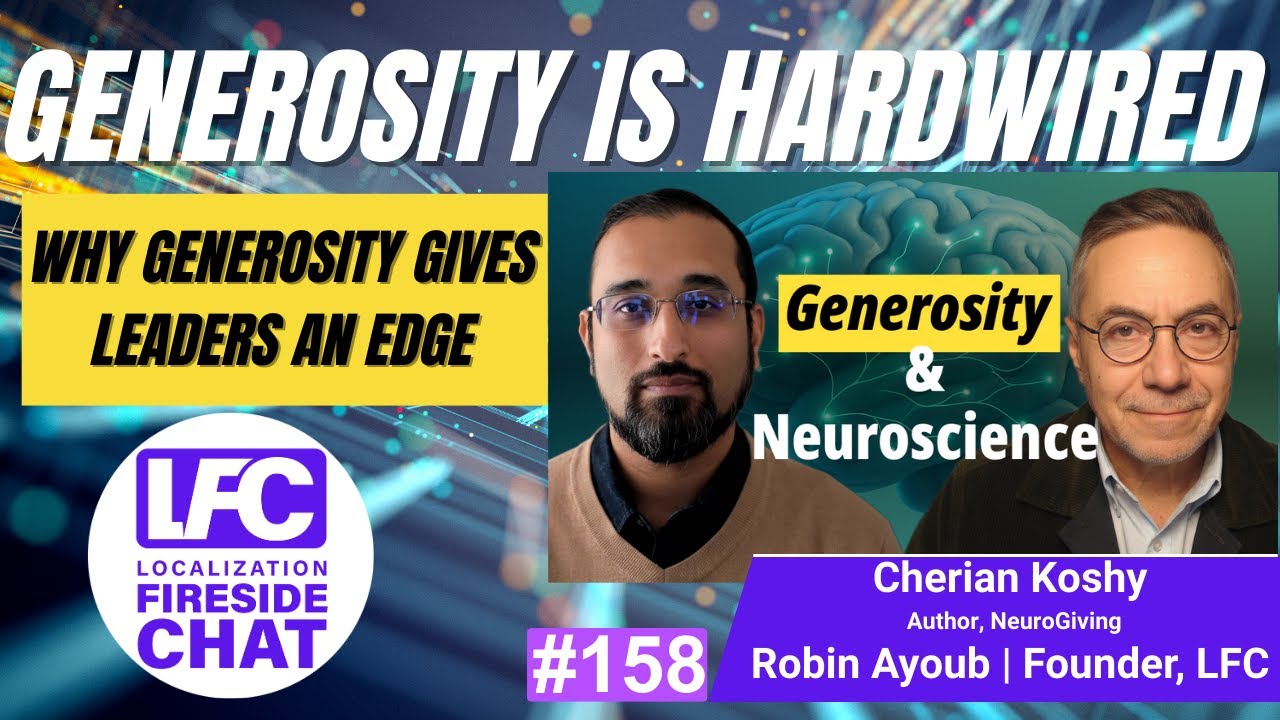
Leadership conversations often frame generosity as a value, a moral choice, or a cultural preference. Something leaders can choose to embrace or ignore depending on style or circumstance. But what if generosity is not optional at all? What if it is biologically wired into how humans assess trust, influence, and leadership credibility?
In this episode of Localization Fireside Chat, I sat down with Cherian Koshy, author of NeuroGiving, to explore the neuroscience behind generosity and what it reveals about how people respond to leaders. This conversation moves beyond feel-good leadership narratives and into how the brain actually processes trust, fairness, and authority.
What emerges is a reframing that many leaders find uncomfortable at first: generosity is not softness. It is signal.
Generosity Is Not a Personality Trait
One of the most important distinctions Cherian makes is separating generosity from personality. Leaders often assume generosity is something you either have or do not have, tied to upbringing or temperament. Neuroscience suggests otherwise.
Generosity activates specific neurological pathways associated with trust, cooperation, and psychological safety. These responses are not learned through training manuals or performance reviews. They are deeply embedded in how humans evolved to assess risk and belonging.
In practical terms, when leaders act generously, whether through transparency, fairness, or genuine consideration of others, the brain interprets those actions as cues of safety. That signal changes how people engage, collaborate, and commit.
Trust Is a Biological Response
Trust is often treated as a cultural outcome or a relationship milestone. In reality, it is a biological response.
Cherian explains how the brain constantly evaluates leaders based on cues related to consistency, fairness, and intent. Generosity plays a central role in that evaluation. When people perceive generosity, the brain reduces defensive responses and increases openness to influence.
This is why fear-based leadership can produce short-term compliance but rarely produces long-term commitment. The brain does not interpret control as safety. It interprets it as threat.
Why Transactional Leadership Hits a Ceiling
Many leadership models rely heavily on transactional dynamics. Incentives, performance metrics, and consequences. While these tools can be effective in narrow contexts, neuroscience shows they have limits.
Transactional leadership engages external motivation. Generosity engages internal motivation.
When leaders rely exclusively on authority and reward structures, they often hit an invisible ceiling. Teams comply, but they do not commit. Innovation slows. Trust becomes fragile. People do the minimum required, not because they lack talent, but because the environment does not signal psychological safety.
Generosity, when practiced consistently, shifts that dynamic. It creates conditions where people are more willing to take risks, share ideas, and invest discretionary effort.
Scarcity Thinking and Leadership Risk
Another theme that surfaced in this conversation is scarcity thinking. Leaders operating under scarcity often withhold information, credit, or opportunity. Neuroscience suggests this approach backfires.
Scarcity triggers protective responses in the brain, both for leaders and their teams. It narrows focus, reduces collaboration, and increases stress. Generosity, by contrast, signals abundance. It tells the brain that resources, whether emotional, informational, or relational, are not under constant threat.
This does not mean leaders should be naive or permissive. It means they should be intentional about the signals they send.
Generosity as a Strategic Choice
Perhaps the most important takeaway from this episode is that generosity is not about being nice. It is about being effective.
Leaders who understand the neuroscience behind generosity are not giving things away indiscriminately. They are designing environments where trust compounds, decision-making improves, and influence scales naturally.
In a world where authority is increasingly questioned and loyalty is fragile, generosity becomes a strategic advantage grounded in biology, not ideology.
Final Thought
Leadership is often discussed in terms of strategy, vision, and execution. Those things matter. But none of them operate in a vacuum.
Every leadership action passes through the human brain first.
Understanding how generosity shapes trust, influence, and decision-making is not optional for leaders who want sustainable impact. It is foundational.
Watch the full episode on YouTube
Prefer audio?
Listen on your favorite streaming platform.
 Robin Ayoub
Leave a comment