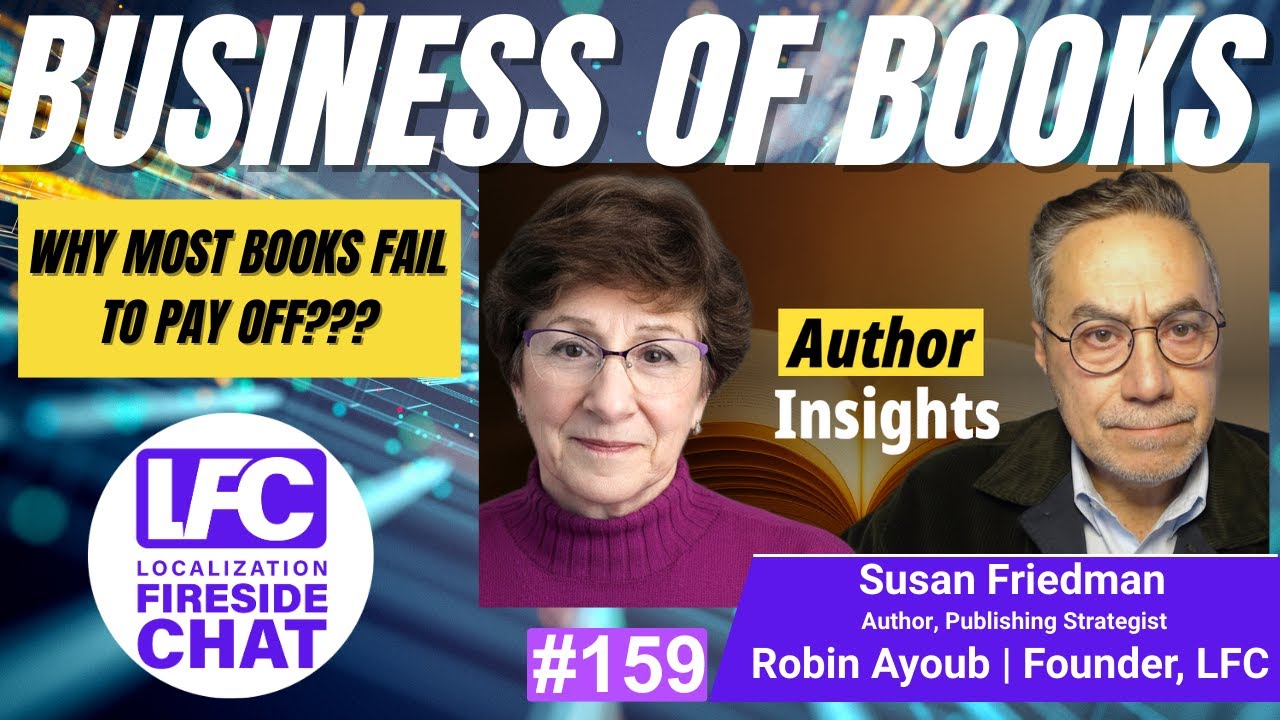
Most books don’t fail because they’re poorly written.
They fail because they’re strategically misused.
In this episode of Localization Fireside Chat, I sat down with Susan Friedman, one of the most experienced voices in nonfiction publishing and book-based business strategy, to unpack a simple but uncomfortable truth:
Most authors treat books like trophies. The smartest ones treat them like assets.
This conversation wasn’t about writing techniques, creative process, or chasing bestseller lists. It was about leverage, authority, and return on effort.
You can watch the full episode here:
👉 https://youtu.be/5UC6w9hRDJI
🎧 Or listen on Simplecast:
👉 https://localization-fireside-chat.simplecast.com/episodes/is-your-book-a-business-trophy-turning-authority-into-revenue
The Core Mistake Most Authors Make
Authors are taught to think in terms of copies sold.
Leaders think in terms of outcomes created.
Susan made this distinction early in our discussion, and it framed everything that followed. A book that sells a few thousand copies but drives no authority, no pipeline, and no strategic advantage is not a success. It’s a vanity project.
By contrast, a narrowly focused book that sells modestly but opens doors to speaking engagements, consulting retainers, bulk purchases, or partnerships can outperform a “bestseller” by orders of magnitude.
This is the difference between a book as a product and a book as infrastructure.
Why Niche Beats Scale Every Time
One of the strongest themes in our conversation was niche positioning. Susan has spent decades helping authors stop competing in crowded, generic categories and start owning specific lanes.
A general business book competes with thousands of others.
A book written for a clearly defined audience solves a specific problem and becomes unavoidable.
We talked about examples where authors intentionally narrowed their focus and, in doing so, increased their impact and commercial success. The logic is simple: relevance beats reach.
If your book speaks directly to a defined group, it does the selling for you.
Books as Credibility Engines
Another misconception Susan dismantled is the idea that books are primarily marketing tools. In reality, their real power is credibility compression.
A book shortens trust cycles. It establishes authority before the first meeting. It reframes conversations from “who are you?” to “how do we work together?”
For speakers, consultants, and founders, this matters more than raw sales numbers. In many professional environments, having a book is no longer optional. It’s expected.
But only if the book is positioned correctly.
The Overlooked Power of Bulk Sales
One of the most underused strategies we discussed was bulk book sales. Not as a gimmick, but as a business model.
When a book aligns with an organization’s objectives, training programs, or customer education efforts, volume becomes a function of utility, not promotion. Susan shared examples where books were integrated into onboarding, certification, and internal training environments, creating predictable demand and meaningful revenue.
This requires authors to stop thinking like publishers and start thinking like partners.
Publishing Is a Jungle. Strategy Is the Map.
We also addressed the confusion around publishing models. Traditional, hybrid, self-publishing. Each has trade-offs, and none guarantee success.
The mistake is choosing a model before clarifying the objective.
Do you want authority?
Leads?
Speaking opportunities?
Enterprise relationships?
The publishing path should follow the strategy, not the other way around.
The Real Question Authors Should Be Asking
By the end of the conversation, the framing became clear.
The question isn’t:
“How many copies did my book sell?”
It’s:
“What does my book do for my business?”
If the answer is unclear, the book is underperforming.
Final Thought
Books are not creative trophies.
They are strategic assets.
Used properly, they create leverage that outlasts any single campaign, platform, or algorithm. Used poorly, they become expensive business cards.
This episode is for anyone considering writing a book or wondering why the one they already wrote isn’t delivering the impact they expected.
Watch or listen when you’re ready to think about books differently.
 Robin Ayoub
Leave a comment