For decades, cybersecurity focused on defending machines.
Firewalls. Networks. Endpoints. Infrastructure.
But what happens when the target is no longer silicon and code, but human perception, attention, and belief?
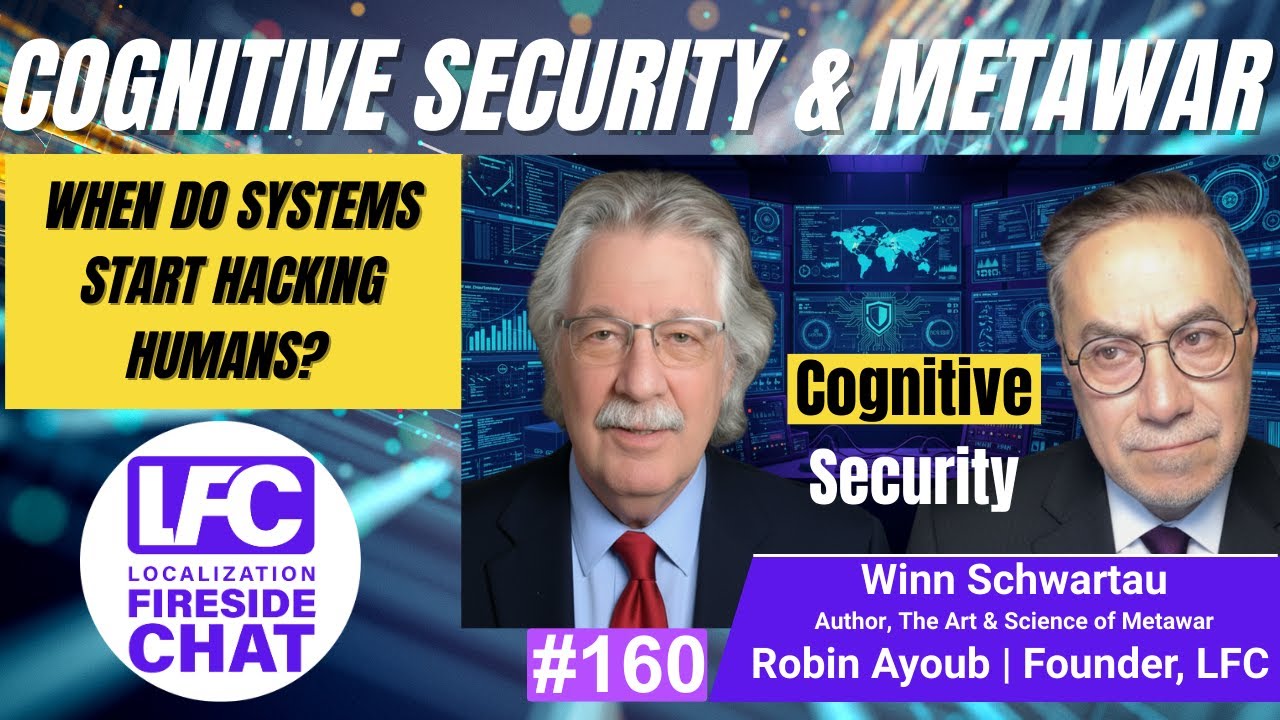
That is the central question explored in Episode 160 of the Localization Fireside Chat with Winn Schwartau, often referred to as the Civilian Architect of Information Warfare and one of the earliest thinkers to warn about large-scale digital and cognitive threats.
This conversation is not about cyber hygiene or tools. It is about power, agency, and the future of decision-making in an AI-shaped world.
From Cybersecurity to Cognitive Security
Winn Schwartau coined the term Electronic Pearl Harbor in the early 1990s, long before most institutions understood the implications of interconnected systems. At the time, the concern was infrastructure collapse and digital sabotage.
Today, the threat has evolved.
The most vulnerable systems are no longer servers or networks. They are humans.
Cognitive security focuses on how information, algorithms, and AI-driven systems influence perception, attention, behavior, and belief. It examines how human decision-making can be manipulated at scale, often invisibly, and often profitably.
As Winn explains, when systems can shape how people think rather than just what they see, the entire security model breaks.
The Rise of Metawar
One of the central concepts discussed in the episode is metawar.
Metawar describes a permanent state of conflict over reality itself. Not episodic cyber incidents. Not isolated misinformation campaigns. A continuous struggle to influence how individuals and societies interpret the world.
This is not theoretical.
Algorithms optimize for engagement, not truth. Platforms reward outrage, not nuance. AI systems amplify content based on attention signals, not accuracy or intent.
The result is an environment where belief systems can be nudged, distorted, or reinforced without the individual ever feeling attacked.
As Winn puts it, the most effective manipulation never feels like manipulation.
Why Human Risk Has Overtaken Technical Risk
One of the most sobering insights from the conversation is that human risk has overtaken technical risk.
Organizations continue to invest heavily in infrastructure security while underinvesting in cognitive resilience. Firewalls are upgraded. Human judgment is assumed.
That assumption is no longer valid.
Social engineering, behavioral influence, and attention hijacking are now the dominant attack vectors. They bypass technical controls entirely by exploiting emotion, trust, habit, and speed.
In other words, the gatekeepers of modern systems are people, not machines.
Disinformation Is an Economic Problem
Disinformation is often framed as a political issue. That framing misses the point.
Disinformation is also an economic weapon.
It distorts markets. It undermines brands. It erodes institutional credibility. It degrades trust, which is one of the most valuable and fragile assets any organization possesses.
When trust collapses, the cost is not abstract. It shows up in volatility, decision paralysis, reputational damage, and long-term erosion of confidence.
As discussed in the episode, organizations must begin to recognize themselves as cognitive entities, not just legal or technical ones.
Can Cognitive Defense Be Systemized?
A critical question explored in the conversation is whether cognitive defense can be systemized or whether it remains purely personal.
The answer, for now, is uncomfortable.
There is no mature, scalable framework for cognitive defense comparable to traditional cybersecurity. Research is fragmented. Incentives are misaligned. Metrics are weak.
Yet the need is urgent.
Winn argues that we must begin applying the same systems thinking used in cybersecurity to human cognition. Detection. Response time. Habituation. Resilience. Recovery.
Until then, individuals and organizations remain largely defenseless.
What Leaders Must Understand Now
This episode is required listening for CEOs, founders, policymakers, and anyone responsible for decision-making in complex environments.
The key takeaway is not fear. It is agency.
Victory in a cognitive conflict does not mean eliminating influence. It means retaining control over identity, attention, and judgment.
Leaders who continue to treat cognitive security as someone else’s problem will eventually discover that it is their problem. By then, the damage may already be done.
Listen and Watch
🎧 Listen to the full audio episode on Simplecast:
https://localization-fireside-chat.simplecast.com/episodes/when-do-systems-stop-hacking-computers-and-start-hacking-humans
🎥 Watch the full video interview on YouTube:
https://youtu.be/1Cd7Srr0aIw
Final Thought
Cybersecurity taught us how to protect systems.
Cognitive security will determine whether we can still trust ourselves to make decisions in a world shaped by AI, algorithms, and infinite noise.
The question is no longer whether systems can hack humans.
The question is whether we will notice in time.
 Robin Ayoub
Leave a comment