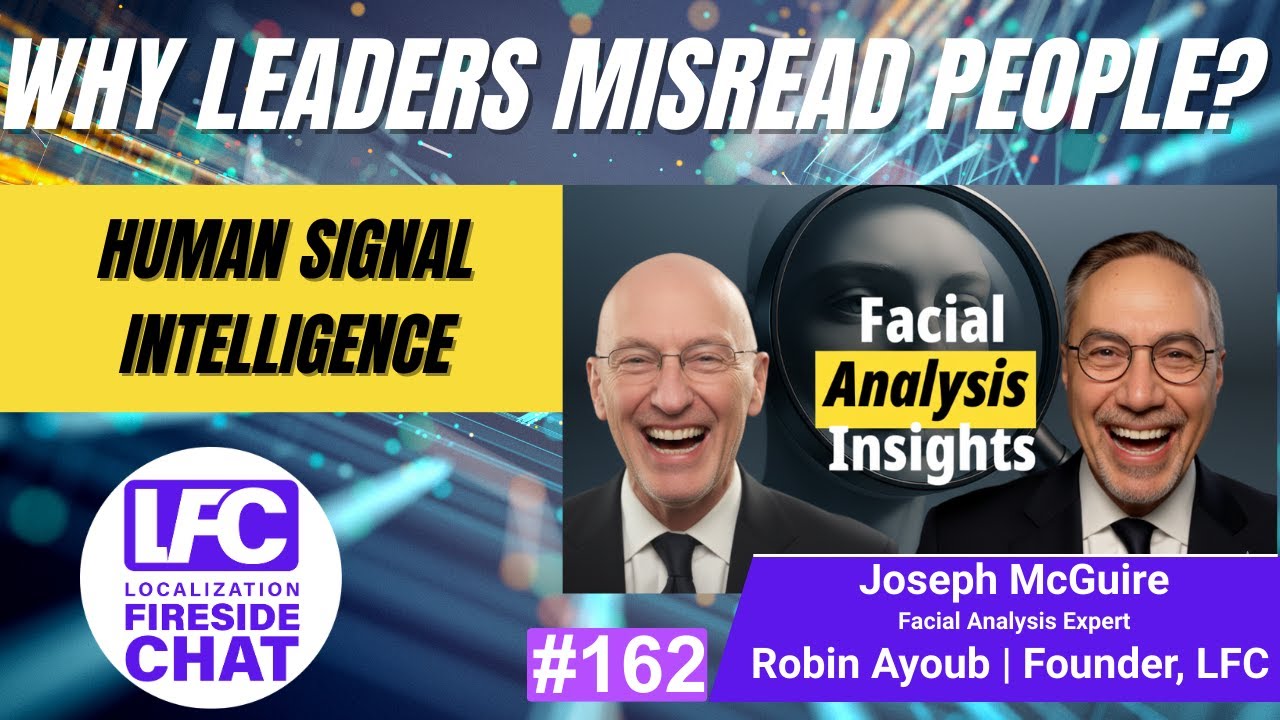
Most leadership failures are not strategy failures.
They are judgment failures.
Hiring the wrong person.
Pushing the wrong message in a sales conversation.
Misreading confidence for competence.
Mistaking silence for agreement.
In this episode of Localization Fireside Chat, I sat down with Joseph McGuire to unpack a problem that shows up in boardrooms, interviews, negotiations, and leadership teams far more often than most executives are willing to admit.
Leaders misread people. And the cost is real.
The myth of rational leadership
Most executives like to believe their decisions are driven by data, experience, and logic. In reality, a significant portion of leadership decisions are made in moments of incomplete information, time pressure, and human interaction.
That is where things break.
People assume they are good judges of character because they have been leading for years. What Joseph makes clear is that experience alone does not sharpen perception. In many cases, it reinforces blind spots.
Leaders read people instinctively, but instinct is inconsistent. It is shaped by bias, comfort, and familiarity. When those instincts are wrong, the consequences compound across teams, revenue, and culture.
What human signal intelligence actually means
This conversation is not about party tricks or body language clichés.
Human signal intelligence is about understanding how people process information, respond to pressure, and communicate intent. Facial analysis is one lens into that system, not as a predictive certainty, but as a way to reduce misalignment.
Joseph explains that faces often reveal how someone prefers to receive information, whether they are under stress, and how they engage with complexity. Leaders routinely miss these signals, especially when they are focused on content instead of context.
The result is familiar. Talking facts to someone who needs narrative. Pushing speed on someone who needs clarity. Reading confidence where there is only performance.
Where leaders get it wrong in hiring
Hiring is one of the highest leverage decisions a leader makes, and one of the most error prone.
Interviews reward performance, not fit. Candidates rehearse answers. Interviewers listen for familiarity instead of alignment. Signals that matter most often appear in how a candidate processes questions, handles pressure, and responds when they are unsure.
Joseph outlines how facial signals, combined with observation of breath, pace, and engagement, can help leaders detect mismatches early. Not to judge character, but to assess role alignment.
Many hiring failures happen not because the candidate was unqualified, but because the leader misunderstood how that person would operate under real conditions.
Sales conversations fail the same way
Sales conversations are another area where misreading people quietly kills outcomes.
A buyer asking for more data is not always skeptical. A buyer asking for stories is not avoiding numbers. Communication preferences matter, and when they are ignored, conversations drift.
Joseph points out that many sales professionals lose deals because they keep delivering the wrong type of information, even when the buyer is signaling discomfort or disengagement. Leaders often interpret this as pricing pressure or timing issues, when it is actually a communication mismatch.
Reading signals accurately does not replace a strong value proposition. It ensures the message lands the way it was intended.
Why video makes this harder, not easier
Remote work and video calls have amplified the problem.
On video, some signals are exaggerated and others disappear entirely. Leaders over index on words and under index on response patterns. Silence, hesitation, and disengagement are often misinterpreted.
Joseph explains that video environments require even more discipline in observation. Leaders who assume they are reading people the same way on Zoom as they do in person are often wrong.
This is especially dangerous in interviews and high stakes discussions where small misreads can shape long term outcomes.
Ethics, limits, and responsibility
This conversation also draws a clear line.
Facial analysis is not mind reading. It does not replace due diligence, references, or performance data. Used poorly, it can reinforce bias instead of reducing it.
Joseph is clear that intent matters. The goal is not to label people, but to communicate more effectively and make better informed decisions. Context always matters more than any single signal.
The real risk is not learning to read signals. It is assuming you already do.
The leadership cost of misjudgment
Every leader has stories of decisions that looked right on paper and failed in reality. Often, the early warning signs were there, but they were missed.
This episode is a reminder that leadership is not just about strategy and execution. It is about judgment. Judgment lives in human interaction.
Ignoring that reality does not make decisions more objective. It makes them less accurate.
Watch and listen
🎧 Listen to the full episode on Simplecast:
https://localization-fireside-chat.simplecast.com/episodes/why-leaders-misread-people-human-signal-intelligence-with-joseph-mcguire
📺 Watch the full conversation on YouTube:
https://youtu.be/NCZtVVszs8o
 Robin Ayoub
Leave a comment