Why leadership, trust, and operating models matter more than the technology
Most organizations today claim to have a GenAI strategy. Far fewer can point to meaningful execution.
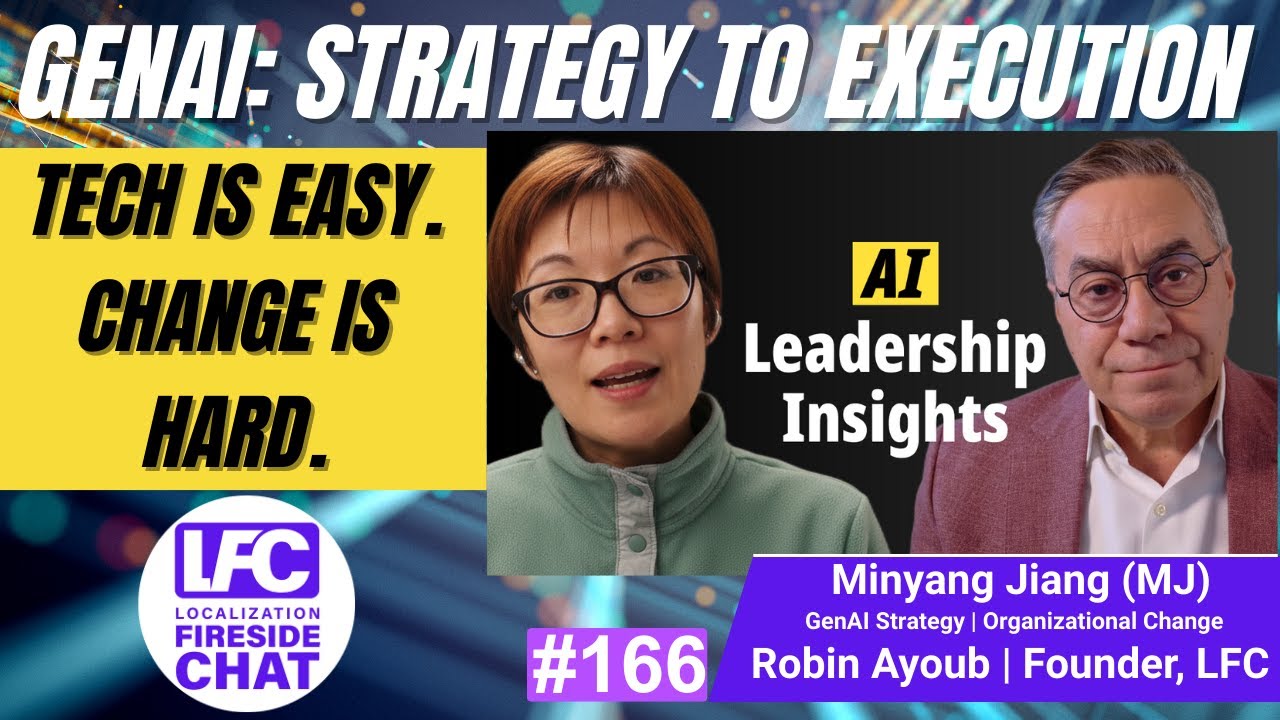
In Episode 166 of Localization Fireside Chat, I sat down with Minyang (MJ) Jiang to unpack why generative AI initiatives so often stall once they move beyond experimentation. The answer, as MJ makes clear, has very little to do with models, tools, or vendors.
It has everything to do with leadership, trust, and how organizations are actually run.
GenAI is not the strategy
One of the central themes of this conversation is deceptively simple: GenAI is an enabler, not a strategy. Too many companies treat AI adoption as a destination rather than a capability. They invest in tools, spin up pilots, and announce transformation programs without addressing the underlying operating model.
When that happens, AI becomes layered on top of broken processes, misaligned incentives, and unclear decision ownership. Execution fails not because the technology underperforms, but because the organization was never designed to absorb it.
MJ frames this clearly: if leadership cannot articulate what problem AI is meant to solve and who remains accountable for outcomes, the initiative is already compromised.
Where execution actually breaks
A recurring failure pattern shows up across industries. Teams experiment with GenAI in isolation. Proofs of concept multiply. Momentum builds. Then nothing scales.
Why? Because execution lives at the intersection of people, process, and trust.
AI systems do not operate in a vacuum. They reshape workflows, redefine roles, and surface uncomfortable questions about authority and accountability. When leaders avoid those conversations, teams fill the gap with resistance, workarounds, or quiet disengagement.
MJ emphasizes that organizations often underestimate the change management load of GenAI. Training alone is not enough. Leaders must actively redesign decision flows, clarify human oversight, and reset expectations around performance and responsibility.
Trust is the real bottleneck
One of the strongest insights from this episode is that trust, not technology, is the limiting factor in GenAI adoption.
Trust operates in multiple directions. Leaders must trust teams to experiment responsibly. Teams must trust leadership to protect them as roles evolve. And everyone must trust that AI systems are being deployed ethically, transparently, and with clear boundaries.
Without that trust, GenAI adoption becomes superficial. People comply, but they do not commit. The system exists, but it is not used to its full potential.
MJ highlights that trust erodes fastest when accountability is ambiguous. When AI outputs are treated as authoritative without clear human ownership, confidence collapses. Strong execution requires leaders to reinforce that humans remain accountable for decisions, even when AI accelerates the process.
High-performing teams adapt differently
Another important distinction in this conversation is how high-performing teams respond to AI-driven change.
Strong teams do not resist GenAI because they fear the technology. They resist when leadership fails to provide clarity. In contrast, teams that are already aligned around purpose and outcomes adapt faster because they understand where AI fits and where it does not.
MJ points out that GenAI tends to expose organizational weaknesses rather than create them. Teams with unclear mandates struggle more. Leaders who rely on authority instead of alignment face greater friction. In this sense, GenAI acts as a forcing function for better leadership.
What leaders should focus on now
This episode is especially relevant for CEOs, operators, and transformation leaders navigating real deployment decisions today. The takeaway is not to slow down AI adoption, but to slow down long enough to get the fundamentals right.
That means:
Treating GenAI as a capability tied to business outcomes, not a standalone initiative
Redesigning operating models alongside technology deployment
Making accountability explicit in AI-enabled workflows
Investing in trust as deliberately as in tooling
Execution does not fail because AI moves too fast. It fails because leadership does not move with it.
A conversation beyond the hype
What makes this episode stand out is its refusal to chase AI headlines. Instead, it focuses on the less glamorous but far more consequential work of leadership and execution.
GenAI will continue to evolve. Models will improve. Tools will commoditize. The differentiator will not be access to technology, but the ability to integrate it into an organization without breaking trust, culture, or performance.
That is the real work of transformation.
🎧 Listen to the full episode here:
https://localization-fireside-chat.simplecast.com/episodes/genai-from-strategy-to-execution
🎥 Watch the full video on YouTube:
https://youtu.be/_GmRHpxhjj0
Disclaimer
The views expressed in this podcast and blog post are those of the participants and do not necessarily reflect the views of their employers or affiliated organizations. This content is for informational purposes only and does not constitute professional or legal advice.
 Robin Ayoub
Leave a comment