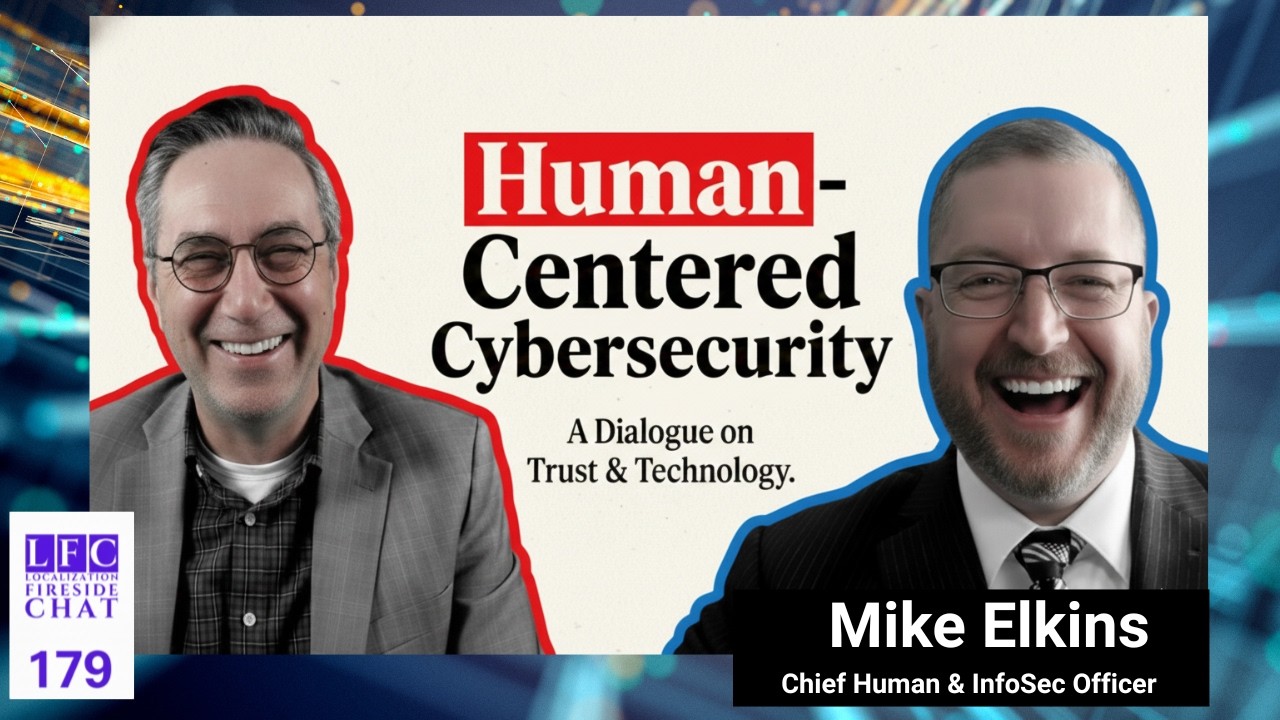
Why Human-Centered Cybersecurity Is the Future of Risk Leadership
What if the next Pearl Harbor isn’t physical?
What if it’s digital?
In Episode 179 of the Localization Fireside Chat, I sat down with Mike Elkins, Chief Human & Information Security Officer at Humanis Technologies, to explore one of the most pressing leadership questions of our time:
Are organizations truly prepared for systemic digital shock?
🎥 Watch the full episode on YouTube:
https://youtu.be/5nM_MQoTAIU
🎙 Listen on Simplecast:
https://localization-fireside-chat.simplecast.com/episodes/what-if-the-next-pearl-harbor-is-digital-human-centered-cybersecurity-with-mike-elkins
This was not a compliance discussion. It was a leadership conversation about risk, resilience, AI acceleration, quantum disruption, and the human element at the center of it all.
Cybersecurity Is Not a Technology Problem
Mike has spent over 27 years operating at the intersection of healthcare IT, enterprise risk, national security strategy, and real estate investing. His thesis is clear:
Cybersecurity is not primarily a technology problem.
It is a human behavior problem.
Most organizations still approach security as a checklist:
• Tools
• Controls
• Certifications
• Framework compliance
But that mindset assumes risk lives in software.
It doesn’t.
It lives in human decision-making.
It lives in cognitive overload.
It lives in behavioral blind spots.
And unless systems are designed with that reality in mind, they fail under pressure.
Lessons From Healthcare IT
Mike’s early career in healthcare shaped his philosophy. In hospitals, technology failures are not abstract. They affect patient care in real time.
One powerful example discussed in the episode was the creation of a staff duress badge in collaboration with Thomas Jefferson University. The badge allowed hospital workers to discreetly alert security during violent or dangerous situations.
It worked not because it was technologically complex.
It worked because it was designed around human behavior.
Healthcare taught Mike something most CISOs never experience:
Risk management is about protecting people first.
That human-centered lens later informed his contributions to cybersecurity frameworks and governance strategies at scale.
The Illusion of Privacy
At one point in the conversation, Mike stated:
“There’s no such thing as privacy anymore.”
It sounds provocative. It is also grounded in reality.
Every digital interaction creates data. Every platform aggregates behavior. Every system introduces exposure.
Traditional perimeter-based security models no longer reflect the modern environment. Leaders must operate with a different assumption:
Compromise is not hypothetical. It is inevitable.
The question is not “Can we prevent every breach?”
The question is “How resilient are we when one occurs?”
AI Is Accelerating Risk
AI is often framed purely as an opportunity.
But it is also a force multiplier for threat actors.
AI enables:
• Automated social engineering
• Adaptive phishing campaigns
• Deepfake manipulation
• Data poisoning attacks
• Behavioral mimicry at scale
Organizations deploying AI must simultaneously defend against AI.
This dual dynamic is reshaping the threat landscape faster than governance structures are adapting.
The leaders who treat AI purely as a growth lever without integrating risk governance are building fragility into their own systems.
Quantum Computing: A Strategic Planning Imperative
Quantum computing is often dismissed as a distant concern.
It shouldn’t be.
When quantum systems reach sufficient scale, today’s encryption standards could become obsolete overnight.
That has implications across:
• Financial systems
• Healthcare records
• Government infrastructure
• Intellectual property protection
• Regulatory compliance
Boards cannot afford to defer quantum risk to technical teams alone.
This is capital risk. Governance risk. Strategic risk.
Waiting until quantum disruption becomes visible will be too late.
What Does a Digital Pearl Harbor Look Like?
When asked what a “digital Pearl Harbor” might look like, Mike did not describe a cinematic cyberattack.
He described systemic erosion.
Simultaneous disruptions across critical infrastructure.
Data integrity collapse.
Trust breakdown.
Cascading institutional failures.
Not a single explosion.
A coordinated unraveling.
This is not science fiction.
It is a scenario risk planners are actively modeling.
The difference between organizations that survive such disruption and those that collapse will not be tools.
It will be leadership clarity.
Risk Is a Boardroom Conversation
Cybersecurity used to sit inside IT.
That era is over.
Modern digital risk intersects with:
• SEC reporting obligations
• GDPR and privacy mandates
• Third-party vendor exposure
• AI governance
• Capital allocation decisions
Risk leadership must move into the boardroom.
Boards need to ask better questions:
Are we modeling behavioral risk?
Are we stress-testing digital resilience?
Are we integrating AI governance into enterprise strategy?
Are we prepared for post-quantum cryptography shifts?
Compliance is not protection.
Resilience is protection.
The Human Element Is Both Weakness and Strength
Humans are often described as the weakest link in cybersecurity.
Mike reframed that.
Humans are only weak when systems ignore how they behave.
When security frameworks incorporate behavioral science, education, and human-centered design, people become the strongest layer of defense.
Technology without human context creates fragility.
Technology aligned with human reality creates resilience.
Final Thoughts
This episode was not about fear.
It was about clarity.
The convergence of AI, quantum computing, behavioral manipulation, and digital interdependence is reshaping risk faster than many leaders realize.
The organizations that thrive will not be those with the most tools.
They will be those with:
• Governance discipline
• Behavioral insight
• Forward-looking strategy
• Executive ownership of digital risk
Cybersecurity is no longer an IT expense.
It is strategic infrastructure.
If you lead a company, advise executives, or allocate capital in a digital economy, this conversation is essential listening.
🎥 Watch the full episode here:
https://youtu.be/5nM_MQoTAIU
🎙 Listen on Simplecast:
https://localization-fireside-chat.simplecast.com/episodes/what-if-the-next-pearl-harbor-is-digital-human-centered-cybersecurity-with-mike-elkins
To explore more leadership conversations at the intersection of technology, governance, and global systems:
🌐 Localization Fireside Chat
https://www.l10nfiresidechat.com
🌐 N49 Networks
https://www.n49networks.com
 Robin Ayoub
Leave a comment