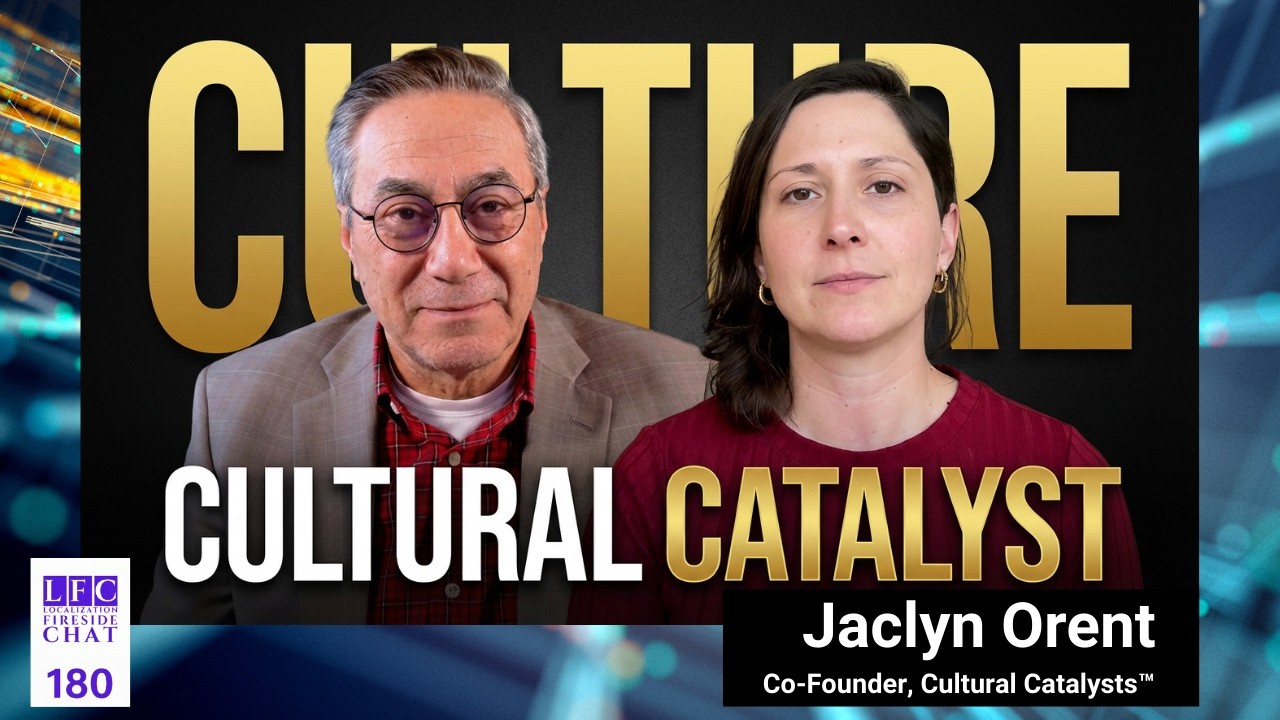
You Can’t Scale Past Your Identity: How Conscious Leadership Drives Systemic Change
With Jaclyn Orent | Cultural Catalysts™
Leadership isn’t a function. It’s an identity.
In this episode of Localization Fireside Chat, I talk with Jaclyn Orent, co-founder of Cultural Catalysts™, about why the real ceiling in business — and in leadership — isn’t market conditions, strategy, or resources. It’s who you have to become to lead at a higher level.
Most leadership conversations focus on tactics: frameworks, incentives, org charts, and KPIs. Jaclyn challenges that approach. She argues that sustainable scaling depends first on inner transformation and consciousness — a shift that fundamentally rewires how leaders think, feel, and act under pressure.
This isn’t spiritual fluff. It’s grounded in research and measurable practice. Jaclyn blends Dr. Benjamin Hardy’s Science of Scaling, Richard Boyatzis’ Intentional Change Theory, and consciousness studies to offer a roadmap for leaders who refuse to plateau.
Here’s what you need to know.
Why Identity Sets the Growth Ceiling
Jaclyn starts with a simple but powerful premise: you can’t scale past your identity.
Your identity — the set of beliefs you hold about what’s possible for you — directly determines the ceiling of your influence and organizational growth. When a founder hits a plateau, it’s often not an external limit. It’s an internal one.
This idea reframes scaling as an identity problem, not a strategy problem.
Business outcomes come from predictable patterns of behavior. Behavior flows from identity. If identity doesn’t evolve, behavior can’t either. And when behavior stalls, growth stalls.
This insight flips traditional scaling logic on its head. Instead of optimizing org structures or KPIs first, Jaclyn suggests leaders start with this question:
Who do I need to become to lead at the next level?
The Science of Scaling: Frame, Floor, Focus
A key part of the conversation centers on what Jaclyn describes as the 3 Fs of scaling:
1. Frame – How you interpret your world
2. Floor – What minimum standards your nervous system tolerates
3. Focus – What you pay attention to
These aren’t abstract concepts. They are measurable patterns that show up in how leaders allocate attention, respond to stress, and govern culture.
For example:
• A leader who operates from a narrow frame will overvalue short-term metrics and undervalue long-term resilience.
• A low nervous system floor keeps leaders in reactive mode, limiting strategic bandwidth.
• A scattered focus spreads energy thin and slows decision velocity.
To scale effectively, leaders must expand their frame, elevate their floor, and sharpen their focus. These shifts are not personality adjustments. They are nervous system upgrades — and that requires dedicated self-awareness and practice.
Consciousness as a Measurable Leadership Variable
This is where Jaclyn draws the line between inner work and organizational impact.
When leaders develop higher consciousness — defined here as increased awareness, emotional regulation, and capacity to hold complexity — measurable changes occur at the organizational level.
You see it in:
• Better cross-team collaboration
• More effective conflict resolution
• Leadership that models resilience under uncertainty
• Faster alignment around purpose and strategy
• Cultural signals that reinforce performance without stress
Conscious leaders don’t bypass difficulty. They manage it with more skill and less friction.
This shift isn’t visible on an org chart. But it shows up in how decisions are made and how people feel while making them.
Psychological Safety vs Comfort Culture
One of the sharpest distinctions Jaclyn makes is between psychological safety and comfort culture.
Psychological safety is about being able to speak up without fear of humiliation or punishment. It’s essential. But comfort culture — where disagreement is avoided to prevent discomfort — is toxic to growth.
Leaders who confuse these sets unintentionally suppress challenge, curiosity, and honest debate.
High-performing teams need:
• Permission to disagree
• Freedom to innovate
• Safety to fail fast and learn
Jaclyn makes it clear: comfort is not safety. Comfort is an avoidance strategy that kills scaling.
Peer Networks vs Traditional Coaching
Most executives reach for coaching when they hit a plateau. Jaclyn believes networks often deliver deeper transformation.
Why?
Traditional coaching tends to be 1:1, introspective, and personalized. That’s valuable. But it often lacks social resonance — the pressure and learning that comes from real group dynamics.
Peer networks introduce:
• Real-world mirrors
• Collective case learning
• Network effects for behavior change
• Pattern recognition beyond personal bias
In a strong peer network, leaders see themselves in others — and this accelerates growth faster than isolated reflection.
Cultural Catalysts™ is built on this principle. The network is intentionally diverse enough to avoid echo chambers, but aligned enough to support sustained evolution.
Intrinsic Motivation and Higher Purpose
A recurring theme in our conversation was why leaders evolve.
Jaclyn distinguishes between extrinsic motivation — validation, status, compensation — and intrinsic motivation — the internal pull toward contribution, mastery, and purpose.
Scaling driven by external reward structures is finite — because it depends on benchmarks others control.
Scaling driven by intrinsic motivation is infinite — because it expands what the leader believes is possible.
This is a critical pivot for founders who feel stuck. The shift isn’t strategy. It’s alignment.
Expanding Nervous System Capacity
Jaclyn also shares practical approaches for expanding what she calls nervous system capacity — the ability to hold multiple complex variables without shutdown.
This matters because:
• High growth environments increase volatility
• Leaders with low capacity default to anxiety and control
• Systems that tolerate complexity perform better
Tools mentioned in the episode include Emotional Freedom Technique (EFT) and structured attention training.
These aren’t random self-help tools. They are intentional interventions that enhance resilience and performance under stress.
Integrating Ecological Regeneration into Leadership Systems
A unique part of Jaclyn’s work ties leadership evolution to ecological regeneration.
This isn’t symbolic. It’s strategic.
She positions regenerative land trust projects as an impact feedback loop — where network value funds real world regeneration initiatives that participants can engage with.
It’s leadership as a system, not a silo.
What the Future of Leadership Looks Like
Toward the end of our conversation, Jaclyn paints a picture of what leadership will require in the next decade:
• Higher emotional bandwidth
• Capacity to hold ambiguity
• Alignment around contribution over compensation
• Openness to continuous identity evolution
• Systems thinking at personal and organizational levels
This isn’t optional. It’s the next threshold for anyone serious about sustained scaling.
Final Takeaway
If you want to scale your company, don’t start with strategy. Start with identity.
Strategy optimizes what already exists. Identity creates what becomes possible.
This episode offers a blueprint for leaders who refuse to be outpaced by their own organization — and who understand that the next frontier of growth starts with who they have to become.
Resources Mentioned
• Power vs. Force – Dr. David Hawkins
• The Science of Scaling – Dr. Benjamin Hardy
• Intentional Change Theory – Richard Boyatzis
• Emotional Freedom Technique (EFT)
• Cultural Catalysts™
• Jaclyn Orent on LinkedIn
Watch the full episode on YouTube:
https://youtu.be/6M8ygvOW0S4
Listen on Simplecast:
https://localization-fireside-chat.simplecast.com/episodes/you-cant-scale-past-your-identity-with-jaclyn-orent-conscious-leadership-cultural-evolution-and-the-science-of-scaling
 Robin Ayoub
Leave a comment