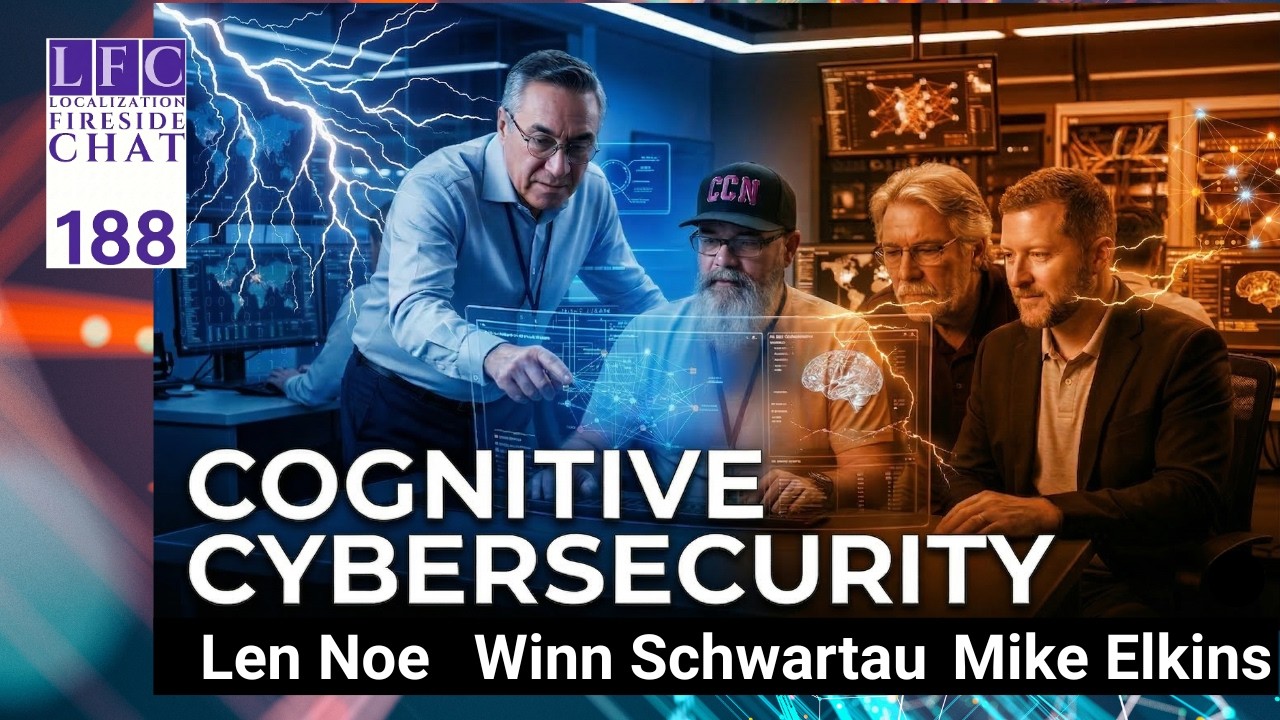
There is a version of cybersecurity most people understand. Firewalls. Passwords. Phishing emails. The idea that somewhere out there, a hacker is trying to break into your system.
That version is already obsolete.
In this episode of Localization Fireside Chat, I sat down with three of the most compelling thinkers working at the intersection of technology and human cognition: Len Noe, the world’s first augmented ethical hacker with 11 pieces of technology implanted in his own body; Mike Elkins, Chief Human and Information Security Officer at Humanist Technologies; and Winn Schwartau, a cybersecurity pioneer who has been sounding the alarm on cognitive threats since 1983. What followed was one of the most unsettling and necessary conversations I have hosted on this podcast.
The thesis is simple and the implications are enormous: the human brain has replaced the network as the most valuable attack surface in cyberspace. And most people — including most security professionals — have not caught up to that reality yet.
The Shift Nobody In Security Wants to Admit
Winn has been making this argument for years. Neuroscience, as a serious discipline, is barely thirty years old. Behavioral psychology and philosophy have given us frameworks for understanding human thought, but the kind of rigorous, operationalized understanding of how the brain can be exploited, manipulated, and defended — that work is still in its early stages. “We’re really only getting started,” Winn told me, “even amongst ourselves.”
What makes this shift so difficult for the security industry to absorb is that it requires a completely different kind of expertise. Mike spent nearly three decades in technology before going deep on cognitive security. “If you would have told me how interdisciplinary I would have had to be,” he said, “I would have thought you were full of crap.” Today he is working with clinical psychologists, cyber psychologists, and academic researchers — because the people engineering attacks on human cognition are already using college-level psychology textbooks. Defenders need to catch up.
The attackers are not waiting. They are exploiting dopamine. They are modulating oxytocin. They are using the same neurochemical levers that Big Tech uses to keep you scrolling — except the goal is not to sell you something. The goal is to compromise you.
The Cognitive Pearl Harbor
The concept Winn introduced that stayed with me longest is what he calls the Cognitive Pearl Harbor. These are events so seismic to your sense of reality that your identity and personal agency are effectively surrendered to others — without you realizing it is happening.
This is not a new phenomenon. Winn traces it from the Pharaonic dynasties through Machiavelli, through czarist Russia, through 1930s Europe. Every era has had actors who understood that controlling the narrative means controlling the population. What has changed is the precision and the scale. “They who control the narrative control your beliefs,” Winn said. “How do we fight that?”
Mike extended the concept into the present. How many people do you know who read something online and take it as gospel, regardless of source? The problem is not that people are gullible. The problem is that AI systems are now building individualized attack profiles — what Mike called a Robin profile, or a Len profile — that know more about each person than that person knows about themselves. The manipulation is not generic. It is intimate. It feels personal because it is engineered to feel that way.
Big Tech, Addiction by Design, and What It Has to Do With Security
Mike made a point that should be more widely understood: the social media industry operates from a playbook that explicitly treats addictiveness as a feature, not a bug. The infinite scroll is not a design accident. The notification ping is not a coincidence. They are delivery mechanisms for dopamine, engineered to keep you returning. Six to thirteen hours a day, Mike cited, just staring at a rectangle chasing the next hit.
Winn connected this directly to the current Meta trial and the public record. Senior executives, including Zuckerberg, made statements acknowledging that controversy drives engagement and engagement drives revenue. “Can you imagine if you had a patent that said this is going to transform your life but it will also be highly addictive?” Winn asked. “Would we allow that to go into the public?” The answer, it turns out, is yes — because it is called the Attention Economy, and it is worth more than most countries’ GDP.
The security implication is direct. A person whose judgment is impaired by addiction is a person who is more susceptible to social engineering, financial fraud, and manipulation. The platforms are not causing this as a side effect. It is the product.
Len’s Grandchildren: A Personal Experiment With Generational Consequences
Len offered one of the most personal moments of the episode. He has two grandchildren raised in completely different environments. One has had a screen in front of her face since she was three months old — a normal upbringing by today’s standards. The other has had essentially no screen time, living what Len described as a life straight out of Little House on the Prairie, with chores, livestock, and long stretches of unstructured time.
The differences are stark. One child can self-soothe, handle responsibility, and sit comfortably with nothing to do. The other has a complete emotional breakdown when her phone is taken away. “I don’t know which one is more prepared,” Len admitted. “They both have positives and negatives. But watching their development has been a real exercise in what the future is going to give to the next couple of generations.”
That honest uncertainty matters. This is not a sermon against screens. It is a serious question about what we are building into the next generation — and whether we have thought carefully enough about the consequences.
Deepfakes, Hyper-Personalized Fraud, and the $850,000 That Disappeared
The practical consequences of all this came into sharp focus when Mike described the $850,000 Brad Pitt deepfake scam. A woman was convinced by a digital twin of the actor — indistinguishable from the real thing — that he needed her financial help. She sent her entire life savings. She is not alone. This kind of fraud is exploding, and it is almost entirely invisible in the statistics because the three forces that prevent reporting are fear, shame, and embarrassment. Victims do not tell authorities. Many do not tell their families.
Len added that he has been the victim of a deepfake scam himself. And he has been doing extensive research into the proliferation of deepfake content and the legal vacuum surrounding it. The technology is moving faster than the law, faster than public awareness, and faster than our instinctive ability to detect what is real.
Neural Data Privacy: The Frontier Nobody Is Protecting
As the conversation moved forward in time, Len raised a subject that should be generating far more attention than it is: neural data privacy. Neuralink’s first patient, Nolan Arbaugh, is now one of the leading advocates for neural data privacy rights — having realized, after the fact, that every piece of biological data recorded by his implant is the legal property of the company that manufactured it. “We have medical privacy laws,” Len said, “but there is nothing that addresses what these sensors are actually receiving and how they are being used.”
Winn added the geopolitical dimension. The NeuroRights Foundation at Columbia University is working on this issue. The EU and UK have committed €150 billion over ten years to neuro rights education and neurological defense. The United States has committed nothing. “Use your own critical thinking to figure out why,” Winn said, and left it there.
How Do You Get People to Unplug?
The question Len posed — and the one I kept returning to after we finished recording — is this: we can explain all of this. We can write books, give keynotes, and run podcasts. But how do you convince someone who is chemically addicted to a dopamine loop to voluntarily walk away from it?
Mike’s answer draws on addiction psychology. Real behavioral change starts with identity. Smokers who successfully quit stop identifying as smokers. They say: I am not a smoker. The same shift has to happen here. And historically, humans make deep behavioral change only when they are desperate enough, or when circumstances force their hand.
Winn’s framework is what he calls critical ignoring — the disciplined practice of treating incoming information as potentially false until verified. Rebuilding the instinctive threat-detection we have always had in the physical world, and applying it to the information environment. “We adapted to the physical environment incredibly well,” he said. “We have not adapted as a species to the information-based environment. If we don’t, we lose.”
What Societies Need to Start Doing Right Now
Finland is the example Winn returns to because it is working. They are teaching cognitive resilience to children as young as three — not in separate classes, but woven into existing storytelling and reading curricula. Critical thinking introduced through fairy tales. The ability to ask what is behind the story, what is behind the headline, built in from the beginning. “Magicians hate kids,” Winn said. “Kids can see behind a lot of the crap that adults can’t, because of the biases we’ve formed throughout our lives. If kids naturally have that, let’s start early like the Finns are doing.”
Mike’s closing was the most urgent. He described what he calls a poly-crisis — not a single attack, but simultaneous waves of cyber, cognitive, and physical infrastructure collapse. Water. Power. Gas. Telecommunications. All of it compromised, in many cases since at least 2014. “We are three to four minutes away from absolute catastrophe,” he said. “And I don’t think we are as prepared as a country — or as a world — for the realities of what humans can do to each other.”
Len closed on the question of individual sovereignty. In a world where everything is monitored, tracked, logged, and used to sell you something, the real fight is not just about cybersecurity. It is about maintaining your identity, your value, and your place as an individual in an increasingly connected reality. “Resistance is futile,” he said. “You can either lead, follow, or get run over. But the key question we need at the front of this discussion is: how do we maintain our own sovereignty?”
That question does not have a clean answer. But it is the right question. And this conversation is one of the best places I know to start.
Watch the Full Conversation
This summary does not capture the full depth of what Winn, Mike, and Len brought to this conversation. Watch the full episode to hear the Cognitive Pearl Harbor explained in Winn’s own words, Len’s firsthand experience with deepfake fraud, and Mike’s complete poly-crisis framework.
YouTube: https://youtu.be/SYKH6iOvNWo
Podcast: https://localization-fireside-chat.simplecast.com/episodes/your-brain-is-the-target-and-you-dont-even-know-it-len-noe-mike-elkins-winn-schwartau
Join the conversation: https://www.linkedin.com/company/lfcpodcast/
If this conversation changed how you think about your own digital life, share it with someone who needs to hear it.
About the Guests:
Len Noe – Divergent Research Engineer and the world’s first augmented ethical hacker. Len has 11 pieces of technology implanted in his body between his elbows and fingertips, is a former black hat and 1% outlaw motorcycle gang member, and is one of the most original thinkers working in cybersecurity today. His work sits at the intersection of human augmentation, offensive security, and cognitive threat research.
Mike Elkins – Chief Human and Information Security Officer at Humanist Technologies, a firm focused on risk management, cybersecurity, and resilience. With nearly 28 years in technology and deep expertise across governance, infrastructure, software development, and R&D, Mike is one of the leading voices on the human and cognitive dimensions of modern security.
Winn Schwartau – Cybersecurity pioneer, author, and founder. Winn has been working in security since 1983 and made a decisive shift in 2016 toward the intersection of cybersecurity, biological security, and cognitive security. His latest book, The Art and Science of Meta War, is essential reading for anyone trying to understand the information warfare landscape. He is a core contributor to the Cognitive Security Institute.
Resources Mentioned:
🌐 Cognitive Security Institute: https://cognitivesecurityinstitute.org
📚 Winn Schwartau’s Book: The Art and Science of Meta War
🧠 NeuroRights Foundation — Columbia University
 Robin Ayoub
Leave a comment