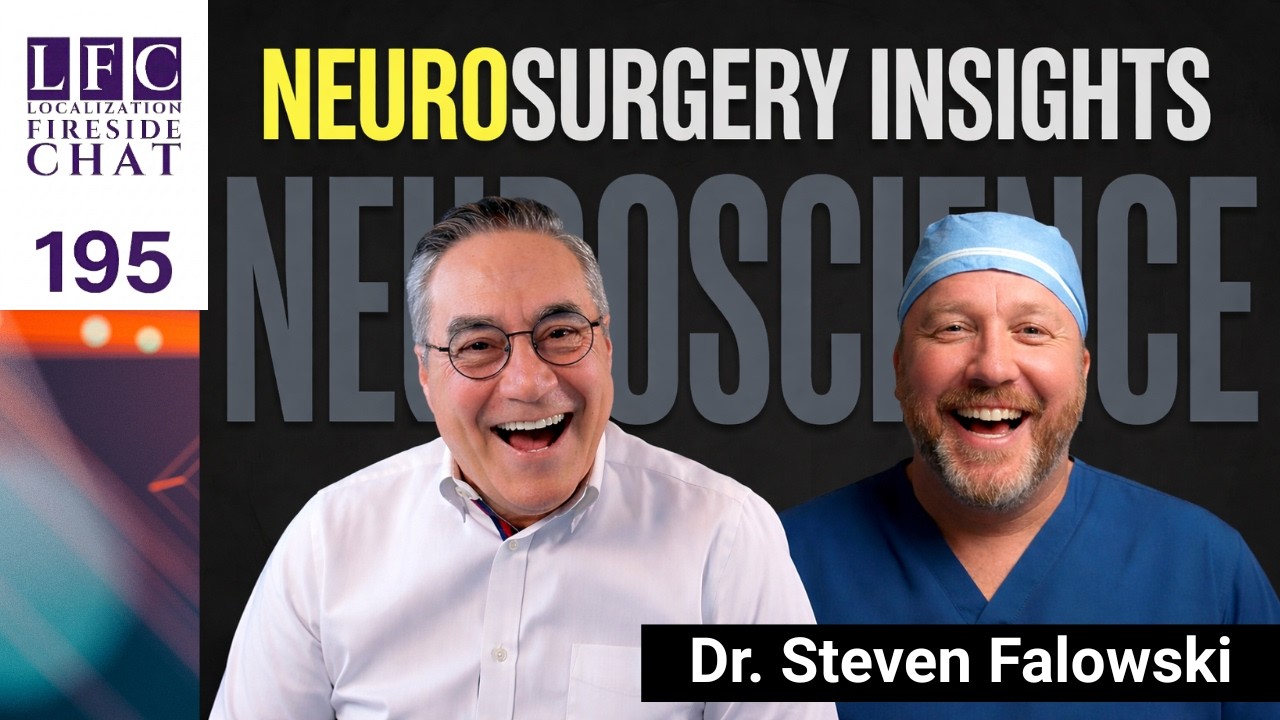
A functional neurosurgeon walks us through the technology that is quietly making opioids obsolete, one nerve at a time.
What if the solution to chronic pain was not in a pill bottle, but in a chip the size of a pacemaker, connected to AI, managed from your phone?
That is not a pitch for a Netflix sci-fi series. That is the present reality of functional neurosurgery, and Dr. Steven Falowski has been building toward it for over two decades.
Dr. Falowski is a functional neurosurgeon practicing near Philadelphia. He is the Director of Functional Neurosurgery, President-Elect of the American Society of Pain and Neuroscience, and Strategic Advisor at SynerFuse, the company behind the E-TLIF, a device that fuses spinal surgery with targeted nerve stimulation to stop chronic pain before it starts. He came straight out of the operating room to have this conversation with us. That tells you everything about his priorities.
The problem he is solving is bigger than most people realize.
Up to 30% of patients who undergo spinal fusion surgery live in chronic pain afterward. Not because the surgery failed. Not because the surgeon made a mistake. But because the spine is one of the most complex pain-generating structures in the human body, and we have been trying to manage it with blunt instruments for decades.
Opioids flood the entire nervous system with chemicals, create dependency, and cost the US healthcare system an estimated $20 billion a year in downstream care for post-fusion chronic pain alone. That is not a treatment strategy. That is a holding pattern.
Dr. Falowski is done holding.
Here is what neuromodulation actually does.
Instead of flooding the body with chemicals, neuromodulation places a small electrode directly on the nerve responsible for the pain. Not the spinal cord. Not a general region. The exact nerve. At the exact level of the spine where the problem originates.
The device then stimulates that nerve using what Dr. Falowski calls ultra-low energy, stimulation so subtle the patient does not even feel it. But the nerve registers it. And the pain stops.
He put it plainly in our conversation: we used to create a tingling sensation where the pain was, hoping one signal would override the other. Now we can isolate specific fibers and cancel the pain without the patient feeling anything at all.
That shift, from masking pain to blocking it at the source, is what moved success rates from the old 50-50 club (50% of patients, 50% relief) to where we are today: 85 to 90% of patients achieving what Dr. Falowski calls close to cured.
Read that again. Close to cured. For chronic pain.
Now add AI. And a Bluetooth connection. And your phone.
Here is where this episode stopped being a medical conversation and started feeling like a preview of the next decade.
The stimulators that Dr. Falowski implants today do not just stimulate. They record. The device sends a signal, then reads how the nerve responds, in real time, via Bluetooth. AI algorithms process that data, compare it against thousands of possible stimulation programs, and automatically adjust the settings to get the best possible result for that specific patient, in that specific moment.
No guesswork. No waiting for a follow-up appointment. The device and the AI are already optimizing while the patient is living their life.
And that is just the current version.
In the next one to two years, Dr. Falowski told us, patients will be able to press a button on their phone, activate a specific nerve, and let the AI read the response and reprogram the device accordingly. Self-managed, AI-guided, physician-monitored pain relief. From a smartphone.
Further out, perhaps five years, the AI chip moves inside the device itself. No external input needed. The stimulator thinks, learns, and adjusts on its own. Dr. Falowski acknowledged the risks of removing physician oversight from the loop. But he was clear: we are heading there.
SynerFuse is the bridge between two worlds that were never supposed to meet.
For most of his career, Dr. Falowski operated in two separate lanes. On one side: major spinal fusion surgery, highly invasive, structurally necessary, but carrying that 30% chronic pain risk. On the other side: minimally invasive spinal cord stimulators, 40-minute outpatient procedures, patients home in two weeks.
SynerFuse merges them. The E-TLIF implants the electrode at the exact moment of the fusion surgery, directly on the nerve being operated on. The patient wakes up with both the structural repair and the pain prevention system already in place. The proof of concept study followed patients for 12 months. Not only did pain scores drop dramatically, but patients continued to improve at the one-year mark, which almost never happens in traditional fusion recovery. And opioid use dropped significantly across the board.
That is what spoke to Dr. Falowski when he met the SynerFuse team. Not a sales pitch. The science.
The language piece. Because this is still the Localization Fireside Chat.
We asked Dr. Falowski what happens when a patient walks into his office and does not speak English. His answer was direct: we use virtual medical interpreters, specialists trained in neurosurgical terminology who can bridge the gap in the room, in real time.
Because explaining that you are about to place an electrode inside someone’s spine, that it will connect to a battery, that AI will read the nerve response and adjust the program, that requires more than a bilingual assistant. It requires a qualified medical translator who understands the science and can carry the meaning accurately across the language barrier.
The gap between surgical innovation and the patient who needs it is not always technical. Sometimes it is linguistic.
What the next decade looks like.
Dr. Falowski will be in Portugal next month for the International Neuromodulation Society meeting, and in Amsterdam shortly after for the international spine pain and neuroscience conference. The field is moving fast globally, not just in the US.
His five-year prediction: more stimulators, fewer invasive fusions, better outcomes. His ten-year prediction: AI chips inside the devices, exoskeletons entering mainstream for spinal cord injury, and brain computer interfaces treating conditions far beyond pain, including paralysis, epilepsy, and movement disorders.
He was the first person in his family to go to college. He once told his mother that if he was not a neurosurgeon, he would probably be a very high-end mechanic, because he loves fixing things that are hard to figure out.
The human spine qualifies.
CLOSING LINKS SECTION
Watch the full episode on YouTube: https://youtu.be/2KBYEDTAVZA
Listen on Simplecast: https://localization-fireside-chat.simplecast.com/episodes/your-spine-has-a-chip-it-connects-to-ai-and-its-already-replacing-opioids-dr-steven-falowski
Connect with Dr. Steven Falowski on LinkedIn: https://www.linkedin.com/in/steven-falowski-876926118/
Connect with Robin Ayoub on LinkedIn: https://www.linkedin.com/in/robinayoub
Follow LFC on LinkedIn: https://www.linkedin.com/company/localization-fireside-chat
Visit N49Networks: https://n49networks.com
Book a call with Robin: https://calendly.com/robin-ayoub/30min
 Robin Ayoub
Leave a comment