800 Million People, 186 Countries, and the Breath That’s Healing Veterans, CEOs, and First Responders
What happens when a pharma researcher walks away from a Novartis career to teach the world how to breathe? Spencer Delisle did exactly that. And twenty years later, the results are hard to argue with.
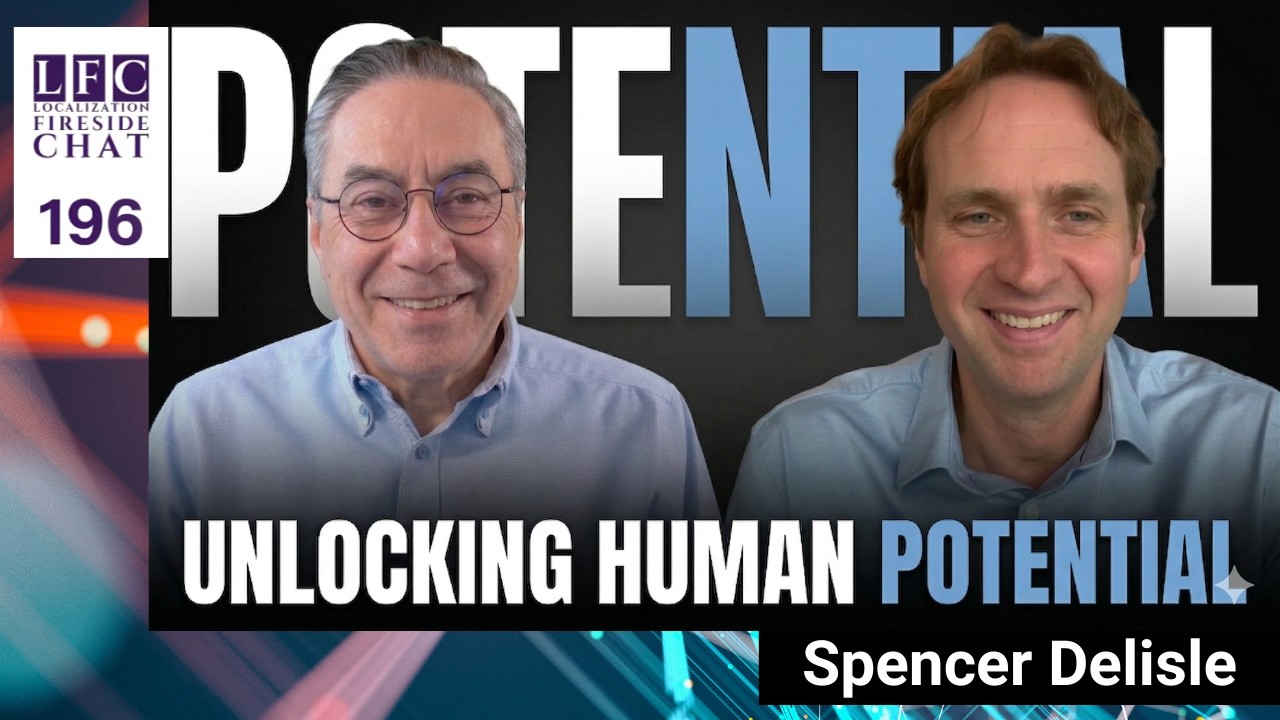
Spencer is the President of the Art of Living Foundation Canada and VP and Board Member of the TLEX Institute, the corporate leadership arm of the Art of Living movement. He joined Robin Ayoub on Episode 196 of the Localization Fireside Chat for one of the most wide-ranging conversations the show has produced.
From the Lab to the World Stage
Spencer’s path started in Montreal, moved through biochemistry labs at McGill, through sales and marketing at Novartis Pharmaceuticals, and then hit a wall. A familiar one.
“My career goals were not giving me the joy they used to,” he told Robin. “Someone had just sucked the juice out of it. I felt like I was on this merry-go-round.”
That search for meaning led him back to university, where he spotted a poster for a free meditation session from the Art of Living Foundation. He went. He experienced it. And he never really left.
Twenty years later, he has personally taught programs in over 25 countries and helped the Art of Living reach more than 800 million people across 186 countries through 40,000 certified teachers worldwide.
What Is TLEX and Why Does It Matter in the Boardroom?
TLEX stands for Transformational Leadership for Excellence. It is the corporate face of Art of Living, and Spencer serves as Vice President and Board Member of the Institute.
The premise is straightforward but the implications run deep. You got your job with your resume. Whether you keep it and rise depends almost entirely on soft skills: your ability to manage your own emotions, lead under pressure, and inspire others.
“How many years have we spent developing our resume?” Spencer asked. “Years and years of schooling, professional training. And in the end, your level of leadership and decision-making is determined not by those skills, but by your ability to manage yourself.”
TLEX has now worked with over 500,000 people in 60 countries, including teams at Google, Deloitte, TD Bank, FIFA, GE, the European Parliament, and the Government of Iraq.
The Veteran Who Slept 10 Hours for the First Time in a Decade
The most powerful moment of the conversation came when Spencer described a military veteran enrolled in a research study at the University of Western Ontario in partnership with the London Health Sciences Centre.
This man had not slept more than four hours a night in ten years since his last deployment. He arrived at the program with his head on a swivel, unable to sit still, his family falling apart alongside him.
He completed the first session of Sudarshan Kriya, the core breathwork technique taught by Art of Living. He went home. The next morning he came back, and according to Spencer, he was “tongue-in-cheek angry.”
The reason? He had almost missed his dentist appointment because he had slept ten hours straight.
Research from Stanford and other institutions, including the University of Toronto and the Canadian Institutes of Health Research, has since confirmed statistically significant reductions in PTSD symptoms from these techniques, reductions that persisted at three, six, and twelve months after the course, whether participants maintained a daily practice or not.
The Science of Breath: What Is Actually Happening
Spencer’s background in biochemistry gives him a grounding that separates him from many in the wellness space. He is not asking anyone to take this on faith.
The breath, he explains, is the one physiological function that sits at the intersection of the conscious and the unconscious. It connects directly to the nervous system, to emotional state, to the immune response, to cortisol levels, and, as emerging research now suggests, even to gene expression.
“The brain,” Spencer noted, “is the only organ in the body that does not cleanse itself around the clock. It cleanses itself when we sleep. And there is now mounting evidence that it also cleanses itself during deep meditation.”
He uses a simple analogy to explain why the breath is also the fastest gateway to the present moment. Can the breath exist in the past or the future? No. The breath is always now. Which makes it the most accessible anchor we have.
Mental Hygiene: When Did You Last Change the Oil?
One of the sharpest lines in the conversation came when the topic turned to daily practice.
“We repair our cars,” Spencer said. “Every 50,000 kilometers, we do the oil change. When do we do the oil change for our mind?”
He frames meditation and breathwork not as spiritual practice but as mental hygiene, the same category as brushing your teeth. Something you do every day not because today was particularly dirty, but because maintenance is how you sustain function.
For organizations, the argument is financial as much as philosophical. Replacing an employee costs a fortune in onboarding, training, and lost institutional knowledge. Investing in the human beings you already have, particularly in their ability to regulate stress and collaborate effectively, is the higher-ROI play.
Happiness Is Not the Goal. It Is Your Nature.
When Robin asked Spencer how he personally handles the days when things go sideways, the answer was one of the most honest in the episode.
Spencer described the emotional impressions we accumulate over a lifetime as layers of colored glasses stacked on top of each other. Red from a failed relationship. Purple from a business loss. Yellow from a fight with a partner. Until eventually, you cannot see anything clearly.
“It is not double exposure,” he said, referencing the old film photography analogy. “It is multiple exposure. We are not able to see things as they really are.”
The breathwork and meditation practices he teaches are, in his framing, the process of removing those lenses one by one. Not comfortable. Not always fast. But real.
He closed with a reflection that stayed with Robin.
Twenty years ago, Spencer was a very anxious and a very angry person. He thought that was simply who he was. What he wishes someone had told him then: it is okay to feel your emotions. Give yourself permission. Forbear the storm. Because on the other side of it, the Sanskrit tradition calls it titiksha, forbearance, is the energy, the clarity, and the peace that was there all along.
What Is Coming to Toronto in 2027
Spencer closed the episode with an announcement worth noting. The World Culture Festival, which Spencer has MC’d before at events drawing 3.75 million people in India and 1.1 million in Washington D.C., is coming to the Greater Toronto Area in 2027. Curtain-raisers across Canada will begin rolling out in fall of this year.
Listen to the full episode on Simplecast | Watch on YouTube | Connect with Spencer Delisle on LinkedIn | Connect with Robin Ayoub on LinkedIn | Visit N49Networks | Book time with Robin via Calendly
 Robin Ayoub
Leave a comment