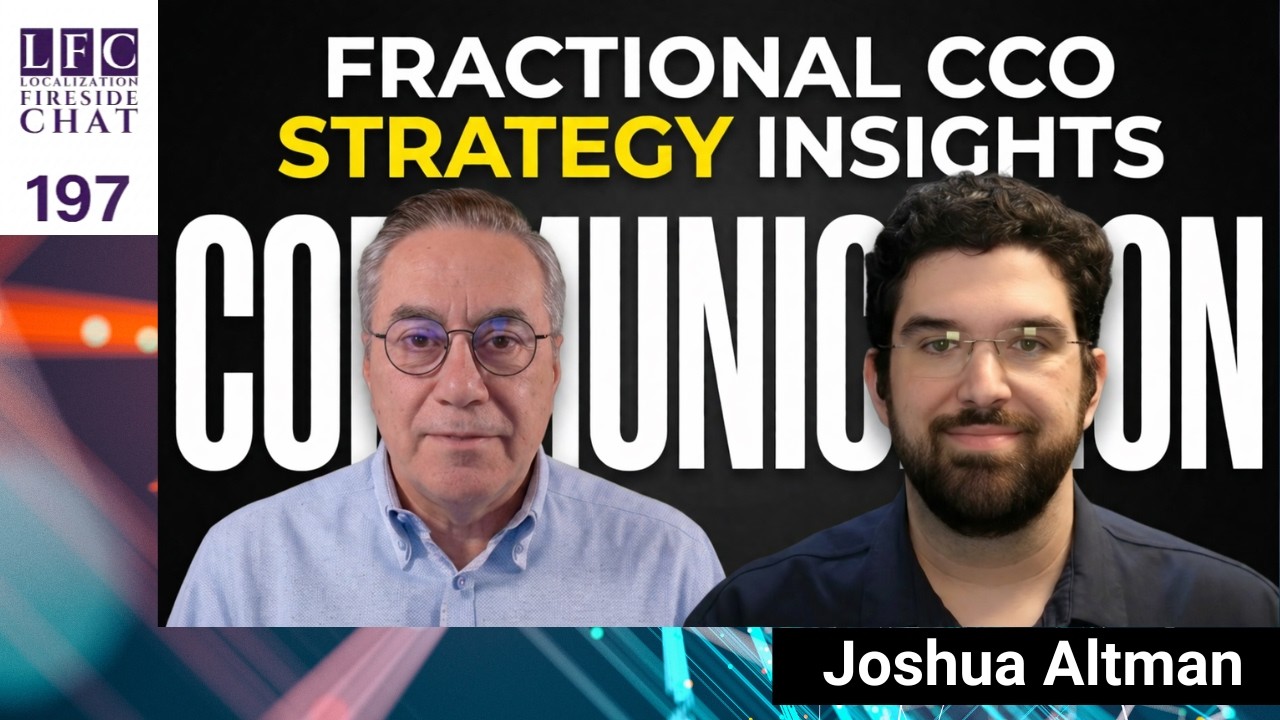
Most organizations think they have a marketing problem. Joshua Altman would tell you they have a communications problem, and those are not the same thing.
Joshua is the Founder and Managing Director of beltway.media, a Washington D.C.-based communications firm that helps brands, startups, and federal agencies cut through the noise. Before launching the firm, he spent five years as a multimedia journalist at The Hill newspaper, covering federal policy, election cycles, and everything in between. He did not plan to leave journalism for corporate work. It happened naturally as he saw a gap: small and medium-sized businesses desperately needed integrated communications expertise that was both accessible and affordable, and nobody was delivering it.
That gap became beltway.media, and that evolution became the foundation of our conversation on Episode 197 of the Localization Fireside Chat.
The CCO Is Not the CMO
One of the first things Joshua clarifies is what a Chief Communications Officer actually does, because most people get it wrong. The CCO is not a rebranded marketer. The role sits above individual campaigns, channels, and tools, and focuses on two core functions: shaping perception and building trust. Where the CMO drives revenue and the brand officer manages visual identity, the CCO owns the integrated view of how every message, internal and external, lands with every stakeholder.
This distinction matters more than ever. Joshua pointed to the speed of information today as the reason. An internal memo photographed on a phone can be on the internet in seconds. The idea that you can say one thing to your employees and something different to your customers is simply no longer viable. Consistency is not a communications best practice. It is a survival requirement.
The Know-Story-Narrative-Brand Framework
Joshua uses a three-tier framework with his clients that he calls know, story, narrative, and brand. Story is the facts, what actually happened. Narrative is how you answer questions about those facts. Brand is everything the audience interacts with, from your website to your press releases to the pens on the table at your next conference. All three must align, and they must align from the beginning, not as an afterthought once the logo is designed and the product is launched.
This is where he sees most organizations fail. They bring communications in at the brand stage, when the story and the narrative are already set, or worse, inconsistent. By then the damage is already done in layers they cannot easily undo.
Quality Over Volume, Every Time
The conversation turned to content, and Joshua made a point that every communicator needs to hear. Flooding your channels does not build an audience. It trains the algorithm to treat you as a low-value poster, and it trains your audience to ignore you. The platforms reward engagement, not frequency. If you are posting three times a week because someone told you that you have to, but two of those posts have nothing valuable to say, you are actively working against yourself.
What works is authenticity. Joshua noted that raw, real content from real people consistently outperforms polished, produced video because audiences have developed a finely tuned radar for content that was manufactured rather than felt. The car video phenomenon, someone talking directly to the camera on a drive, performs because it signals realness. That is the bar. Not Hollywood. Real.
The Four Languages of Communication
Joshua’s framework for how audiences receive messages covers four channels: what they read, what they see, what they hear, and what they experience. Most organizations focus on one or two and neglect the rest. The CCO function exists to ensure all four are working together and amplifying each other, rather than competing or contradicting.
For the localization and language services community, this framework hits close to home. Every time a brand adapts its message for a new market, it is making decisions across all four of those channels simultaneously. Translation handles the words. But the visual design, the audio tone, and the experiential context all carry meaning that survives or fails independently of the text. Joshua’s framework is a useful lens for any localization professional advising clients on global communications strategy.
Be the Signal, Not the Noise
Joshua closed the conversation with the line that became the title of this episode. Be the signal, not the noise. Communicate strategically, not voluminously. It is a simple directive that cuts against almost every instinct the content marketing industry has spent a decade reinforcing. Post less. Mean more. Show up when you have something worth saying, and when you do, make sure every channel, every language, every stakeholder, and every touchpoint tells the same story.
That is the job of the Chief Communications Officer. And after this conversation, it might be the job you realize you have been leaving unfilled.
CLOSING LINKS SECTION
Connect with Joshua Altman on LinkedIn: https://www.linkedin.com/in/joshuaialtman
Visit beltway.media: https://beltway.media
Watch Episode 197 on YouTube: https://youtu.be/AiBo0Qac-qk
Listen on Simplecast: https://localization-fireside-chat.simplecast.com/episodes/be-the-signal-not-the-noise-communications-strategy-with-joshua-altman
Connect with Robin Ayoub on LinkedIn: https://www.linkedin.com/in/robinayoub
Visit N49Networks: https://n49networks.com
Read the blog: https://robinayoub.blog
Book time with Robin: https://calendly.com/robin-ayoub/30min
 Robin Ayoub
Leave a comment