Meta Description: Talia Baruch, Founder of GlobalSaké and LocLearn, joins Robin Ayoub on the Localization Fireside Chat to explore global-first product strategy, sovereign AI infrastructure, multilingual AI at population scale, and the upcoming GlobalSaké Global-First Roundtable at Adobe HQ in San Francisco on April 30, 2026.
Most Companies Go Global. Very Few Are Built For It.
Most companies treat global expansion as a translation problem. Talia Baruch has spent 20 years proving it is a systems problem, and she has the receipts from Google, LinkedIn, and SurveyMonkey to back it up.
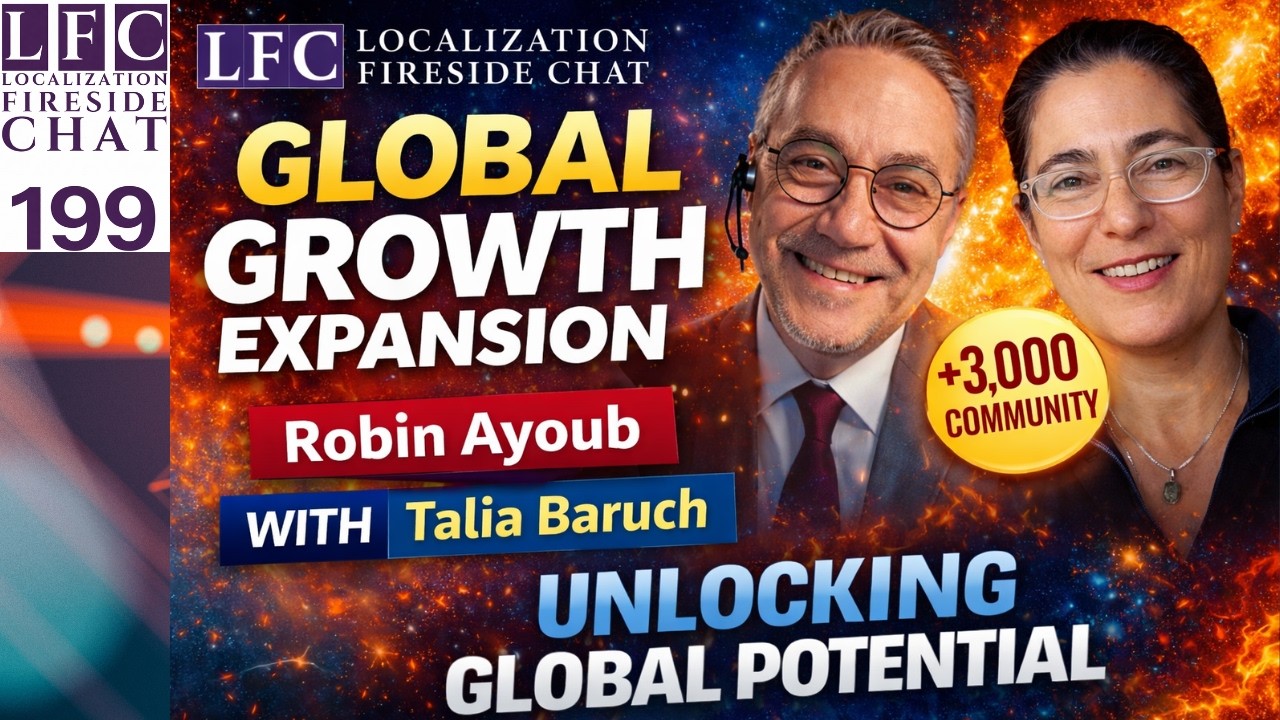
In Episode 199 of the Localization Fireside Chat, host Robin Ayoub sits down with Talia, Founder and CEO of GlobalSaké and LocLearn, to explore what it actually means to build a product for the world rather than translating it after the fact. The conversation covers sovereign AI infrastructure, multilingual AI at population scale, the global skills gap, and the upcoming GlobalSaké Global-First Roundtable at Adobe HQ in San Francisco on April 30, 2026.
The Gap That Launched GlobalSaké
Talia did not set out to build a community. She set out to solve a problem she kept running into at some of the biggest tech companies in the world. Localization teams were isolated. International insights arrived too late in the product cycle to make a real difference. The result was missed opportunities and feature gaps in markets that deserved better.
GlobalSaké, founded in 2017, was her answer. Not a consultancy, not a software platform, but a cross-functional community of 3,000+ tech leaders committed to getting global expansion right from the start. The premise was simple: when you bring together product researchers, UX designers, engineers, and localization experts early and often, you build products that actually fit the markets you are trying to serve.
What Global-First Actually Means
The phrase gets used loosely, so Talia is precise about what it means in practice. Global-first is not about translating content after launch. It is about designing the product, the architecture, and the team structure so that international markets are not an afterthought. That means internationalization baked into the platform from day one, cultural intelligence embedded in the research process, and international KPIs sitting alongside domestic ones in the product roadmap.
The traditional build-then-localize model, she argues, is not just inefficient. It is a strategic liability. By the time localization gets involved, the decisions that determine whether a product will land in a new market have already been made.
AI-Powered Human Solutions: Where the Balance Sits
Talia’s framing on AI is deliberate. She is not anti-AI. She is pro-balance. As organizations move toward AI-powered circular launches, the infrastructure challenge becomes more complex, not less. Autonomous, agent-driven systems need human quality governance alongside them. Auditability and trust are not optional features in a global deployment. They are the operating requirements.
Her recent writing on India’s BHASHINI platform sharpens this point. The real gap in most global AI deployments is not the model. It is the operating environment: multilingual training data, sovereign infrastructure, real-world latency, and production-grade deployment at population scale. BHASHINI, which completed its migration to sovereign Indian cloud infrastructure in February 2026, is now powering 500+ government websites, running 350+ optimized models across 36 text languages and 23 voice languages, and processing 15+ million inferences per day. That is not a lab demo. That is what multilingual AI looks like when it is forced to work under real constraints.
Markets as Teachers
One of the most provocative ideas in this episode is that the most constrained markets produce the most durable infrastructure thinking. India, with 22 constitutionally scheduled languages and 121 widely spoken languages, turned multilingual AI from a product feature into a systems challenge. The answers it produced are now a blueprint that the rest of the world can learn from.
Talia’s framework is memorable: Europe regulates, America innovates, China coordinates, India operationalizes inclusion. That last category is underrated. The next AI breakthrough may not come from the market with the biggest models. It may come from the market forced to make AI work across the most languages, the most users, and the hardest real-world constraints.
LocLearn and the Skills Gap
In 2023, Talia launched LocLearn to address a gap she saw widening every year. The localization and global product workforce was not keeping pace with the speed of change. AI was reshaping the production pipeline, but the professionals working inside that pipeline did not have the frameworks or the language to lead the conversation.
LocLearn offers certificate courses in International Product Management, taught by subject-matter experts in live interactive sessions. The goal is not just technical upskilling. It is building the cross-functional leadership capability that global-first product development actually requires.
The GlobalSaké Global-First Roundtable: April 30 at Adobe HQ
On April 30, 2026, GlobalSaké is hosting its Global-First Roundtable at Adobe’s headquarters in San Francisco. The event brings together cross-functional leaders from product, engineering, localization, and growth to work through the real challenges of global-first deployment in expert-led roundtable sessions.
Tracks include global-first infrastructure architecture and integrations, geo-cultural context as the intelligence layer for global readiness, and next-generation AI-powered infrastructure. If you are working in global product, international expansion, or multilingual AI, this is the room to be in.
Register and find full program details at https://www.globalsakegrowth.com/globalsake-2026.
Listen, Watch, and Connect
Listen to this episode on Simplecast | Watch on YouTube | Connect with Talia Baruch on LinkedIn | Follow Robin Ayoub on LinkedIn | Visit N49Networks | Book a 30-minute virtual coffee with Robin
https://localization-fireside-chat.simplecast.com/episodes/most-companies-go-global-very-few-are-built-for-it-talia-baruch-globalsake | https://youtu.be/4MHa3deJPOo | https://www.linkedin.com/in/taliabaruch/ | https://www.linkedin.com/in/robinayoub | https://n49networks.com | https://calendly.com/robin-ayoub/30min
Most Companies Go Global. Very Few Are Built For It. | Talia Baruch | GlobalSaké | LFC Ep. 199
 Robin Ayoub
Leave a comment