Search has quietly crossed a threshold.
What used to be a game of keywords, backlinks, and rankings is now something fundamentally different. Discovery is no longer controlled by search engines responding to human queries. It is increasingly controlled by AI systems interpreting intent, authority, and trust.
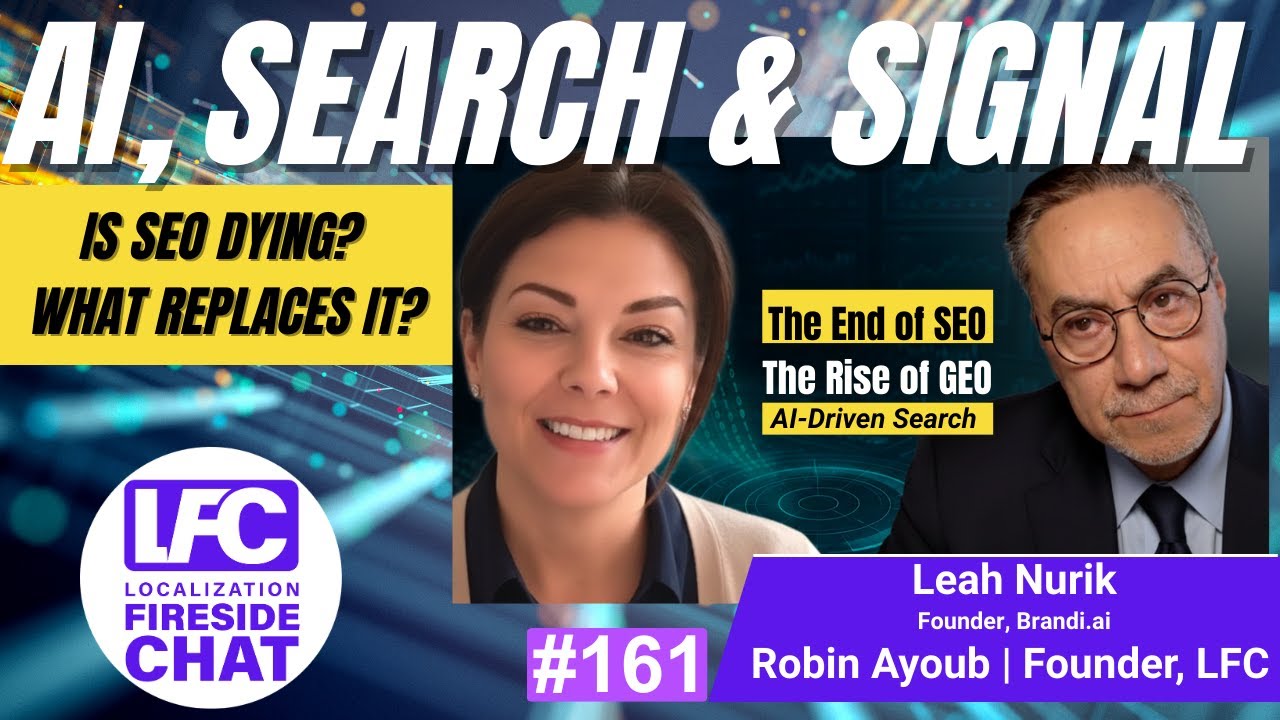
In this episode of Localization Fireside Chat, I sat down with Leah Nurik, Founder of Brandi.ai, to unpack what this shift really means and why many organizations are still optimizing for a world that no longer exists.
This was not a tactical SEO conversation. It was a structural one.
From SEO to GEO: What Actually Changed
Traditional SEO was built around a simple premise. Humans search. Algorithms rank. Pages compete.
AI-driven search breaks that model.
Large language models and generative search engines no longer just retrieve links. They synthesize answers. They decide which sources are credible enough to reference and which brands are invisible. That shift changes everything.
Leah introduced a concept that is quickly becoming unavoidable: Generative Engine Optimization, or GEO.
GEO is not about keywords. It is about how AI systems interpret signal.
That signal is formed from multiple inputs: earned media, third-party validation, consistent positioning, clarity of value, and external credibility. In many cases, your own website is no longer the primary source of truth.
This is where many brands get uncomfortable.
Why Keyword Thinking Is Failing Leaders
One of the strongest takeaways from the conversation was this: most organizations are still optimizing content for humans, while AI is now the first reader.
AI models do not reward repetition. They reward clarity and consistency across the open web.
You can no longer say whatever you want on your site and expect it to stick. AI systems cross-reference claims against external sources. If your positioning is unsupported, inconsistent, or inflated, it collapses under scrutiny.
In practical terms, this means:
Keyword stuffing no longer drives visibility
Owned content alone is insufficient
Authority must be validated externally
Discovery is intent-based, not query-based
This is not an evolution of SEO. It is a replacement layer.
Earned Media Is Now a Ranking Signal
One of the most important points Leah made is that AI search elevates earned media dramatically.
Mentions, citations, interviews, reputable coverage, and third-party validation now function as trust anchors. AI models use them to decide whether a brand is worth referencing in generated responses.
This changes how leaders should think about marketing investment.
The question is no longer how much content you publish. It is how credible your signal is across sources you do not control.
Visibility has shifted from production to validation.
Discovery Is Now About Intent
Another critical shift is the move from keyword matching to intent interpretation.
AI search engines do not simply respond to what users type. They infer what users are trying to solve. Brands that align clearly with those problem spaces surface. Brands that rely on vague positioning disappear.
This is why GEO is fundamentally strategic.
It forces leaders to ask harder questions:
What problem are we actually known for solving?
Is that reflected consistently across third-party sources?
Would an AI system understand our value without reading our website?
If the answer is no, visibility is already eroding.
What Leaders Need to Rethink Now
This conversation was not about fear. It was about alignment.
AI-driven discovery rewards organizations that already have clarity, credibility, and coherence. It punishes those that rely on volume, noise, or outdated growth tactics.
For founders, executives, and operators, the implications are clear:
SEO tactics alone are no longer defensible
Brand signal must be intentional and external
Discovery is now mediated by machines
Trust is interpreted, not declared
GEO is not a trend. It is a structural shift in how visibility works.
Final Thought
Search did not die overnight. But control changed hands.
We are moving from a world where humans decided what to click to one where AI decides what gets shown. That changes how brands are built, how authority is earned, and how relevance is maintained.
If your strategy still assumes that keywords equal visibility, you are already behind.
🎧 Listen to the full episode on Simplecast:
https://localization-fireside-chat.simplecast.com/episodes/the-end-of-seo-how-ai-and-geo-decide-what-gets-seen
▶️ Watch the full conversation on YouTube:
https://youtu.be/5a8BsoWpHh4
Disclaimer:
The views expressed in this episode are those of the host and guest and do not necessarily reflect the views of their respective organizations. This content is for informational purposes only and does not constitute professional or legal advice.
 Robin Ayoub
This frames the shift in a helpful way because it moves the conversation from tactics to visibility mechanics. Search is no longer only about ranking pages but about how information is selected, summarized, and surfaced by intelligent systems. That raises the bar for clarity, structure, and credibility in content creation. The future is less about gaming algorithms and more about being the most understandable and trustworthy source in the system.
LikeLike