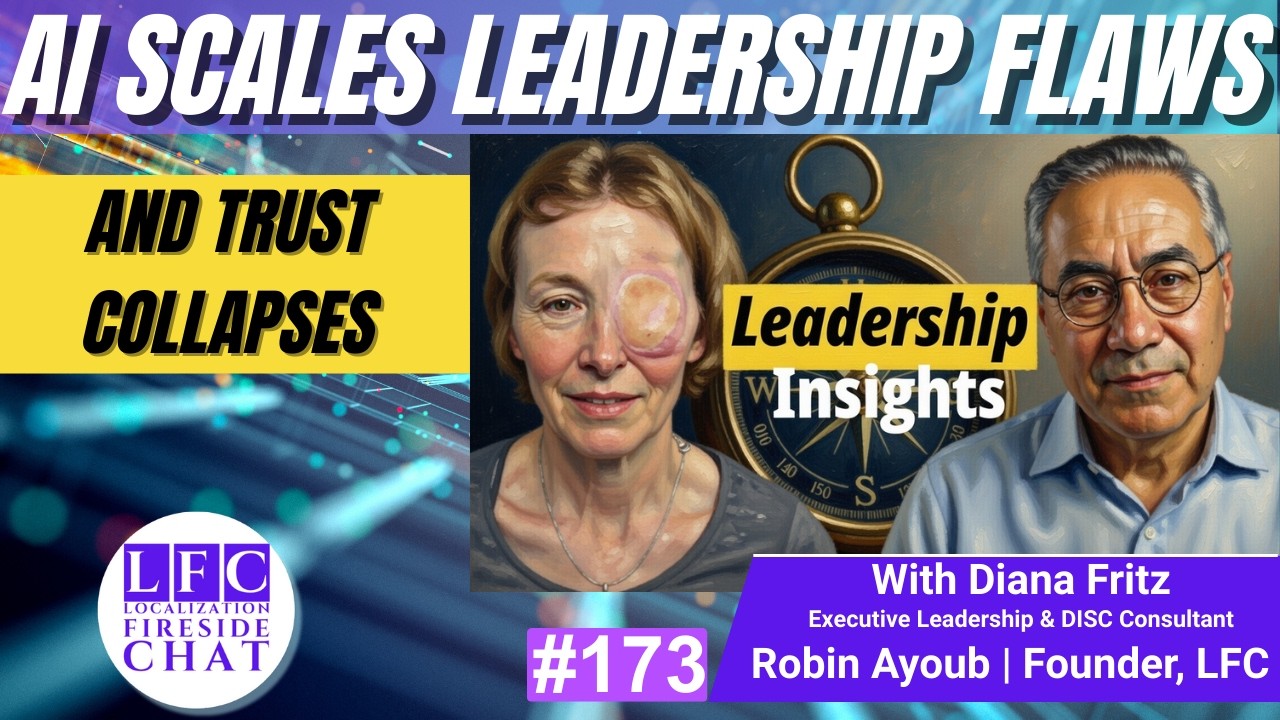
AI Scales Leadership Flaws: Why Trust Collapses Under Pressure
In Episode 173 of the Localization Fireside Chat, I sat down with Diana Fritz for a grounded conversation about what actually breaks first when pressure rises inside an organization.
It is not strategy.
It is not systems.
It is not AI.
It is trust.
And trust collapses when communication fails.
Watch the full episode here:
YouTube: https://youtu.be/Sxh5KY8EXfA
Diana Fritz brings more than 25 years of executive leadership experience across operations, HR, business planning, and organizational development. She is also a Certified DISC Consultant working directly with leadership teams to uncover blind spots in communication, influence, and accountability.
This conversation moves beyond theory. It addresses the human dynamics that determine whether organizations scale effectively or fracture under pressure.
AI Is Not the Primary Risk
Organizations today are accelerating AI adoption, digital transformation, and automation at an unprecedented pace. Many leaders assume the primary risk lies in the technology itself.
Diana challenges that assumption.
AI does not create leadership weaknesses. It amplifies them.
If communication is unclear, AI accelerates confusion.
If authority replaces influence, AI magnifies disengagement.
If trust is fragile, AI exposes it.
Technology scales behavior. It does not fix it.
Communication Is the Real Vulnerability
One of the most important insights from our discussion is simple: when communication gaps appear, negativity fills the space.
Leaders frequently underestimate how much context their teams require during change. Strategic shifts, restructuring, new tools, or new priorities are often announced without sufficient framing.
When employees do not understand the reason behind change, they create their own narrative. That narrative is rarely optimistic.
Leadership credibility is built on clarity. The ability to communicate change with transparency, consistency, and alignment with core values determines whether trust strengthens or erodes.
Communication is not a soft skill. It is structural.
Authority Versus Influence
Another key distinction we explored is the difference between leading through authority and leading through influence.
Authority commands compliance.
Influence builds commitment.
Under pressure, leaders often default to control. Decisions become centralized. Dialogue narrows. Transparency decreases.
Short term, that may feel efficient. Long term, it fractures trust.
Influence-driven leadership requires intentional listening, behavioral awareness, and emotional discipline. Leaders must understand how their communication style lands, especially under stress.
DISC and Leadership Blind Spots
DISC is often misunderstood as a personality label. In reality, it is a behavioral lens.
It helps leaders understand how they naturally respond to pressure, conflict, and decision-making.
For example:
High D leaders may prioritize speed over clarity.
High I leaders may over-communicate without structure.
High S leaders may avoid necessary conflict.
High C leaders may delay decisions in pursuit of precision.
None of these patterns are inherently negative. But under pressure, unexamined tendencies create friction.
Self-awareness at the executive level directly impacts organizational trust.
Resilience Without Performance
We also discussed resilience, not as a branding exercise, but as leadership discipline.
Resilience is composure under uncertainty.
In rapidly changing environments, teams observe leadership behavior closely. Tone, pacing, transparency, and emotional regulation matter more than polished messaging.
Resilient leaders create stability without pretending certainty. They communicate honestly about risk while reinforcing shared purpose.
That balance builds trust.
The Real Leadership Question
If AI is scaling everything inside your organization, the question becomes simple:
What behaviors is it scaling?
Clear communication or confusion?
Influence or control?
Trust or skepticism?
Leadership is no longer shielded by hierarchy or information asymmetry. In distributed and AI-enabled environments, behavior becomes visible faster and spreads further.
The organizations that will thrive are not those with the most advanced tools, but those with disciplined leadership communication.
To explore more conversations on AI, leadership, and global business transformation, visit:
https://www.l10nfiresidechat.com
Disclaimer:
The views expressed in this episode are those of the participants and are intended for educational and informational purposes only. Localization Fireside Chat provides a platform for open dialogue and does not endorse specific professional advice.
 Robin Ayoub
Leave a comment