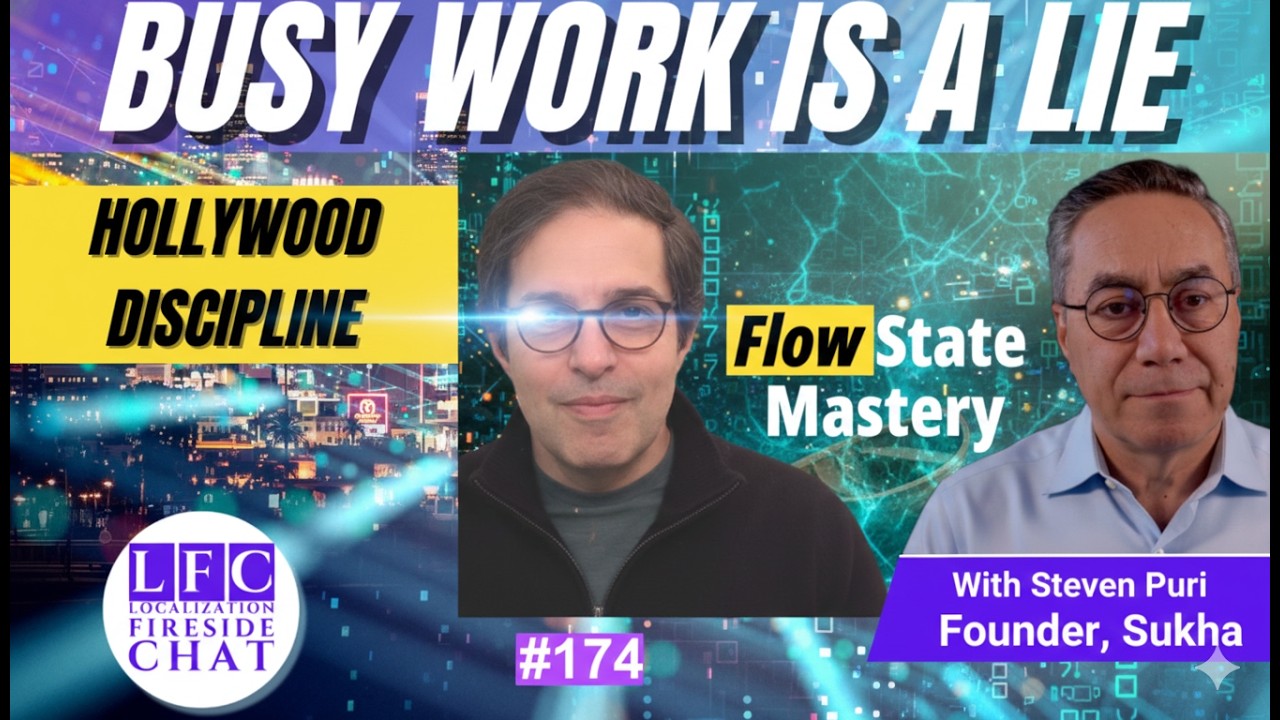
Localization Fireside Chat Episode 174
Watch the full interview: https://youtu.be/5m2dzQaDLgc
In this episode of the Localization Fireside Chat, host Robin Ayoub talks with Steven Puri, Founder of The Sukha Company and a former Hollywood film executive, about focus, discipline, and what it really takes to get meaningful work done in today’s world.
Steven’s story bridges two worlds: the high-stakes, deadline-driven environment of Hollywood production and the distributed, distraction-heavy landscape of modern knowledge work. What unites them is this truth: busy work feels like progress, but only deep focus produces results.
This conversation isn’t about productivity hacks or hustle culture. It’s about systems and practices that create focus, intentional work flow, and long-term output.
From Hollywood Sets to Focus Systems
Steven spent years inside major film studios. In film production, there is no tolerance for distraction or inefficiency — deadlines and budgets demand real progress, not just activity. That sensibility shaped how he thinks about work, and it ultimately led him to build Sukha — a platform designed to help people enter deep focus deliberately rather than stumble into it by accident.
Sukha combines structure, intentional sound environments, and task prioritization to help teams and individuals work with attention, not against distraction.
Why “Busy Work” Is a Lie
One of the central themes of the conversation is this: being busy is not the same as producing value. Modern work environments — especially remote or hybrid setups — are full of noise: meetings, notifications, status updates, multitasking, and activity that feels urgent but isn’t.
Steven breaks down why this happens:
People confuse motion with progress
Teams reward responsiveness over real output
Leaders signal priorities implicitly through what they measure
Steven argues that flow state and deep work are not luxuries. They are competitive advantages.
What Deep Work Really Means
Deep work isn’t a buzzword. It’s defined by extended periods of uninterrupted concentration on cognitively demanding tasks. It’s the difference between checklists and breakthroughs.
In practical terms, Steven describes:
Prescribed focus windows that save more time than they cost
Environmental cues that reduce cognitive switching
How priority framing helps people say “no” to noise
The term “flow state” gets used a lot in productivity circles. Here, Steven frames it not as a mystical experience, but as something that emerges when conditions are intentional — not accidental.
Leadership Lessons from Film Production
Hollywood taught Steven a lot about how to manage creative, complex projects. The skills translate into any discipline where outcomes matter more than activity.
Key takeaways include:
Leaders must declare a clear mission and values
Discipline does not require punishment — it requires structure
Trust matters more than surveillance in remote teams
Systems beat motivation every time
His perspective flips the common management script: focus is not enforced, it is cultivated.
Remote Work, Focus, and Trust
Remote and hybrid teams struggle with focus not because people are lazy, but because environments are poorly designed for deep work.
Steven highlights:
The role of trust in performance
How teams can build routines that protect focus
Why time-boxing and boundaries beat busy calendars
This is a leadership challenge, not a technology one.
How Sukha Helps People Actually Get Work Done
Sukha was built to help people intentionally enter focus sessions and stay there. The platform combines task priorities, structural cues, and soundscapes designed to reduce interruption and increase cognitive engagement.
“Focus everyday looks different,” Steven says. But with intention and structure, deep work becomes the default, not the exception.
Key Takeaways
Busy work feels productive but creates no real value
Focus and flow are supported by systems, not motivation
Leadership must clarify priorities and protect teams from noise
Remote work requires intentional design to support deep work
High output is a function of environment, culture, and structure
Connect with Steven Puri
Website: https://www.thesukha.co
Media Resources: https://www.thesukha.co/media
Watch the Full Episode
About Localization Fireside Chat
Localization Fireside Chat explores real lessons from people building products, teams, and systems that scale in complex global work environments.
Learn more: https://www.l10nfiresidechat.com
N49Networks: https://www.n49networks.com
 Robin Ayoub
Leave a comment