The global language services market is valued between $70 to $80 billion.
It powers healthcare systems.
It supports global commerce.
It enables legal frameworks.
It fuels AI training data.
It localizes the world’s digital infrastructure.
And yet, despite its economic weight and strategic importance, the language industry operates without a unified global governing body.
No neutral authority.
No coordinated global voice.
No multi-stakeholder structure representing providers, buyers, professionals, and technology leaders at once.
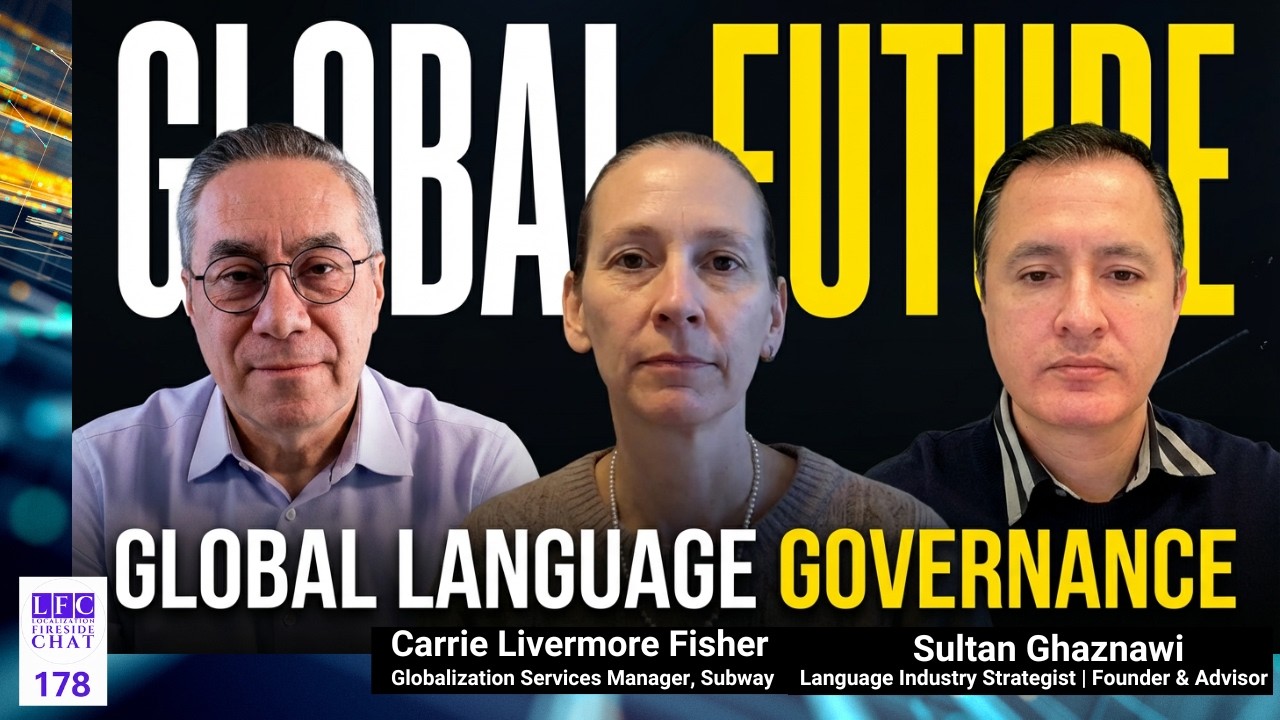
In this episode of the Localization Fireside Chat, I sat down with Carrie Livermore Fischer and Sultan Ghaznawi to ask a simple but uncomfortable question:
What if fragmentation is now holding us back?
🎥 Watch the full episode on YouTube:
https://youtu.be/0dfs-hW387U
🎧 Listen on Simplecast:
https://localization-fireside-chat.simplecast.com/episodes/what-if-the-80b-language-industry-had-a-global-authority
A $80 Billion Industry Without a Unified Voice
The language industry is filled with talent. Conferences are packed. Associations are active. Regional and national organizations are thriving.
But they operate in silos.
Today, dozens of associations exist globally. Some represent translators. Others represent language service providers. Some focus on interpreting. Others on localization technology. Many operate at the national level. Few operate across borders with neutral authority.
The result is fragmentation.
Fragmentation weakens advocacy.
Fragmentation dilutes standards.
Fragmentation slows coordinated innovation.
Fragmentation limits our influence in global policy conversations.
Other industries of similar scale built governance models.
Aviation did.
Finance did.
Internet governance did.
Why not us?
Is Governance About Control — Or Coordination?
The conversation quickly moved beyond the surface question of “Should we create a governing body?”
The deeper issue is this:
What is the industry optimizing for?
If we are optimizing for translation volume, then fragmentation may not matter.
But if we are optimizing for:
• Consumer protection
• Ethical AI deployment
• Global standards
• Long-term trust
• Value longevity
Then governance becomes strategic infrastructure.
Carrie emphasized the need to focus on delivering real value to end-users, not simply on translation as a transactional output.
Sultan challenged the industry’s internal politics and protective silos, arguing that coordination requires maturity and long-term thinking.
The tension is clear:
Are we building institutions — or are we simply hosting events?
The AI Inflection Point
Digital globalization is accelerating.
AI is reshaping how content is produced, translated, distributed, and consumed. Machine translation, LLMs, and AI-driven workflows are redefining the value chain in real time.
Yet governance frameworks for AI in language services remain fragmented.
There is no unified ethical standard.
No coordinated consumer protection framework.
No shared position on AI integration across the ecosystem.
If the industry does not coordinate around AI governance, others will define the standards for us.
This is no longer a theoretical debate.
It is a structural inflection point.
Redefining the Value of Translation
One of the most important insights from this conversation is that the industry often defines itself too narrowly.
Translation is not the product.
Trust is the product.
Clarity is the product.
Risk mitigation is the product.
Market access is the product.
Longevity of content is the product.
If the industry reframes its identity around value creation instead of linguistic output, governance becomes a natural evolution rather than a bureaucratic ambition.
A unified voice would not eliminate diversity.
It would coordinate it.
What Would a Global Model Look Like?
No one is suggesting a rigid, centralized authority.
The more realistic model would resemble a multi-stakeholder framework:
• Language service providers
• Enterprise buyers
• Professional linguists
• Technology platforms
• AI experts
• Policy voices
A neutral body focused on standards, advocacy, consumer protection, and technological alignment.
The alternative is continued fragmentation.
And fragmentation at scale eventually becomes vulnerability.
The Real Question
The episode does not pretend to have all the answers.
Instead, it leaves us with the right question:
If we are a global industry powering global systems, why do we not operate with global coordination?
This conversation is an invitation.
To association leaders.
To founders.
To enterprise buyers.
To policymakers.
The industry is large enough.
The stakes are high enough.
The AI transition is urgent enough.
Now the question is whether we are ready to mature structurally.
🎥 Watch the full episode:
https://youtu.be/0dfs-hW387U
🎧 Listen on Simplecast:
https://localization-fireside-chat.simplecast.com/episodes/what-if-the-80b-language-industry-had-a-global-authority
🌐 Learn more about Localization Fireside Chat:
https://www.l10nfiresidechat.com
🌐 Explore N49Networks:
https://www.n49networks.com
Disclaimer
The views expressed by guests on Localization Fireside Chat are their own and do not necessarily reflect the views of their organizations or affiliates. This conversation is intended to spark thoughtful discussion within the language and localization community.
 Robin Ayoub
Leave a comment