Most people are not afraid of AI. They are afraid of what they think AI is.
That distinction matters. And it is exactly where this conversation begins.
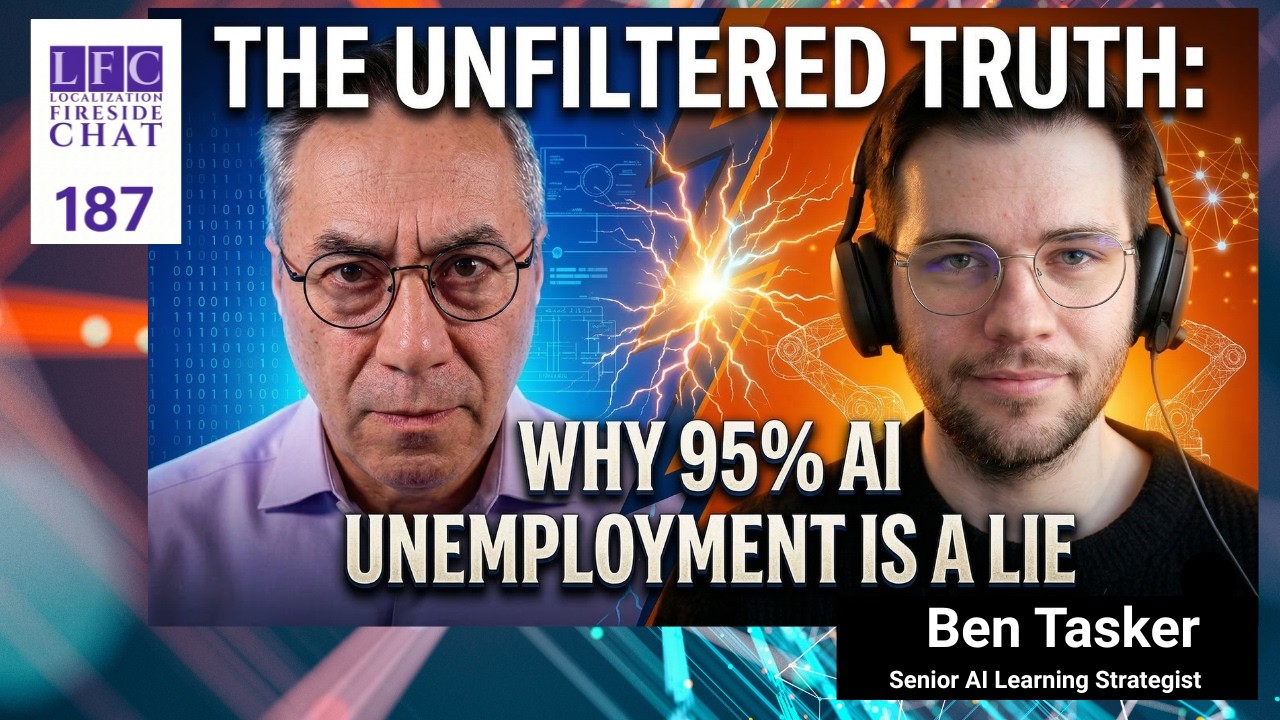
In Episode 187 of the Localization Fireside Chat, I sat down with Ben Tasker, Senior AI Learning Strategist and leader of a Data and AI Academy currently upskilling over 36,000 professionals at National Grid. Ben’s journey into AI was not planned. It started with a notepad, a doctor’s office, and the realization that data-driven decisions carry real human consequences — and that the humans on the receiving end of those decisions are the ones who matter most.
This episode also marks a milestone. Three years in, and over 100,000 downloads since November 2025. Thank you to every listener and viewer who has been part of this journey.
Watch the full episode: https://youtu.be/XPvKNifB-64
Listen on Simplecast: https://localization-fireside-chat.simplecast.com/episodes/ai-wont-take-your-job-but-ignoring-it-will-ben-tasker
AI ADOPTION IS A PEOPLE PROBLEM, NOT A TECHNOLOGY PROBLEM
Ben’s first role out of school was in hospital administration. He was tasked with tracking patient volumes across affiliated clinics. The data was not in a database. It lived on notepads. He had to count by hand.
The stakes were real. A wrong number could mean a practice closure. A community losing access to care. That experience taught him that the human side of data-driven decisions is where the real work lives — not in the algorithm, but in the person reading the output and acting on it.
That insight carries directly into what he does now. Across every organization he has worked with, the barrier to AI adoption is never the technology. It is change management. It is the employee who says, I am not training this thing to take my job. It is the executive who frames AI as a cost reduction tool instead of a capability multiplier. It is the organization that drops a tool into one department and calls it a transformation.
THE AI BETWEEN TIMES
Ben has a phrase for where we are right now: the AI between times.
We are not fully out of the old way of working. Some firms still use typewriters. We are not yet into the future the headlines promise. We are in the awkward middle, where AI is already embedded in Microsoft, Google, Adobe, and the phone in your pocket — but most of the workforce has not meaningfully engaged with it.
That gap is not going to close on its own. The organizations closing it intentionally, deliberately, and with respect for the human element are the ones pulling ahead.
HOW TO TRAIN 36,000 PEOPLE WITH A TEAM OF FIVE
At National Grid, Ben leads an AI upskilling academy for over 36,000 employees with a core team of four to five people. The approach starts with a skills taxonomy. Every role is mapped to skill levels organized into three tracks: beginner, intermediate, and advanced. No one sits through a course that was not built for them.
What made the biggest difference was not the curriculum. It was the change management layer underneath it. Going into each department, listening to real problems, and building lessons around those problems instead of arriving with a pre-packaged deck.
Ben described visiting a call center where employees had transcripts of every customer interaction and a clunky legacy system for managing them. He showed them how two prompts could analyze sentiment, summarize the call, flag escalation needs, and generate training notes. Three people told the rest of the department. Adoption spread on its own.
That is the pattern. Find the task people hate. Show them AI can fix it. Let them tell each other.
WHAT WALMART GOT RIGHT THAT MOST COMPANIES GET WRONG
Walmart gave every employee access to an AI tool and told them to use it — inside work and outside of it. No mandatory training. No forced curriculum. Just access and trust.
Employees started using it to plan meals, design rooms, and organize their personal lives. That saved them time and energy at home, which made them better at work. Internal adoption numbers were well beyond what anyone projected.
Ben’s term for companies that do the opposite — rushing to cut headcount based on AI hype before tools are even tested — is an AI whoopsie. Many of those organizations ended up rehiring at a higher cost than before. Transformation takes 24 months, not 24 days.
THE 95% UNEMPLOYMENT MYTH
The most persistent fear in the AI conversation is that the technology will hollow out the workforce. Ben’s answer is direct: the 95% unemployment figure being thrown around is not just wrong, it is backwards. His counter is 95% employment.
Not because AI will not change roles. It will. But the change looks less like replacement and more like elevation. Knowledge workers using AI get more done. Radiologists with machine learning catch more. Call center staff with AI tools handle more complex cases. And entirely new job categories — ones we do not have names for yet — are emerging from the technology itself.
He also made a point that rarely gets enough attention: even if you are resistant to AI, learning about it is still worth your time. The jobs that will remain premium — teaching, healthcare, skilled trades — are human-skills-based roles. Right now is the best time to build those skills alongside your AI literacy.
RESPONSIBLE AI: THREE PILLARS BEFORE ANY TOOL GOES LIVE
Ben is direct about the sequence: responsible AI governance has to come before deployment, not after. Not as a compliance checkbox. As a living framework.
His recommendation is a steering committee with representation from every department. Everyone needs a voice in what tools get used, how they are used, and who is accountable when something goes wrong. He keeps the framework to three pillars — because any more than three and people will not remember them — but the exact pillars have to be built by the organization, not imported from a template.
The starting questions matter. What happens if data is breached through an AI system? Who is responsible if an employee misuses a tool? These are not theoretical. They are happening now.
LIGHTNING ROUND
One AI skill everyone should build: Knowing how to validate AI output. Not just use it — verify it.
One AI myth that needs to die: 95% unemployment. The real number is closer to 95% employment.
One industry about to be truly disrupted: The creative arts and acting, especially given recent legal developments around AI-generated content and copyright.
One habit to build with AI: Learning agility. Use it for fun. Make a grocery list. Plan a workout. You do not need an account or a course. Just start.
This conversation is worth the full 55 minutes. Ben does not deal in hype. He deals in results, frameworks, and the hard-won lessons of someone who has actually moved the needle at scale.
Watch the full episode: https://youtu.be/XPvKNifB-64
Listen on Simplecast: https://localization-fireside-chat.simplecast.com/episodes/ai-wont-take-your-job-but-ignoring-it-will-ben-tasker
Subscribe to the blog for 2-minute episode summaries: https://www.robinayoub.blog
 Robin Ayoub
Leave a comment