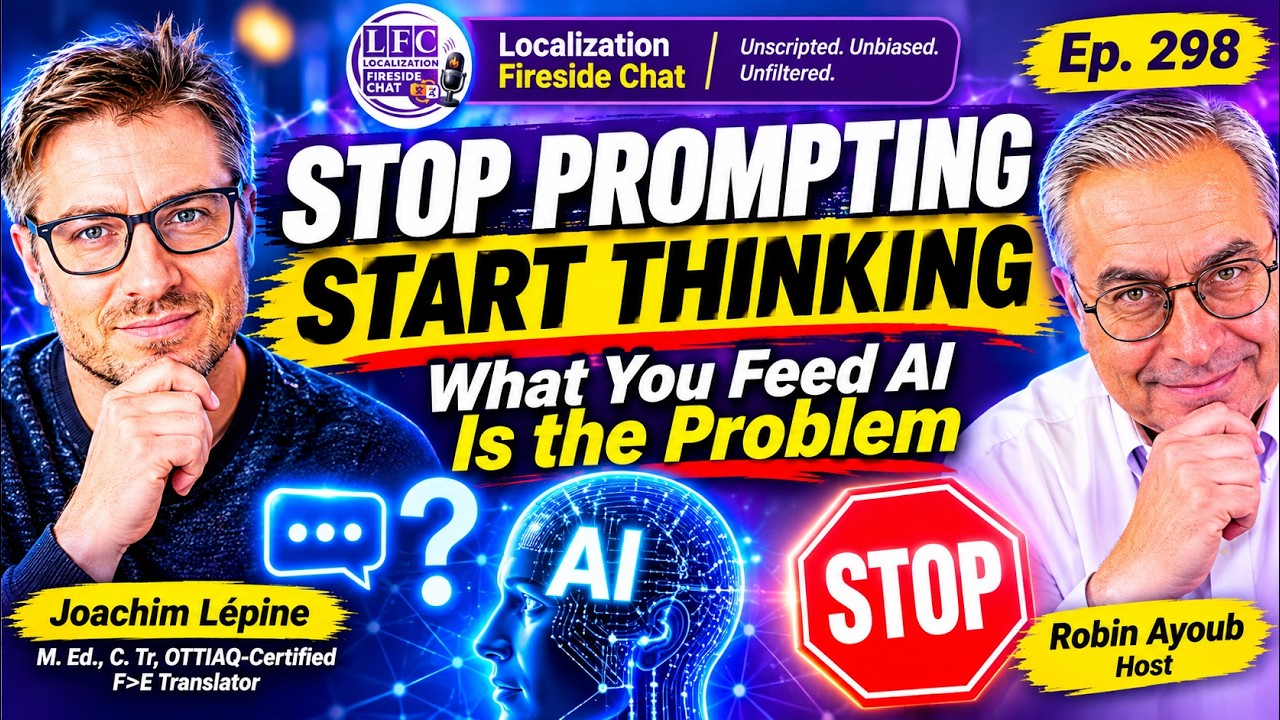
The Human Behind the Framework
Joachim Lépine did not arrive in translation through the expected door. He started as a music teacher, moved to Quebec, fell in love with French, and discovered that the comparative stylistics of two languages felt, as he put it, like a different kind of music. That backstory matters because it explains why his entire professional philosophy is rooted in how people learn rather than simply what they produce. Fifteen years teaching at the University of Sherbrooke and a master’s in education later, he co-founded LION Translation Academy with celebrated literary translator Anne-Marie Boulanger, and the mission has never really been about software or workflow optimization in the conventional sense. It has been about helping translators feel genuinely good about the work they do, which Joachim frames as an emotional deliverable rather than a marketing afterthought. His own path through social anxiety and low self-esteem is not incidental to that framing. He told Robin he built his confidence one brick at a time from ground zero, and that experience now shapes every coaching session and workshop he runs for translators who struggle to put a proud post on LinkedIn or walk into a discovery call without apologizing for their rates.
YouGPT and the Amplifier Problem
The central argument of Joachim’s book YouGPT is deceptively simple: AI is an amplifier, and amplifiers do not care whether the signal they receive is strong or distorted. The book grew out of a single jarring moment when a friend suggested asking ChatGPT whether Joachim should enroll in an MIT executive AI program, and that moment crystallized everything. If we stop checking in with ourselves before we reach for the tool, we quietly cede the judgment that makes the tool worth using in the first place. In practice, Joachim applies this upstream thinking to his own translation workflow by extracting specialized terminology with SynchroTerms before he opens any AI-assisted environment, ensuring that ninety to ninety-five percent of the correct terms are locked in before the engine ever touches a sentence. The result is that the AI stays a step in the process rather than the process itself, a distinction he returns to repeatedly throughout the conversation. He also raised a subtler risk: the moment we lose awareness of when we have stopped trusting our own judgment and started trusting the model instead. Research is now backing that concern up, and for translators working on high-stakes documents, a single wrong word in a guidebook going to every high school across Canada, to use his own live example, is precisely the kind of quiet failure that never makes the funny-anecdote list but causes real harm.
What the Industry Still Gets Wrong
Joachim was direct about the structural problems facing the profession. The per-word pricing model created a race to the bottom almost by design, and debates about whether to switch to hourly or project-based billing tend to miss the deeper issue. His counterintuitive position is that no unit will ever be perfect, and the energy spent arguing about pricing models would be better invested in relationship-building conversations with clients who barely glance at the invoice line once trust is established. He also pushed back on the idea that associations alone can carry the advocacy load. His own response has been to go on the radio, do television, and frame the conversation around adapting to AI rather than around translation specifically, because every profession is wrestling with that question right now and translators have been doing it for over a decade. That, he argued, is a genuine leg up that the industry has not fully claimed. For individual translators anxious about relevance, his most concrete advice was to specialize, pursue a micro-credential in a subject area they already find interesting, and stop waiting for external validation before speaking up. A free HubSpot marketing certification or a Google AI certificate will not transform someone’s career overnight, but it sends the right signal to the market and, more importantly, to the translator themselves.
This conversation is exactly the kind of exchange that travels well beyond the localization bubble, and you will want to hear the full version. Watch on YouTube if you want to catch Joachim’s delivery and the moments where Robin pushes past the prepared answer, or Listen on Simplecast if you prefer audio on your own schedule. You can also take every episode of the Localization Fireside Chat with you by downloading the free LFC app on the App Store or Google Play.


Leave a Reply