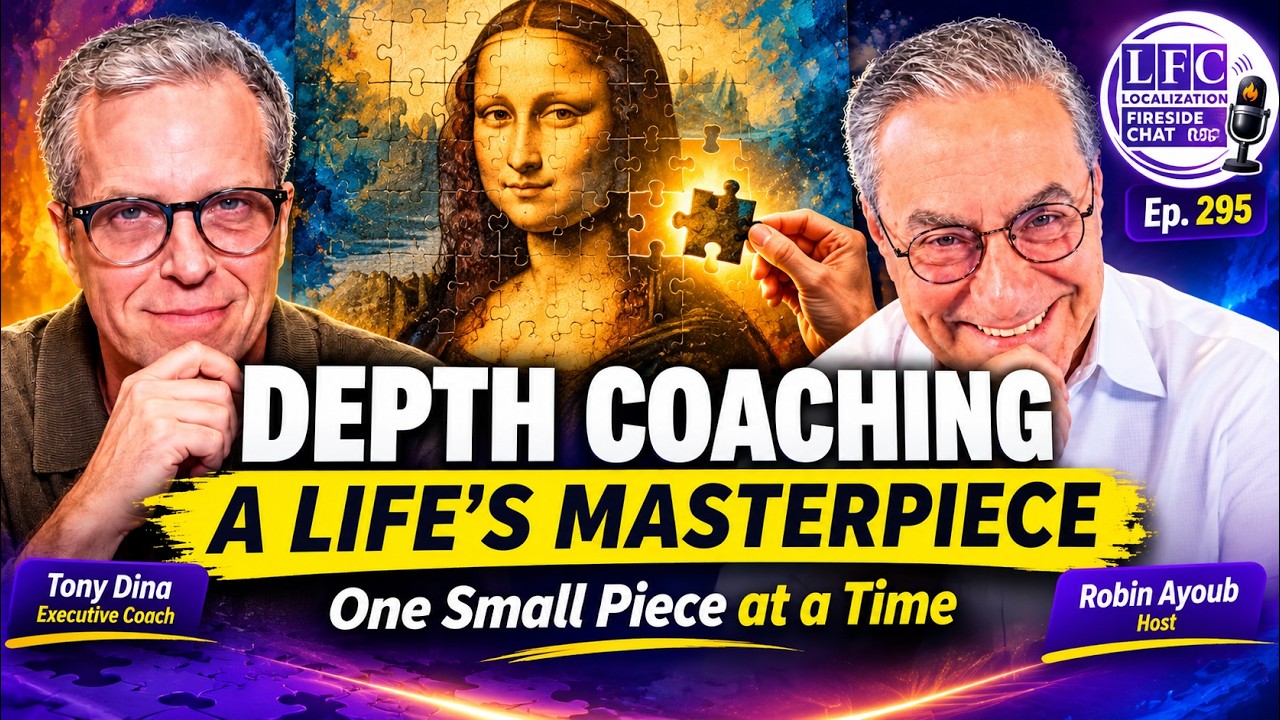
The Moment the Operating System Stops Working
Tony Dina spent close to three decades inside technology, eventually leading AI and data analytics work at Dell Technologies, and then he walked away. Not dramatically, not impulsively. He came back from a meditation retreat, recognized what he called incoherence, and built a twelve-month roadmap out. The story he told Robin in episode 295 is not really about leaving a job. It is about the quieter, harder thing: realizing that the patterns that made you successful in your forties are the same patterns that will hollow you out in your fifties. He had pruned himself to fit the corporate system for so long that the parts he had put away, assertiveness, creative identity, the ability to sit with conflict without flinching, had become strangers. The career pivot was not the destination. It was the first honest look at the canvas.
What makes Tony’s perspective unusual is the credential behind the criticism. He was not a philosopher looking in from the outside. He was building the AI systems. He watched from the inside as teams handed over their judgment along with the task, as senior leaders looked at the productivity math and said the algorithm tells us to make more calls, so make more calls. The result was not better relationships with customers. It was noise. His distinction between productivity and capacity is one of the sharpest ideas in this episode: AI deployed to do the same thing faster is a productivity play, and it usually produces diminishing returns. AI deployed to open up entirely new capabilities, new ways of showing up, new things you could not do before, that is a capacity play, and it is where the real leverage lives.
Why Depth Coaching Is Not Executive Coaching
Tony chose the title depth coach deliberately, and the distinction matters. Conventional executive coaching tends to work on behavior: set goals, build frameworks, track outputs, have the crucial conversation. Depth coaching, rooted in Jungian psychology, starts from a different premise. The external irritant is pointing to something internal. If a person or a situation keeps triggering you, the work is not to manage the trigger. The work is to find what you repressed. Jung called this the shadow, and Tony gave Robin a candid example from his own life. His father was assertive to the point of harshness, and Tony spent decades promising himself he would never be that way. What he actually did was put assertiveness itself in a box. The shadow is not the dark version of you. It is the discarded version, and it contains genuine capability waiting to be recovered. His company, Crucial Canvas, takes its name from exactly this idea: the masterpiece you were meant to create is your life, and most people are only working on a fraction of the canvas.
What AI Cannot Reach and Why That Changes Everything
The conversation moved into territory that will stay with anyone who works at the intersection of technology and human judgment. Tony referenced Carl Jung’s concept of the collective unconscious, the shared psychological inheritance that shows up across cultures that have never made contact, the same archetypes appearing in myths, dreams, and stories across every civilization. It is the reservoir that inspired Joseph Campbell’s hero’s journey framework, which then shaped Star Wars, which Disney now runs new scripts against algorithmically to predict audience response. The irony is rich: a studio uses an algorithm to measure how well a story maps to something that exists beneath the reach of algorithms. Tony’s point is that AI can infer your emotion from the words you choose. It cannot imagine riding a beam of light. Einstein’s theory of relativity began as a daydream, not a calculation. The lived experience, the values, the capacity to pick yourself up after failure, the ability to walk into someone’s office because you remember it is their daughter’s recital and you brought a card, that is human judgment. It is not replicable, and it is not at risk of being replaced. The risk Tony names is different and more urgent: not that AI will become conscious, but that people will not.
This is one of those conversations that keeps working on you after it ends. If you want to watch Tony and Robin go deep on identity, shadow work, and the judgment problem inside modern AI, Watch on YouTube. If you prefer audio, Listen on Simplecast and take it with you. You can also get every episode of the Localization Fireside Chat through the free LFC app on the App Store or Google Play.


Leave a Reply