Are You Hiring in Ontario? Navigating Bill 149 with Julie Alleyn
Most business owners do not think about HR until something goes wrong. A termination handled badly. A job posting that violates a law that came into effect four months ago. A manager who has quietly destroyed their team’s trust without ever raising their voice. By the time the problem is visible, it is already expensive.
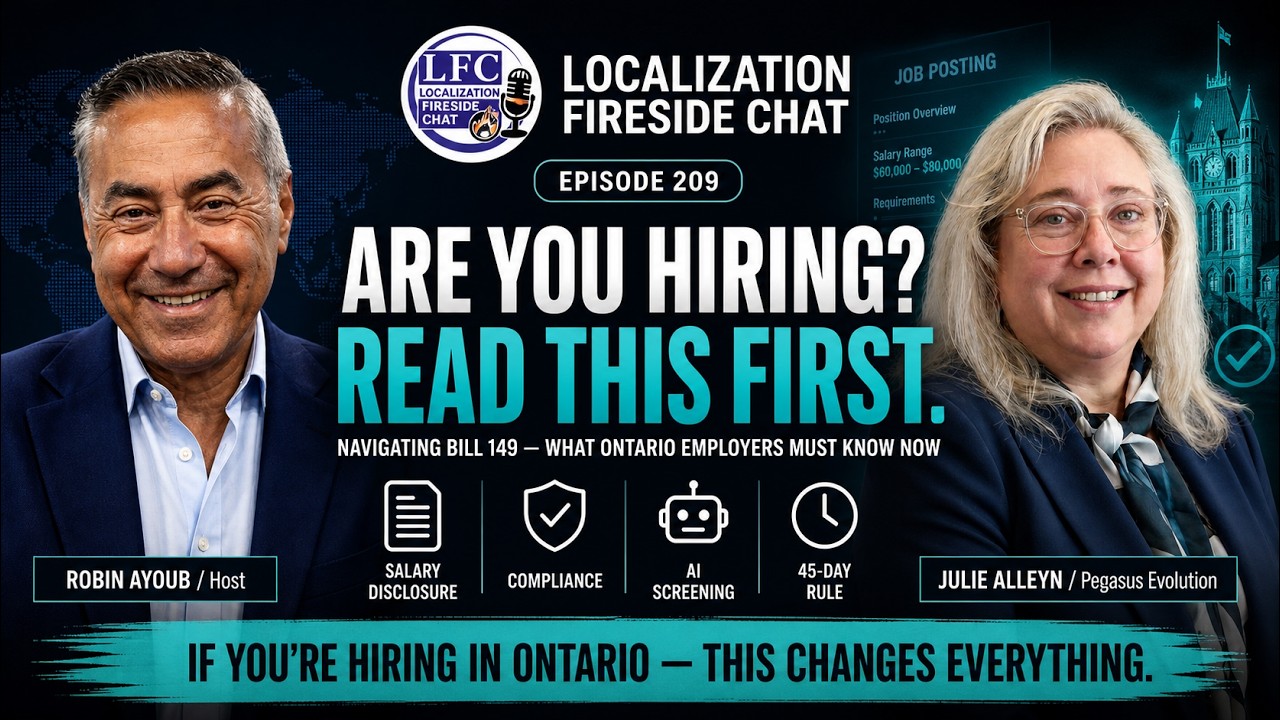
Julie Alleyn has spent 25 years preventing exactly that. As the founder of Pegasus Evolution and a bilingual fractional HR consultant and leadership coach operating across Canada, she has seen these patterns in every industry imaginable — pharmaceuticals, law firms, broadcast media, engineering, and yes, even funeral services. In Episode 209 of the Localization Fireside Chat, she sat down with Robin Ayoub to talk about what is actually broken in Canadian HR right now, what Bill 149 means for your next job posting, and why the fractional model is not a trend but a permanent shift in how expertise gets deployed.
From Montreal to Mississauga: A Career Built Across Every Industry
Julie did not take a straight line to where she is today. Her introduction to HR came as a summer student at an insurance company, where she watched the HR director work and decided that was the career she wanted. She pursued a Bachelor’s degree in Industrial Relations at Université de Montréal and went on to do MBA studies at Université de Sherbrooke — a foundation that gave her both the legal and human dimensions of the discipline.
What followed was a career that most HR professionals would never attempt. She moved across industries that could not be more different from each other: Sandoz in pharmaceuticals, Blakes in law, Groupe Média TFO in broadcast media, IBI Group in engineering, Stitch It in retail, and Service Corporation International in funeral services — where she was the only HR person supporting roughly one thousand employees across Eastern Canada. Each of those environments had different compliance obligations, different cultures, different union dynamics, and different definitions of what HR was even supposed to do.
That breadth is exactly what she brought to Pegasus Evolution when she launched it in 2020 — right before COVID arrived and made the decision feel either catastrophically timed or perfectly prescient, depending on the week.
What Fractional HR Actually Solves
Pegasus Evolution targets companies in the 20-to-150 employee range. That window is not arbitrary. Below 20 people, most founders are managing HR instinctively and getting away with it. Above 150, the complexity typically justifies a full-time CHRL. In between, companies are too big to wing it and too small to absorb the cost of a senior HR hire on their payroll.
The fractional model answers that gap directly. Julie’s clients get 25 years of experience, CHRL designation, ICF coaching accreditation, and bilingual capability — for a fraction of what that profile would cost as a permanent hire. As she put it on the show, it is a no-brainer: you pay for what you need, when you need it, at a level of expertise that most SMEs could never afford to staff full-time.
Her entry point with new clients is often the HR Pulse Check, a proprietary diagnostic that evaluates compliance, engagement, and overall HR effectiveness. The finding that surprises business owners most is not usually what they are doing wrong — it is how much they did not know they were supposed to be doing at all.
Conversational Intelligence: The Neuroscience of Trust at Work
One of the most unexpected segments of the conversation was Julie’s explanation of Conversational Intelligence, the C-IQ framework developed by Judith Glaser for which Julie holds an Enhanced Skills Practitioner certification through the International Coaching Federation.
The premise is grounded in neuroscience. The words a leader chooses in a conversation do not just convey meaning — they trigger neurochemical responses in the listener. Certain language patterns activate the threat response, flooding the brain with cortisol and shutting down collaborative thinking. Others build psychological safety by triggering oxytocin. Most leaders have no idea which effect they are producing.
For Julie, this is not a soft skills conversation. It is a performance conversation. When managers are unknowingly triggering a stress response in their teams, the cost shows up in disengagement, turnover, and the quiet erosion of the culture that was supposed to retain the people the company worked hard to hire.
Bill 149: What Ontario Employers Must Know Right Now
This is the segment every Canadian business owner with hiring plans needs to hear. Bill 149 — the Working for Workers Four Act — came into force on January 1, 2026, and it changed the rules for every Ontario employer with 25 or more employees. The key requirements:
Salary disclosure is now mandatory. Every publicly posted job must include a salary or a salary range. That range cannot exceed $50,000 unless the role pays above $200,000.
AI screening must be disclosed. If your applicant tracking system uses any form of artificial intelligence in its screening process — and most modern ATS platforms do — you are required to say so in the posting. Many employers do not realize the tools they have been using for years are caught by this rule.
Speculative postings must be disclosed. If the vacancy is not yet confirmed, that must be stated.
Candidates who are interviewed must be notified of a hiring decision within 45 days.
The requirement for Canadian experience as a condition of consideration is now banned.
Julie’s read on compliance four months in: most employers are not there yet. The salary range requirement is the one generating the most resistance, with business owners worried about internal equity conversations they are not prepared to have. But the AI disclosure rule is the one with the most hidden risk, precisely because the non-compliance is invisible until it is not.
Bilingual HR Across Canada: More Than a Language Skill
Julie operates in both English and French, which in Canada is not a marketing differentiator — it is an operational one. Quebec’s Bill 96 has significantly strengthened French language requirements for employers operating in the province, including requirements around communications, contracts, and workplace language policy. For Ontario-based companies that have employees in Quebec, this has created a compliance exposure they frequently did not know existed.
Beyond compliance, Julie pointed to a genuine cultural dimension. The relationship between francophone employees and their employers, the expectations around communication and respect, the dynamics of a bilingual workplace — these are not things that get resolved by translating the employee handbook.
AI in HR: Useful Tool, Not a Decision Maker
Robin asked Julie directly where she stands on AI in HR workflows. Her answer was clear: it is a colleague, not an authority. AI helps create documents faster, generates policy drafts, accelerates screening, and surfaces patterns in engagement data. But every output needs human review. Compliance cannot be delegated to a language model. Confidentiality must be protected. And the judgment calls that matter most — the ones involving people’s livelihoods and dignity — still require a human being who knows what they are looking at.
Why the Fractional Model Is Winning
Both Robin and Julie are running fractional practices, and the conversation turned naturally to what they are both observing in the market. Businesses are increasingly willing to pay for specific expertise rather than headcount. Senior professionals are increasingly choosing autonomy over stability. And AI is accelerating the shift by reshaping which roles justify full-time employment.
Julie’s prediction: the fractional model will become the dominant structure for senior expertise in professional services. The math is simply too compelling on both sides of the transaction.
Her closing message to Canadian business owners: treat HR the way you treat your accountant and your lawyer. You do not wait until you have a tax problem to get an accountant. Do not wait until you have a people problem to get HR. Surround yourself with experts who have the knowledge you do not, so you can focus on growing the business you built.
Watch the full conversation with Julie Alleyn here: https://youtu.be/wFzt48tnSZY | Listen on Simplecast: https://localization-fireside-chat.simplecast.com/episodes/are-you-hiring-in-ontario-navigating-bill-149-with-julie-alleyn | Connect with Julie: https://www.linkedin.com/in/juliealleyn/ | Pegasus Evolution: https://www.pegasusevolution.com | HR Pulse Check: https://www.jotform.com/231306274289256 | Follow LFC on LinkedIn: https://www.linkedin.com/company/localization-fireside-chat/ | N49Networks: https://www.n49networks.com | Book a call with Robin: https://calendly.com/robin-ayoub/30min
Are You Hiring in Ontario? Navigating Bill 149 with Julie Alleyn


Leave a Reply