From Near-Death to Emotional Operating System: Thayne Martin on Healing Trauma and Installing EQ in Organizations
Thayne Martin was a six-time President’s Club executive, consistently in the top 10% of performers nationally across automotive, SaaS, finance, and logistics. He was also, quietly and privately, managing DID, complex PTSD, bipolar 1, and ADHD, carrying a history of severe childhood abuse by a religious cult, and running on seven pill boxes a day under doctor supervision. Nobody at work could tell. That was the point.
Then came the near-death experience. A medication error, an accidental drowning, a coma. When Thayne came out of it, he made a decision. He walked away from corporate America, spent two and a half years and $250,000 in research, and built something genuinely new: the ELAH eqOS, an emotional operating system for optimal human performance, installed not through training but through experiential neuroscience.
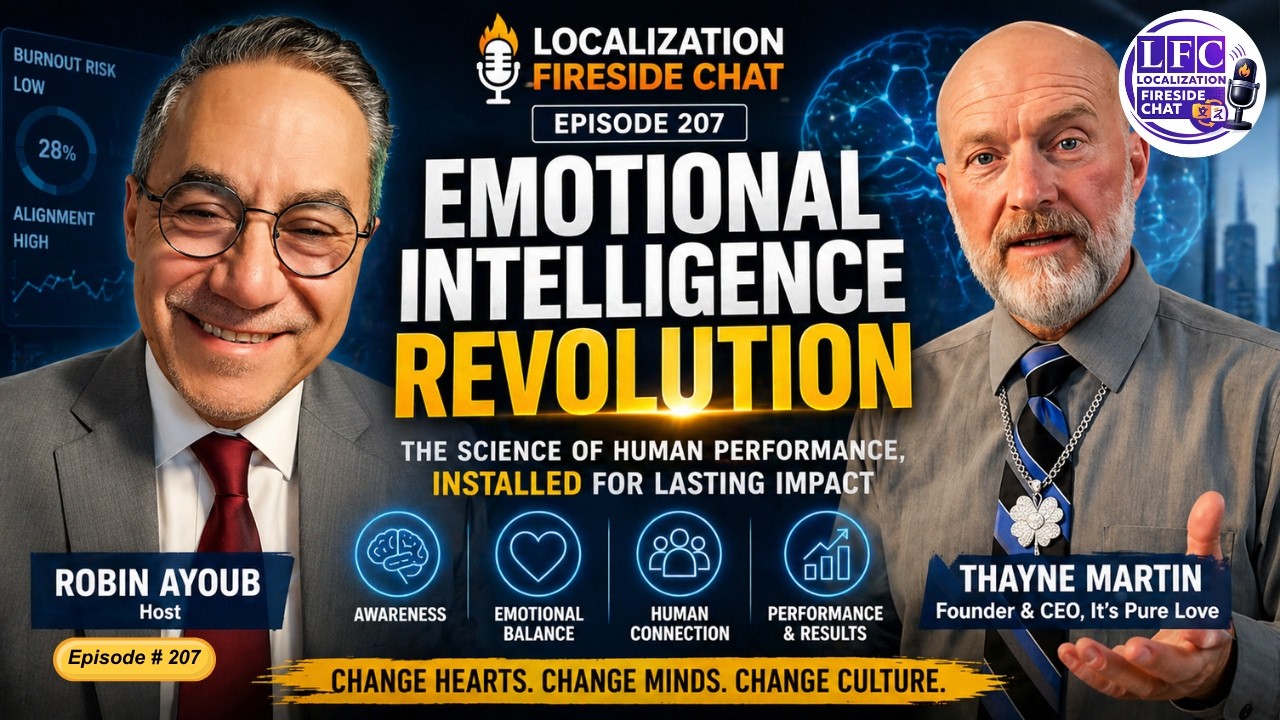
He joined Robin Ayoub on episode 207 of the Localization Fireside Chat for a conversation that went to some of the most unexpected and powerful places this podcast has ever reached.
The Problem With Running an Outdated Emotional OS
Thayne’s central argument is disarmingly simple. Every human being has an emotional operating system built by living their life. And for most people, the key files in that system were written by an immature brain in childhood, at a moment when the person lacked the cognitive development to write an accurate story. Those stories became self-limiting beliefs. And decades later, they show up in the boardroom, in sales meetings, in leadership decisions, running silently in the background like corrupted firmware.
Unless emotionally intelligent parents installed the idea that failure is feedback, what got installed instead was shame, avoidance, and a nervous system wired to protect rather than grow.
The result is a workforce where 95% of thoughts are subconscious, where most employees are running their default mode network for most of the workday, where an argument with a teenage son at breakfast shows up in a sales meeting that afternoon, and where no one has ever been taught how to stop it.
Why Culture Change Programs Fail
Thayne has a clear diagnosis for why the corporate learning and development industry produces so little lasting change. He calls it being PowerPointed to death. A consultant flies in, delivers a framework, gets people nodding, and leaves. Monday morning, the culture change leaves with them.
The reason, he says, is retention. Traditional learning channels produce a 10% retention rate. Experiential learning produces 90%. Not because the content is different, but because the body was involved in learning it.
His protocol, Ex Em NeuroConditioning, puts employees into real experiences with real social risk, structured environments where the brain predicts average or failure, and then receives something it did not expect: kindness, connection, gratitude, love. That mismatch is the mechanism. The brain enters the memory reconsolidation window, updates the physiological response from the old story to the new experience, and the self-limiting belief that had been quietly governing behavior begins to change.
The 0.25-Second Window
One of the most practically useful moments in this episode comes when Thayne describes the amygdala window. Between the moment the amygdala fires a stress response and the moment it executes the wrong behavioral script from the subconscious, there are 0.25 seconds. That is the window.
His training teaches people how to grab that window, transfer the thought to the prefrontal cortex, and make a rational decision in real time instead of running the old tape. Once awareness is established, the next stage is emotional intelligence and regulation. Then metacognition: the ability to observe your own behavior in real time and correct it.
The Gratitude Cocktail and the Neuroscience Behind It
Thayne did not set out to discover a protocol. He started with a sunrise and a question on social media: what are you grateful for? He became curious about why he could remember every detail of September 11th with vivid clarity but struggled with other memories. He started studying how emotional encoding works in the brain.
Then a stranger at a fast food counter changed something. He thanked her genuinely and fully for something small she had done. She cried. He cried. And then his vagus nerve activated and something happened between his brain and his heart that he had no scientific vocabulary for yet. He went home and tried to repeat it. It worked with strangers but not with colleagues, and he eventually understood why: perceived social risk puts the brain into an elevated learning mode. That risk is the catalyst.
Four days later, his brain shifted. The default toward negative triggers began to give way to what he calls glimmers: evidence of alignment, of purpose, of being on the right path.
The hormones involved in what he now calls the gratitude cocktail include oxytocin, acetylcholine, vasopressin, dopamine, serotonin, and adrenaline, all produced naturally, all teachable. Gratitude, it turns out, literally quiets the amygdala and strengthens the prefrontal cortex.
Measuring Emotional Health in Real Time: Workplace.io
One of the most forward-looking parts of the conversation covers Thayne’s partnership with Workplace.io, a platform that uses NLP to analyze communication across Slack, Teams, and email, measuring 1,200 signal points to deliver a real-time emotional health dashboard to executives.
The platform generates a burnout score, an executive decision-making score, a psychological safety risk score, and an alignment score. Everything is anonymized. Employees opt in. No individual can be identified from the data. But the signal it captures reflects what employee surveys never can: the actual emotional temperature of the organization in real time, not what people think their manager wants to hear six weeks after the fact.
Thayne takes a baseline measurement before installing ELAH eqOS. He tracks KPIs alongside the emotional health metrics. As the program progresses, executives can watch both sets of numbers move together. Sales performance, focus, and retention all shift when employees are no longer bringing unmanaged emotional weight to work.
What Every Leader Should Do This Week
Robin closed by asking Thayne for one practice. One thing a leader could start this week to begin upgrading their own emotional operating system.
Thayne’s answer was immediate: lean into empathy. Listen to your people. Give them the experience of being heard and seen. When a leader treats an employee as a full human being with a life outside the office, the employee responds in kind, moving mountains rather than the minimum.
He pointed to ADP as a company that has understood this at scale, where empathy is embedded into the culture even inside a Fortune 500 structure. And he pointed to the leaders he never forgot, not because they were demanding, but because they told him his effort was seen and his struggles outside work mattered.
The conversation between Robin and Thayne lasted just over an hour and covered childhood abuse, neuroscience, near-death experiences, sales culture, burnout, AI, and the human capacity to change. It is one of those episodes that stays with you well after the audio ends.
Watch on YouTube | Listen on Simplecast | Connect with Thayne at itspurelove.com | Follow Robin at robinayoub.blog | N49Networks: n49networks.com | Book a conversation with Robin: https://calendly.com/robin-ayoub/30min
Watch on YouTube: https://youtu.be/ug7wnDfO9TA | Listen on Simplecast: https://localization-fireside-chat.simplecast.com/episodes/he-healed-bipolar-1-and-ptsd-without-medication-then-built-an-emotional-operating-system-for-leaders-thayne-martin | Connect with Thayne: https://www.linkedin.com/in/thaynemartin/ | Follow LFC: https://www.linkedin.com/company/localization-fireside-chat/ | Book Robin: https://calendly.com/robin-ayoub/30min | N49Networks: https://www.n49networks.com
From Near-Death to Emotional Operating System: Thayne Martin on Healing Trauma and Installing EQ in Organizations


Leave a comment