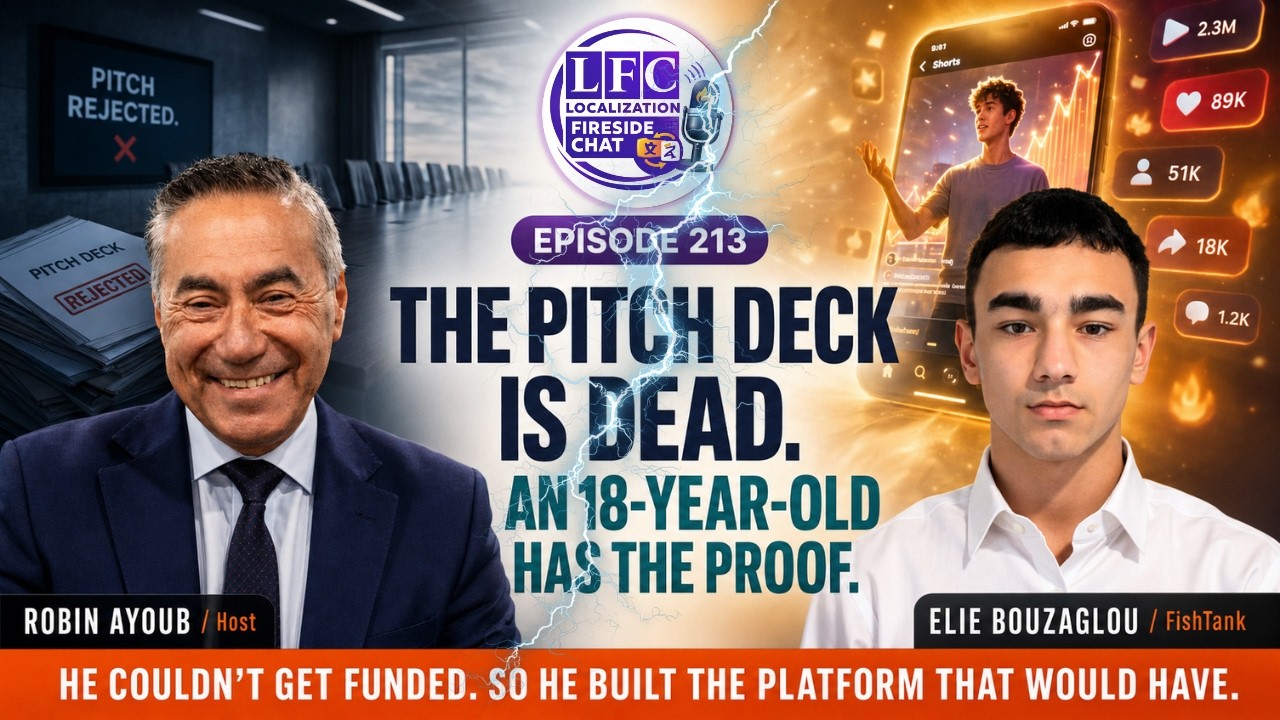
The Pitch Deck Is Dead. An 18-Year-Old Has the Proof.
What does it take to reimagine one of the most gatekept systems in the world? If you ask Elie Bouzaglou, the answer is a rejection letter, an Instagram video, and the audacity to build the alternative yourself. At 18 years old, Elie left school, scaled an AI-powered web agency, got shut out by every crowdfunding platform he approached, and turned that frustration into FishTank, a platform he describes as Shark Tank meets TikTok, purpose-built to tear down the walls keeping talented founders out of the room.
This episode of the Localization Fireside Chat is one of the most energizing conversations Robin Ayoub has had in 213 episodes. Not because Elie has all the answers, but because he is asking the right questions at an age when most people are still figuring out what the questions even are.
From Web Agency to Platform Builder
Elie did not start with FishTank. He started with a web agency, scaling it to 15 to 20 employees using AI to automate the entire build and sales workflow. A prospect would fill out a form, OpenAI would turn it into a prompt, Lovable would generate the website, and a Stripe invoice would follow. It worked. But a recurring problem inside the sales team led him to build an internal AI cold calling coaching tool called Prospector, and that tool made him realize something bigger: if you want to bring a consumer product to market, you need capital, and the existing system for accessing that capital is fundamentally broken.
The Crowdfunding Rejection That Started Everything
When Elie tried to crowdfund Prospector, every platform either rejected him outright or delayed him indefinitely. The reason was always the same: he was not building a unicorn. The platforms were designed for VCs and angels looking for companies that return the whole fund. A solid, profitable, non-unicorn business had no home.
That gap became the thesis for FishTank. As Elie puts it, no one is willing to read a thousand pitch decks to find the next great company. But people will scroll through thousands of short-form videos without thinking twice. So why not judge founders on the one skill that actually matters most in 2026: their ability to bring a product to market through content?
Shark Tank Meets TikTok
FishTank works on two sides. Investors open a TikTok-style feed and scroll through founder pitch videos, company updates, and progress posts. Founders get a dashboard, a company page, and the tools to document their journey from idea to investment. AI-backed vetting filters out low-quality submissions before they reach the feed. And open community feedback replaces the polished, behind-closed-doors pitch dynamic with something more honest and more useful.
The compliance layer is real: founders who want to accept investments need to file a Form C, which takes time but provides investor protection. The business model is straightforward: a small fee to create a company page ensures quality, and FishTank takes a transaction fee on successful investments.
The Proof Is in the Investor
The most powerful moment in this episode is not a theory. Two days before recording, Elie announced that Jason Butcher, founder and CEO of Orbit Capital, had signed on as an investor. How did Jason find him? Not through a pitch deck. Not through a warm introduction. He saw one of Elie’s videos on Instagram, sent a message on LinkedIn, and a week later the wire was in the bank. The deck came after the call, as an afterthought.
That is not a coincidence. That is the entire point of FishTank, proven on its own founder before the platform has even launched.
Language, Culture, and the Pitch as Performance
Robin brings his 30 years in the language and localization industry directly into this conversation, and it produces one of the sharpest exchanges in the episode. A pitch is not just information: it is cultural performance. The way a founder in Beirut tells their story is not the same as the way one in Boston does. FishTank is launching in the US first, in English, which is a pragmatic business decision. But the longer arc of the platform, reaching multilingual founders across borders, is where its democratization thesis will truly be tested.
Why College Is Now the Riskier Bet
Elie does not shy away from the school question. He stopped. And his reasoning is worth sitting with. Five years ago, the most promising path was a computer science degree. Today, AI is replacing the junior analyst, the junior developer, the intern. The job market for entry-level positions is being hollowed out. Meanwhile, the cost of starting a company has never been lower. Failure is faster and cheaper than ever. For Elie, entrepreneurship is not the risky path anymore. It is the safer one.
The Vision: Meta for Entrepreneurship
The end goal for FishTank is to be the all-in-one platform for the full founder journey, from the 3am idea to IPO or acquisition. Test the idea with the community, get destroyed, refine it, build it, document the process, pitch it, grow your social following, attract investors, raise capital, hire with equity, scale, exit, and then switch your user type from founder to investor and start the cycle again. That is the loop Elie is building.
Listen, Watch, and Connect
Listen to this episode on Simplecast: https://localization-fireside-chat.simplecast.com/episodes/the-pitch-deck-is-dead-an-18-year-old-has-the-proof-elie-bouzaglou-ep-213 | Watch on YouTube: https://youtu.be/AYyyKMvzK5A | Connect with Elie on LinkedIn: https://linkedin.com/in/elie-bouzaglo | FishTank: https://fishtank.vc | Connect with Robin: https://linkedin.com/in/robinayoub | N49Networks: https://n49networks.com | Book a call with Robin: https://calendly.com/robin-ayoub/30min
The Pitch Deck Is Dead. An 18-Year-Old Has the Proof. | Elie Bouzaglou | Ep. 213


Leave a Reply