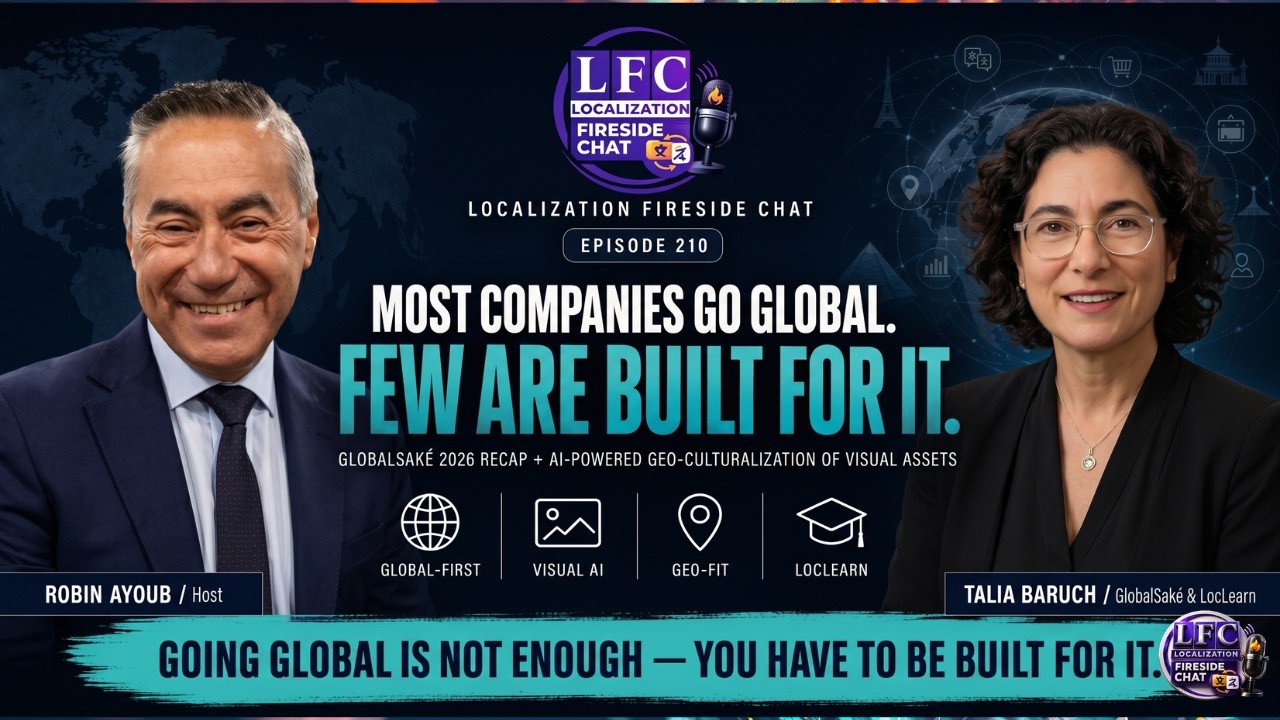
Most Companies Go Global. Very Few Are Built For It. | Talia Baruch | GlobalSaké & LocLearn | LFC Ep. 210
Talia Baruch has a line that stops people in their tracks: most companies go global, but very few are actually built for it. When she said it on Episode 199 of the Localization Fireside Chat, it resonated deeply with practitioners across the industry. On Episode 210, she returns to go even further, and this time she brought receipts from one of the most talked-about evenings the localization world has seen in recent memory.
GlobalSaké 2026: A Sold-Out Evening at Adobe HQ That Nobody Wanted to Leave
On April 30, 2026, Talia and her team pulled off something rare in this industry. The GlobalSaké Global-First AI Roundtable at Adobe Headquarters in San Francisco sold out a full week before the event, and when the evening finally arrived, getting attendees to leave was the biggest logistical challenge of the night.
The format was intentional. A networking reception opened the evening with sake tasting, a live world music concert by Wobbly World, and an international buffet, before breaking into five parallel expert-led roundtable tracks covering platform infrastructure, data governance, organizational structure, product adaptive performance, and geo-cultural context in AI. The space was Adobe’s open-floor San Francisco headquarters, chosen specifically so nothing and nobody would get lost.
Talia moderated Track 4 on product adaptive performance alongside Jane Nemcova of Ollang and Macduff Hughes, formerly of Google Translate and Adobe. What came out of that room was a reminder that the localization industry is still largely operating on language-first assumptions when the real opportunity is much broader. Product people and localization professionals are both missing each other, and the intersection between those two disciplines is where the real work lives.
Track 5 brought gaming industry case studies to the table, with Kate Edwards of Geogrify leading a conversation on geo-cultural pitfalls that go well beyond text. The example of a game where players in a specific market consistently took the wrong path because the visual cue was culturally unintuitive, turned into one of the most concrete illustrations of what geo-cultural context actually means in practice.
The feedback from attendees was consistent: the content could have filled a two-day packed conference. That signal is shaping what GlobalSaké does next.
What Product Geo-Fit Actually Means
Talia draws a clear line between two concepts that are often conflated. Product global readiness is the internationalization layer, the infrastructure, the modular architecture that allows a product to scale across languages and geographies without a code freeze every time a new market opens. Product geo-fit is the layer on top of that, and it is where most companies fall short.
Geo-fit is about understanding who you are solving for in a specific market. At LinkedIn, the addressable segment in China in 2014 was professionals and students aged 17 to 26. That demographic informed the what: entry-level internship jobs. That what informed the how: a standalone mobile app, not connected to the global LinkedIn database, built specifically for a mobile-first, younger, more isolated-from-the-West user base. In Germany, the addressable segment was 35 to 46, and the proposition was career advancement and upskilling. Same product, completely different geo-fit strategy.
Adobe’s Japan story is equally instructive. When they entered the Japanese market and tried to create InDesign templates for local designers, the first attempt leaned on stereotypical cherry blossom and kimono imagery. That is exactly what Talia means when she says adaptation has to feel native, not forced. Adobe eventually built entirely new templates for Japanese designers from scratch, designed around the different typographic sensibility of the market. That is the difference between translation and geo-fit.
The principle Talia returns to throughout the episode is adaptability. Do not build for a specific fixed solution. Build for the capacity to adapt to any solution. Companies that hardcode their architecture for a single market spend years refactoring when they are finally ready to scale. Companies that build with a modular, adaptive foundation treat new market entry as a configuration, not a construction project.
LocLearn and the AI-Powered Geo-Culturalization of Visual Assets Course
Talia launched LocLearn in early 2023 as a practical upskilling school for localization professionals entering the AI era. The courses are live Zoom sessions, applied and hands-on, with real deliverables, not slide decks and passive watching.
The newest course is designed and delivered by Dorota Pawlak, localization consultant, AI trainer, and founder of Localize Like A Pro. The course title is AI-Powered Geo-Culturalization of Visual Assets, and the tagline is deliberate: this is not a how to generate pretty images class.
The thesis is straightforward. Visuals fail across markets even when text is perfectly localized. An image that works in one culture can confuse, alienate, or offend in another. AI tools now exist that can help practitioners adapt and create visuals for specific markets with precision, but only if the person using those tools understands the cultural and regional factors at play. Without that understanding, AI produces generic output that looks polished but lands wrong.
The course runs three live sessions on May 28, June 4, and June 11, 2026, on Thursday mornings from 9:00 to 11:00 AM Pacific. It covers image creation and adaptation with tools including Midjourney, Nano Banana, Genspark, Leonardo AI, and Ideogram. It covers video, voice, and avatar localization with HeyGen, ElevenLabs, and Synthesia. And it covers the judgment layer that AI cannot supply on its own: when to use these tools, when not to, and how to evaluate and refine the output against a real cultural checklist.
Talia used a NanoBanana example during the conversation that made this concrete. The tool allows a practitioner to isolate a specific nano-element in an image, a background detail, a clothing item, a cultural symbol, and adapt just that element without touching the rest. The skill is not in clicking the button. The skill is knowing which element to change, what to change it to, and how to make the result feel native rather than corrected.
The same principle applies to video. Lip sync is a solved problem. The harder problem is prosody, tonality, pitch, and the cultural expectation of what a voice sounds like in a given region. In Japan, a higher pitch and different prosody is the norm. In Brazil for certain commercial contexts, a deeper and softer male voice signals confidence and trust. These are not translation decisions. They are geo-cultural decisions, and they require human judgment working alongside AI tools.
Exclusive Discount Codes for LFC Listeners
Talia offered two discount codes live on the show for listeners registering for the course.
Use code GlobalSakeVIP20 for 20% off as an individual registrant. This code was offered exclusively for LFC listeners and GlobalSaké 2026 attendees. It expires May 20, 2026.
Use code VisualTeam20 for 20% off when registering as a group of three or more. This code has no expiry.
Both codes apply at registration here: https://www.globalsakegrowth.com/loclearn/visual-culturalization
LocWalks, 2026 Plans, and What Every Product Leader Needs to Hear
LocWalks started during the pandemic as a simple idea: take a walk with like-minded people from the GlobalSaké community. It has grown into a global format with walks in San Francisco, Tokyo, Berlin, Chicago, Seattle, Monterey, Toronto, and beyond. The next one is May 23, 2026 in San Francisco. All LocWalks are free.
For the rest of 2026, LocLearn is adding a Level 2 cohort for building agentic AI applications, this time incorporating vibe coding with the N8n platform. The first two cohorts sold out with roughly 50 students each. The new cohort is open to anyone, no prior coding experience required.
And Talia’s closing answer to what every product leader needs to understand before hitting launch was the most honest thing said all episode: assume you do not know. There is more that is veiled than unveiled. Operate from that mindset, do better due diligence, launch as V1, and build in the expectation of V2 with the corrections. That is not a concession. That is how global products actually work.
Watch the full episode on YouTube and listen on Simplecast below. If this conversation resonated, share it with a product manager, a localization lead, or a designer who works across markets. They need to hear it. | Watch on YouTube: https://youtu.be/aaIg57q1YSg | Listen on Simplecast: https://localization-fireside-chat.simplecast.com/episodes/most-companies-go-global-very-few-are-built-for-it-talia-baruch-globalsake-loclearn-lfc-ep-210 | Connect with Talia Baruch: https://www.linkedin.com/in/taliabaruch/ | GlobalSaké: https://www.globalsakegrowth.com | LocLearn Course: https://www.globalsakegrowth.com/loclearn/visual-culturalization | Robin Ayoub Blog: https://robinayoub.blog | N49Networks: https://n49networks.com | Book a Call with Robin: https://calendly.com/robin-ayoub/30min | Be a Guest on LFC: https://calendly.com/robin-ayoub/localization-fireside-chat-podcast-recording :::end


Leave a comment