Why 85% of Your Customers Won’t Buy From Your Website
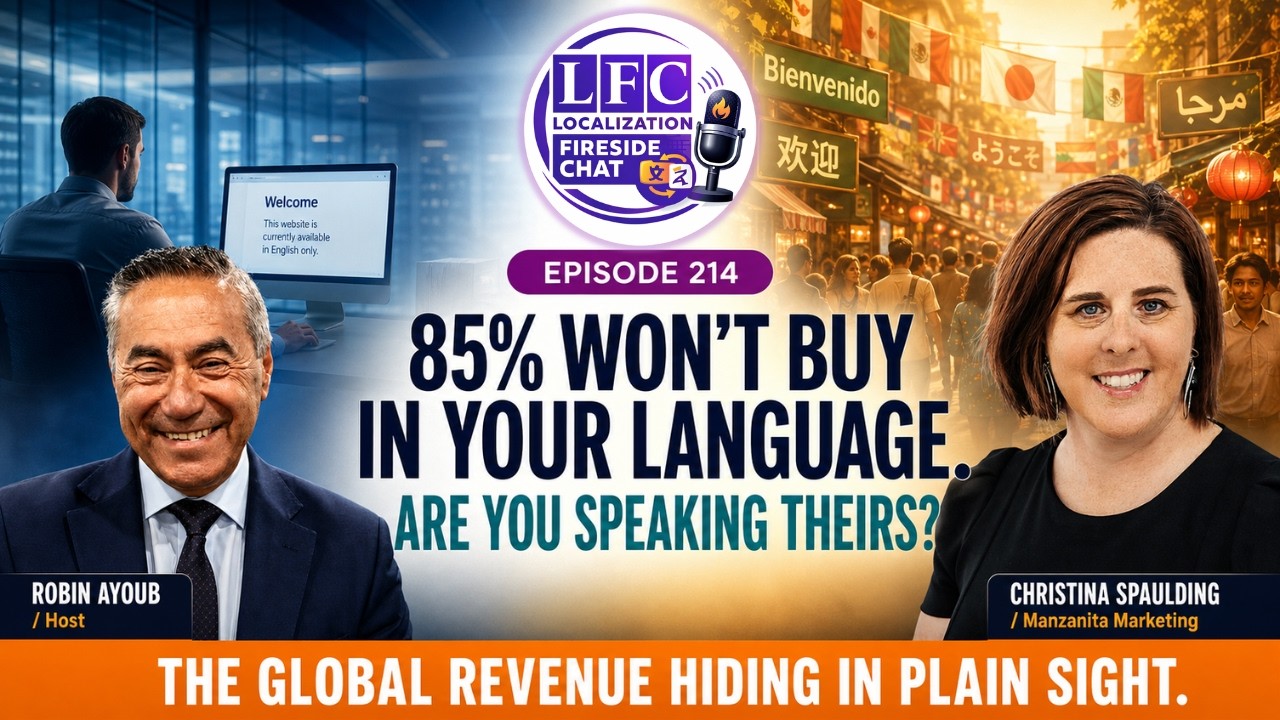
Over 50% of online content is in English, yet only about 20% of the world actually speaks it. That gap is not just a linguistic curiosity. It is a revenue problem that most businesses are choosing to ignore. In Episode 214 of the Localization Fireside Chat, Robin Ayoub sits down with Christina Spaulding, founder of Manzanita Marketing in Las Vegas, to unpack exactly why multilingual content is one of the most overlooked growth levers available to small and medium-sized businesses today.
Christina brings more than 20 years of in-house marketing experience at companies like Textbroker and IGT, personal fluency in English, Spanish, German, and French, and six years of living and working in Germany. She also brings something rarer: the willingness to combine linguistic expertise with business strategy in a way that most language professionals have not yet done.
From Language Student to International Marketing Founder
Christina’s path into international marketing started in second grade, where she chose French over Spanish and never looked back. She added German in high school, majored in both languages in college, and landed an internship in Germany that turned into a six-year stay. Along the way she studied Quebecois French in Quebec City and a regional French dialect in Strasbourg, giving her firsthand experience with the kind of linguistic variation that standard translation tools routinely miss.
After returning to North America and settling in Las Vegas, she worked her way through the language industry, picking up roles in import-export, localization project management, and content marketing. She was laid off seven times, including during the Great Recession and through multiple mergers and acquisitions. In 2023, after her final layoff, she decided to pitch herself to small and medium-sized businesses instead of large employers, and Manzanita Marketing was born.
The Marketing Wrapper That Changes Everything
The turning point in Christina’s career came at Textbroker, where she was hired as their first US employee to bridge the gap between the German founders and the American market. Running a growing team gave her a taste of calling the shots, and she quickly realized that language professionals who add a marketing layer to their work create a fundamentally different kind of value.
As she put it during the episode, there is a ceiling on how much value you can add when you are purely translating. When you wrap cultural knowledge, market research, and content strategy around the language work, you move into a category that is much harder to commoditize and much harder to replace with AI.
The 85% Stat Every Business Owner Needs to Hear
A Weglot study found that people are 85% more likely to purchase when information is presented in their first language. Christina uses this stat strategically in her client conversations, not as an opener, but as a confirmation once a business owner has already started to see the opportunity in front of them.
For context, between 20 and 30% of Las Vegas residents speak Spanish as their first language. In the US overall, the figure is around 15%. These are not fringe demographics. They are existing customers already searching for services in Spanish, as Christina discovered with one of her clients, a veterinarian in the Georgia suburbs, who was receiving Spanish-language queries through her website chat box and had no way to close the loop.
The practical advice Christina offers for hesitant business owners is to start small. A single landing page tied to a targeted Spanish-language ad campaign requires roughly the same budget as any other marketing pilot. The difference is that the translation budget gets reframed as a content creation budget, which is a much easier conversation for most business owners to have.
Translation, Localization, and Transcreation: Knowing the Difference
One of the clearest segments in the conversation is Christina’s breakdown of the three tiers of language work. Translation sticks close to the source material. Localization gives the writer freedom to adapt examples and references to the target culture. Transcreation means providing a brief and letting the writer create entirely in the target language, pulling in local references naturally.
Her example is memorable: if you are creating sports betting content for a German audience and your English original is built around American football, translating it does nothing. You are still talking about touchdowns and field goals to an audience that cares about Borussia Dortmund and Bayern Leverkusen. A German writer briefed from scratch will naturally reach for the references that resonate. The same brief sent to a writer in Spain gets Barcelona. Sent to Colombia, it gets Colombian club football. The content becomes genuinely interesting to local readers rather than a foreign document that has been linguistically converted.
AI, Panda, Penguin, and the New Content Swamp
Christina draws a direct parallel between the current AI content explosion and the era that prompted Google’s Panda and Penguin algorithm updates. In the early days of SEO, low-quality content farms and keyword stuffing were gaming the algorithm. Google responded with quality filters. Today, AI is enabling a new wave of generic, smoothed-out content that looks passable but says nothing distinctive.
Her take on what wins in this environment is practical: content that reveals something specific. The price no one else lists. The material specifications the competition glosses over. The personal experience of the practitioner. She frames this as the language professional’s moment to shine, because the cultural knowledge that a fluent, embedded language worker brings is exactly what no AI tool can replicate from a brief.
What LSPs Should Be Telling Their Clients
For language service providers listening to this episode, Christina’s message is direct. Delivering translated content without asking whether it will actually rank in the target market is leaving a critical piece of the job undone. The keyword strategy should be defined before translation begins, not after. Terms like “mobile telephone” versus the German informal “handy” carry different search volumes and different audience expectations. If the LSP is not having that conversation with the client at the scoping stage, someone else will.
Her broader recommendation for localization buyers is equally clear: do the market research before you spend a dollar on translation. Understand whether the features and benefits of your product solve the same problems in the target market that they solve in your home market. In Germany, efficiency may matter far more than it does in the US. That insight does not just change the keywords. It changes the entire content brief.
The Language Problem Is Not Solved
Robin closes the episode with a point he returns to regularly in the LFC community: the technology industry’s recurring claim that the language problem is essentially solved is premature. From the Babylonians to the present day, every generation has tried to bridge the gap between human languages with varying results. AI is making meaningful advances, but the cultural knowledge, the regional variation, the emotional resonance of content written by someone who actually lives inside a language and a culture, that is not a problem that any current model has solved.
Christina agrees, and adds that this is exactly why language professionals who understand both sides of the equation, the linguistic and the commercial, are more valuable now than they have ever been.
Connect with Christina Spaulding and explore the full episode at the links below: https://localization-fireside-chat.simplecast.com/episodes/why-85-of-your-customers-wont-buy-from-your-website-christina-spaulding-manzanita-marketing | https://youtu.be/jbYzn9MedRM | https://www.linkedin.com/company/manzanita-marketing/ | https://www.linkedin.com/in/robinayoub/ | https://n49networks.com | https://calendly.com/robin-ayoub/30min
Why 85% of Your Customers Won’t Buy From Your Website | Christina Spaulding | Manzanita Marketing


Leave a Reply