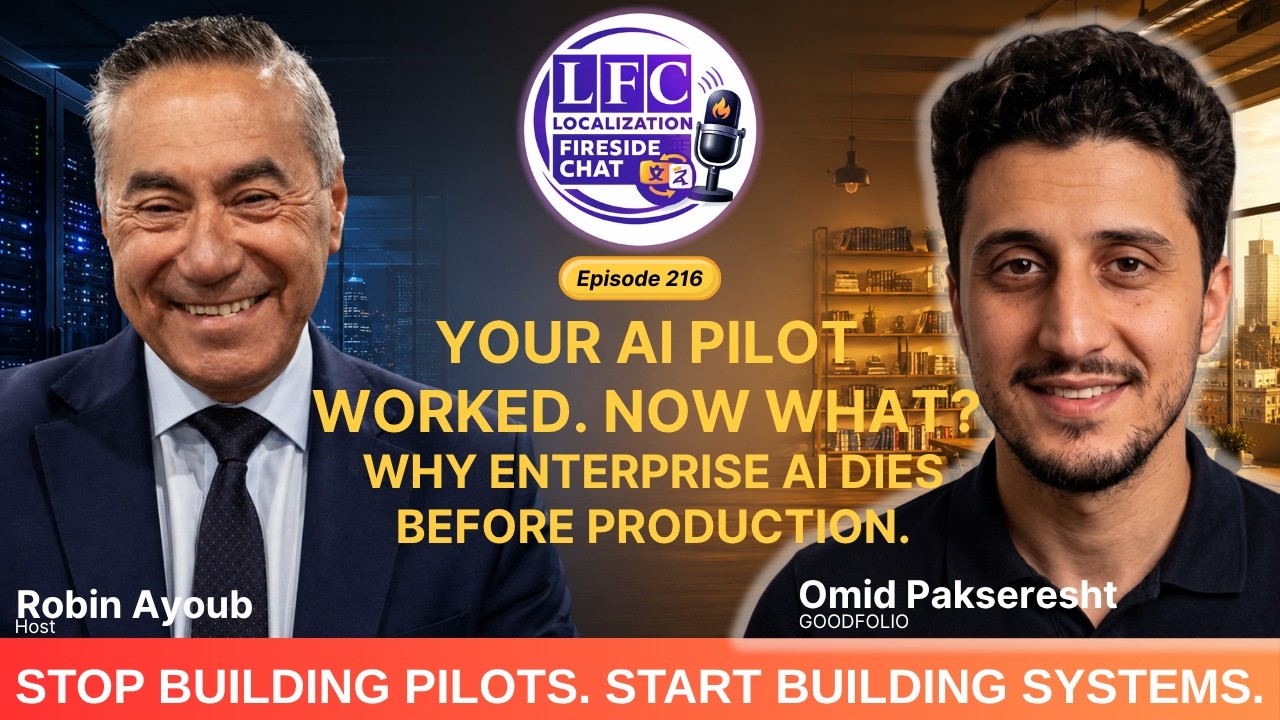
Your AI Pilot Worked. Now What? Why Enterprise AI Dies Before Production
Most organizations have done an AI pilot. Many have done ten. And yet remarkably few have something running in production that actually changes how work gets done. That gap between what AI can do and what it actually does inside a real organization is one of the defining challenges in enterprise right now.
In Episode 216 of the Localization Fireside Chat, Robin Ayoub sits down with Omid Pakseresht, founder and CEO of GOODFOLIO, a London-based AI venture studio that builds and deploys specialised AI systems directly into enterprise workflows. Omid has spent the last decade at the intersection of product, market, and technology in enterprise AI. His perspective is shaped not by theory but by building systems that operate under real constraints: workflows, incentives, governance, and the very human challenge of adoption.
From Iran to Oxford to Enterprise AI
Omid arrived in the UK from Iran at 16. He studied mathematics at Oxford, moved into quantitative finance as an analyst at Record Currency Management, and then into entrepreneurship with TransferGuru, an international money transfer comparison platform. What he learned from that first venture shaped everything that followed: building a fast-growth technology business is a fundamentally different framework from building a small business, and the only real way to close that gap is to get out, experiment, and be willing to be wrong.
He co-founded GOODFOLIO with his brother, who came at AI from academia and enterprise deployments. Together they built a venture studio with shared infrastructure across multiple AI products, including Finspector for financial marketing compliance, GoodMora for strategic intelligence, Libera for retail AI in emerging markets, and GoodMind for neurological diagnostics. The unifying principle across all of them is simple: AI does not create value in isolation. It becomes meaningful only when it is embedded into how organizations actually operate.
The Pilot-to-Production Gap
The failure most organizations experience with AI is not a technology failure. It is a systems failure. There is a whole value chain inside any enterprise: multiple stakeholders with different priorities, misaligned incentives, and the very real complexity of how things actually function. A pilot can be designed around ideal conditions. Production cannot.
Omid’s view is direct: the focus of too many AI strategies is on efficiency gains and job replacement. That framing creates resentment and resistance before the system even launches. The real opportunity, and the one that tends to get overlooked, is growth. Using AI as an enabler rather than a replacement changes the entire internal conversation, and it changes who shows up to champion the deployment versus who shows up to block it.
Governance Is a Capability, Not a Process
One of the clearest frameworks Omid shares in this conversation is his reframe of governance. In most organizations, governance functions as a gateway: the AI project goes in, and it may or may not come out. That model almost guarantees delay and eventual abandonment.
GOODFOLIO’s approach treats governance as infrastructure. The questions are not about approval but about understanding: what is the system doing, why is it doing it, and what happens if it starts doing something different? Building monitoring, building trust incrementally, and building the ability to scale up or scale down are the foundations that allow an AI system to survive long enough to prove its value.
Human in the Loop vs Human as Gateway
One of the most useful distinctions in this episode is the difference between human in the loop and human as gateway. The phrase human in the loop has become so common that it has lost its meaning. In many deployments it has come to mean that a human must approve every output before it goes anywhere. That is not human in the loop. That is a bottleneck, and it typically leads to overloaded people who resent the system they were supposed to benefit from.
The better question is: which parts of the output actually require human judgment, and what specifically is that human bringing that the system cannot? When that question is answered clearly, the system can be designed around genuine human value rather than human approval as a liability shield.
What the Language Services Industry Needs to Hear
The localization and language services industry is navigating the same crisis that Omid describes across enterprise broadly. Buyers have run AI pilots with machine translation, AI-assisted review, and workflow automation. Many are disappointed. LSPs are trying to figure out where they fit in a world where the technology is changing faster than client expectations.
Omid’s answer is consistent with his broader philosophy: stop starting with the technology and start with the workflow. Where does human skill create the most value in this process? Design around that. The organizations that will succeed with AI in language services are not the ones with the best models. They are the ones that understand their own workflows well enough to know exactly where AI belongs and where it does not.
The Road Ahead for GOODFOLIO
GOODFOLIO closed a pre-seed round on Republic Europe at 157 percent of its target with more than 100 investors. The next phase is aggressive growth, built on a differentiated approach to enterprise AI deployment that Omid describes simply as doing something good with AI. His closing thought for the audience captures it well: there is a lot of negativity and despair around what AI is doing. But we have a certain level of control over where that destiny goes. That responsibility, to work toward a more hopeful future of AI, is worth taking seriously.
Listen to the full episode on Simplecast | Watch on YouTube | Connect with Omid Pakseresht | Connect with Robin Ayoub | Visit N49Networks | Book a 30-minute virtual coffee
Your AI Pilot Worked. Now What? Why Enterprise AI Dies Before Production
 Robin Ayoub
Leave a comment