From Faxed Job Listings to Frontier Models
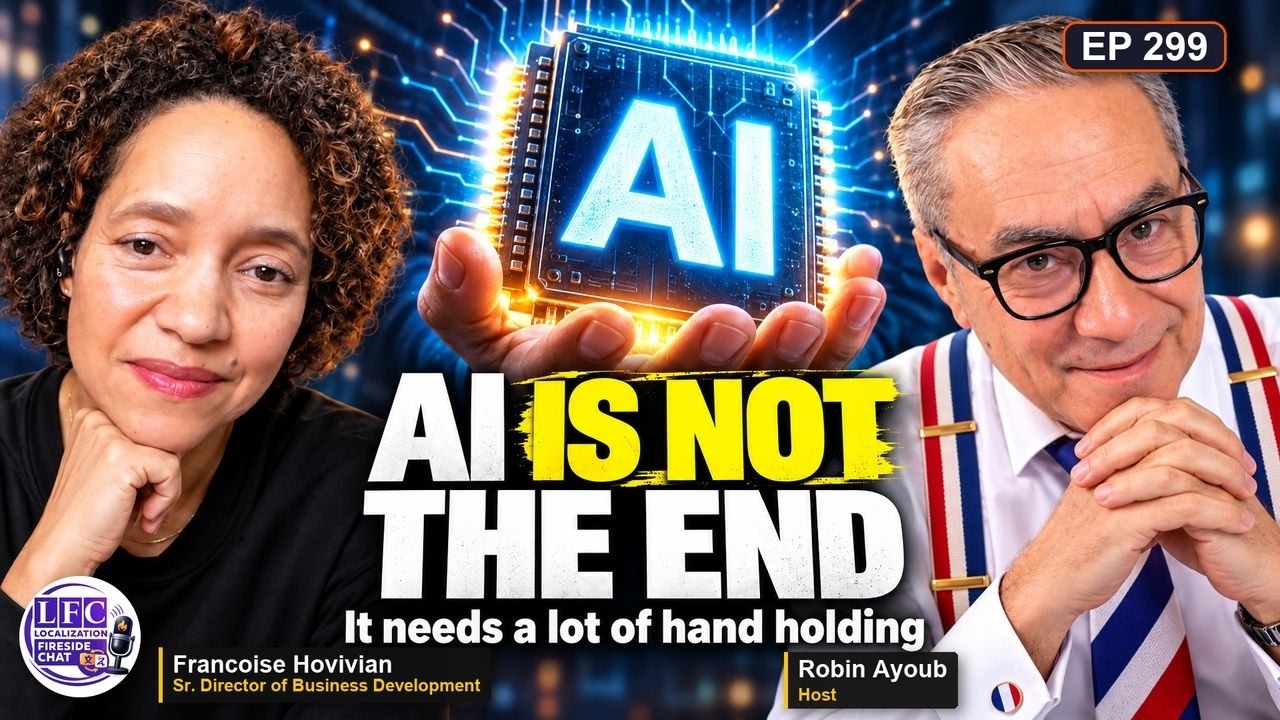
Françoise Hovivian did not plan a career in localization. She was studying English at the Sorbonne, spent two undocumented years working in New York investment offices in the late 1980s, came back to Paris at her mother’s urging, stumbled into a technical writing certificate program, and then received a fax from Microsoft in Redmond. She sent her resume when everyone around her said not to bother. That resume landed her a localization specialist role in the Word business unit in 1992, back when Word, Excel, and PowerPoint were still separate products. What she describes from those early years is not nostalgia but infrastructure: she was present when Microsoft decided to move everything from ASCII to a Unicode base, and she spent years doing the evangelization work that change required, convincing writers and editors to let go of the doc-to-RTF-to-WinHelp workflow they had built their entire practice around. The parallel she draws to 2025 is direct and uncomfortable. The resistance to Unicode came from the same place as the resistance to AI: people who had genuine expertise were being asked to become more technical, and that felt like a threat rather than an expansion. The difference now, she argues, is that the complexity on the other side of the transition is higher than anything the Unicode shift produced.
What Volga Partners Actually Does and Why the Gap Exists
Françoise joined Volga Partners two months before this recording, and her description of the company cuts against how most of the industry still talks about AI and translation. Volga is not an LSP that added an AI practice. It is an engineering firm that combines its own platform, Solibra, with expert human judges to tell enterprise clients how their models actually perform in markets where the language is hard and the stakes are high. The specific example she reaches for is a German-to-Japanese evaluation, a language pair that most pipelines would route through English in both directions. Volga goes direct, because they have the linguists and domain experts to do it. That capability matters most in regulated industries, in the long-tail languages where training data is thin, and in any market where a bad output is not just awkward but legally or reputationally dangerous. The honest framing she offers for the sales conversation is that AI data evaluation is not a quality assurance add-on. It is part of the model training process itself, and cutting it to save money is equivalent to removing testing from a software release cycle and hoping nothing breaks in production.
The Honeymoon Is Over and That Is Actually Good News
One of the most useful things Françoise says in this episode is that the enterprise AI honeymoon, the two-year period after ChatGPT launched when buyers genuinely believed translation was essentially solved, is finished. Companies tried retrieval-augmented generation and discovered it does not automatically produce better multilingual output. They attempted supervised fine-tuning and found they needed data scientists and engineers they did not have. The practical result is that human evaluation is becoming important again, not as a nostalgic preference for the old way but as a structural requirement for anyone deploying AI across linguistically diverse markets. The localization industry has a real advantage here, she argues, because language expertise is exactly what AI evaluation requires. The frameworks are not identical. MQM and traditional error typologies feel increasingly misaligned with what enterprise buyers actually want, which is content that a customer in a specific market will find acceptable, not content that scores well against a rubric built for a different era. But the underlying skill, the capacity to read language carefully and judge it against a cultural context, transfers directly. The practitioners who will do well in the next phase are the ones who are willing to think more like engineers without abandoning what they already know about how language actually works across communities.
This is one of the most grounded conversations we have recorded about where AI evaluation fits inside a real enterprise workflow, and Françoise brings a perspective that is genuinely rare: she has been the buyer, the program builder, and the vendor, and she is not sentimental about any of those roles. If you work in AI, localization, or the space where those two things are colliding right now, this episode is worth your full attention. Watch on YouTube or Listen on Simplecast and choose the format that fits your day. You can also get every episode of LFC on the go by downloading the free app on the App Store or Google Play.


Leave a Reply