When Good Plans Get Stuck
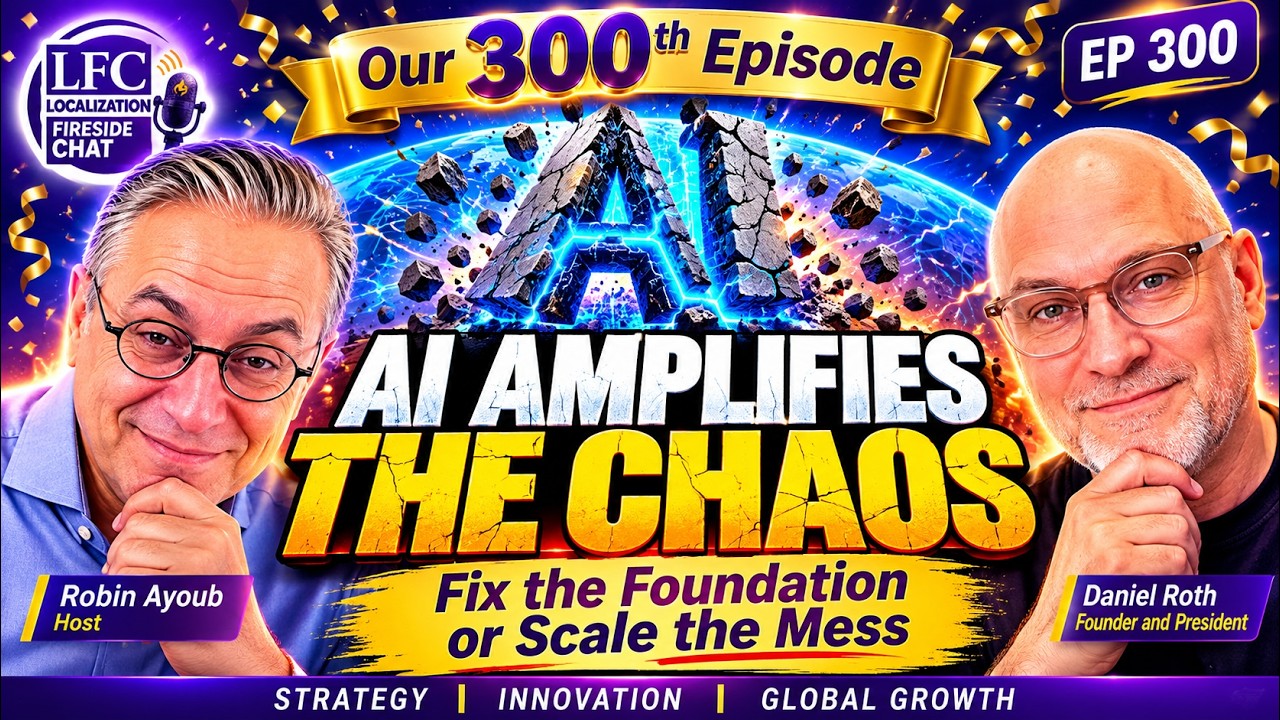
Episode 300 of Localization Fireside Chat brings back Daniel Roth, Founder and President of PangeaEffect, for a conversation that ended up being richer than the first. The original recording from episode 286 published on October 8th and generated 29 clips before a Riverside export wiped roughly 20 minutes of Daniel’s audio. So Robin and Daniel did what any operations-minded person would do: they diagnosed the failure, removed the obstacle, and ran it again. That backstory is not just a footnote. It is the episode’s central argument lived out loud. The same gap between a plan and its execution that Daniel diagnoses in Fortune 500 contact centers showed up in the recording session itself, and both of them named it plainly before moving on.
Daniel’s work at PangeaEffect is built around a concept he calls execution drift, the distance between what leadership decides and what actually happens at the front line on a given Tuesday. After 27 years across 15 industries, including leading a team of 2,500 with a $70 million P&L, he stopped seeing these gaps as talent problems or motivation problems. He started seeing them as systems that were never built, or systems that were quietly abandoned after someone got promoted. The distinction matters because the fix is different in each case. A team that never documented its workflows needs to build from scratch. A team that built the documentation and then stopped using it has a culture and reinforcement problem, and no AI tool will close either gap on your behalf.
The Interruption Audit and What It Reveals
One of the most immediately actionable frameworks Daniel shares is the one-week interruption audit. The mechanics are almost embarrassingly simple: every time the same problem interrupts the work, you mark it. At the end of the week, you sort those interruptions into three buckets. What your team can fix on its own, what requires a cross-functional conversation, and what sits outside anyone’s control. In a healthcare operation Daniel helped transform, that audit revealed a category of appointment types where the company was legally prohibited from requesting a credit card at the time of booking. That segment represented over 15 percent of call volume. The operation had been held to a 90 percent collection target that was structurally impossible to hit, and nobody knew it until the data from an AI-assisted call analysis tool made the shape of the problem visible. The audit did not create that insight. The AI did not create it either. What created it was the discipline to count the interruptions first and then let the data confirm what the count was already suggesting.
The healthcare example also illustrates the point Daniel makes about AI as an amplifier. When Robin named that idea during the conversation, that AI amplifies what already exists, Daniel’s response was precise. If you bring an AI tool into an operation with undocumented processes, conflicting versions of the same workflow, and decision rights that live inside specific people’s heads rather than in a shared system, the tool will scale all of that inconsistency faster than your best people can catch it. The first sign a leader usually sees is not a catastrophic failure. It is a creeping sense that the rework volume is climbing and the team is spending more time on fires than on the work itself. That is execution drift with an engine attached to it.
What a Localization Team Can Do on Monday Morning
For the LFC audience sitting in the middle of a TMS migration or an MT deployment or an AI-assisted review rollout, Daniel’s advice lands in a specific place. He expects the interruption audit in a localization program to surface three recurring categories: fires pulling people away from their actual work, rework on tasks that were technically completed but did not meet the standard, and inconsistent experiences at the handoff points between teams or time zones. His framing for global programs is worth quoting directly from the conversation: make the outcome and the handoff clear in the work while leaving room for the way people need to work locally. Global consistency means people can depend on the promise you make, even when delivering it requires different actions in different places. That is not a localization-specific insight, but it describes the localization problem exactly. The standard travels. The judgment has to stay local. The organization has to provide the support that makes both possible at the same time.
Daniel’s book, The E3 Effect, is available on Amazon and lays out the Enable, Empower, Endeavor framework in full with stories and exercises you can apply directly to your operation. His team at PangeaEffect works with well-funded startups scaling quickly and with mid-size to Fortune 500 organizations looking to remove drift before it shows up in the headline numbers. If you want a starting point before reaching out, the free four-question assessment at pangeffect.com will generate a two-page report telling you exactly who to talk to and what conversation to have.
You can Watch on YouTube or Listen on Simplecast and choose whichever format fits your Monday morning. Then grab every episode in one place by downloading the free LFC app on the App Store or Google Play.


Leave a Reply