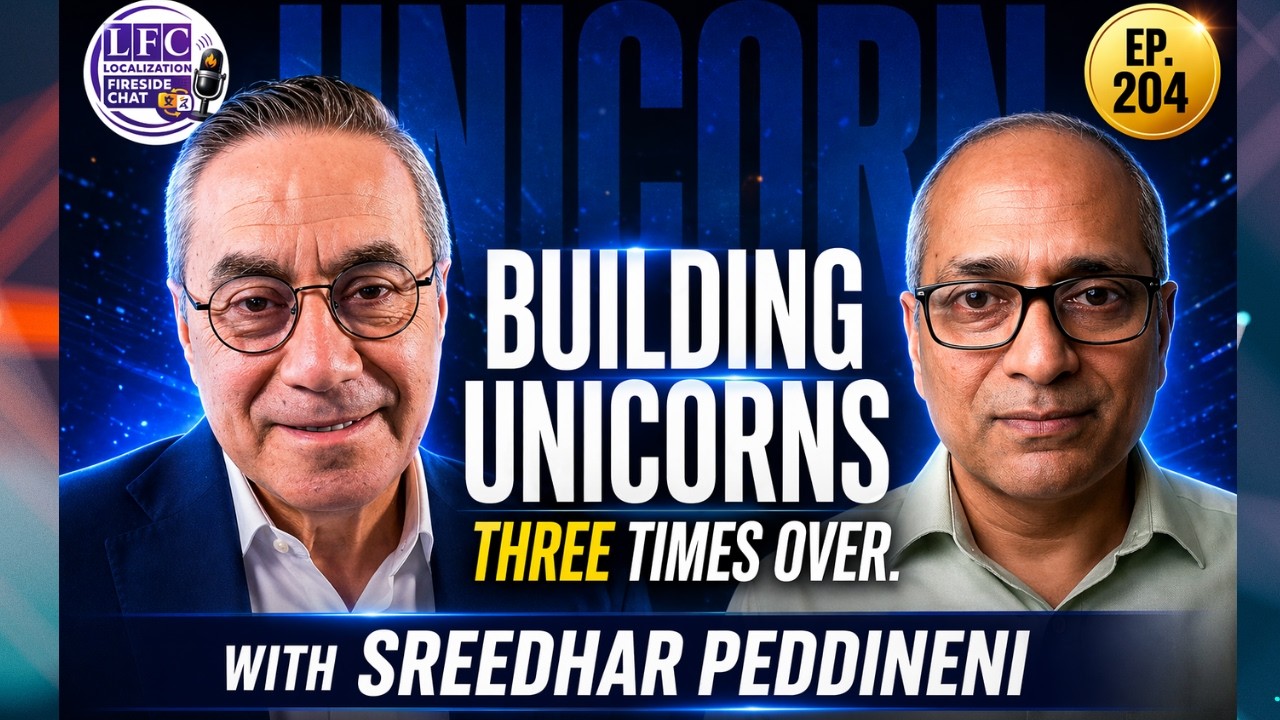
He Built a $1B Unicorn. Three Times.
Sreedhar Peddineni has a pattern. He finds a problem that nobody has a name for yet, builds the software category to solve it, and then watches the world catch up to him.
He did it with Host Analytics, one of the first cloud-based Enterprise Performance Management platforms, built for CFOs drowning in Excel chaos and later acquired by Vector Capital.
He did it with Gainsight, where he co-founded the company, coined the term Customer Success Manager, and helped build what became a $1.1 billion unicorn, backed by Battery Ventures with Nick Mehta as CEO.
And in 2026, with GTM Buddy, he is doing it again.
In Episode 204 of the Localization Fireside Chat, host Robin Ayoub sat down with Sreedhar for a wide-ranging conversation on systems thinking, category creation, the economics of customer retention, and why sales enablement is the next broken function waiting to be fixed.
The Engineer Who Keeps Seeing the Same Pattern
Sreedhar’s story begins in India, where a chance introduction to serial entrepreneur Jim Evelyn in the year 2000 launched his first company. What started as a vendor conversation became a co-founding relationship, and Host Analytics was born.
The insight was simple but hard to execute. Finance leaders were running their most critical planning processes inside spreadsheets. The risk was enormous, the inefficiency was staggering, and nobody had built a cloud-based alternative yet. Sreedhar and his team did.
His engineering background gave him something that most product founders lack: systems thinking. The ability to look at a complex, fragmented environment and see how all the pieces should fit together.
That skill defined every company he built after.
Gainsight and the Birth of Customer Success
By the time Host Analytics was growing, Sreedhar was already noticing a new problem.
Every subscription business eventually hits an inflection point. Renewals start to outpace new customer acquisitions. When that happens, the health of existing customers becomes more important than the sales pipeline. Companies that miss this moment can unravel fast.
The tools available in 2008 to understand customer health were CSAT surveys and Net Promoter Score. Useful signals, but not predictive. Not actionable. Not enough.
Sreedhar saw it differently. If the renewal is an outcome of value delivered, then the real question is whether customers are actually getting value from your product. And you cannot answer that question with a quarterly survey.
That realization became Gainsight, launched in 2011. The foundation was Customer 360: a unified view of customer data pulled from CRM systems, billing platforms, product databases, and click tracking tools across ten to fifteen different systems. Synthesized, analyzed, and turned into a call to action.
The company coined the term Customer Success Manager. It created a new C-suite role, the Chief Customer Officer. It turned what used to be a reactive support function into one of the most powerful revenue engines in B2B software. And it sold for $1.1 billion.
Why Sales Enablement Is Broken in 2026
The same systems thinking that built Gainsight led Sreedhar to his third chapter.
In 2021, he began looking at sales enablement with fresh eyes. The incumbent platforms were built in an era before cloud collaboration was mature. Their model was essentially a content library: organize your documents, tag them, make them searchable.
But by 2021, reps were frustrated. Search was returning irrelevant results. Content was being ignored. Win rates were flat despite enormous investment in training and materials. The function was being cut at companies under financial pressure because nobody could draw a straight line from enablement spend to revenue outcomes.
Sreedhar saw the same pattern he had seen twice before. A real business problem with no real solution, and a technology moment that finally made something new possible.
GTM Buddy is built on a different premise. Instead of a content library, it is a revenue activation platform. It integrates with CRM systems, call recording tools like Gong and Chorus, learning management systems, and content repositories. It uses AI to evaluate rep performance against a competency framework, identify skill gaps, and surface coaching opportunities for managers. It helps reps engage more effectively with buying teams that can include up to nineteen stakeholders. And it does all of this inside the rep’s flow of work.
What Sreedhar Told Robin About Growing Revenue Without Growing Headcount
One of the sharpest moments in the conversation came when Sreedhar described what GTM Buddy has done for his own company.
GTM Buddy has tripled its revenue without increasing headcount. The reason is AI adoption across the entire business. Not just in the product, but in every function. And even with that track record, Sreedhar is candid about how hard it is to get a team to change how they work when the pace of new tools is this fast.
His personal approach: every weekend, he picks a business problem and builds something using available AI tools including Claude Code, Codex, and Gemini. He has not written traditional code in decades. That is no longer a barrier.
The One Piece of Advice Across Three Chapters
Robin closed the conversation with a question he asks every guest.
If you could go back and give yourself one piece of advice before any of the three chapters, what would it be?
Sreedhar’s answer was personal and direct. He had opportunities to move to the United States earlier in his career but personal circumstances kept him from making that move. In hindsight, he would have moved sooner.
Be close to your customers.
Not a framework. Not a methodology. Just a reminder that in B2B software, proximity to the people you are trying to serve changes everything.
Watch, Listen, or Read
Watch on YouTube: https://youtu.be/8J96G56Vii8
Listen on the podcast: https://localization-fireside-chat.simplecast.com/
Read more on the blog: https://robinayoub.blog


Leave a Reply