🎧 Listen on Simplecast | 🎥 Watch on YouTube
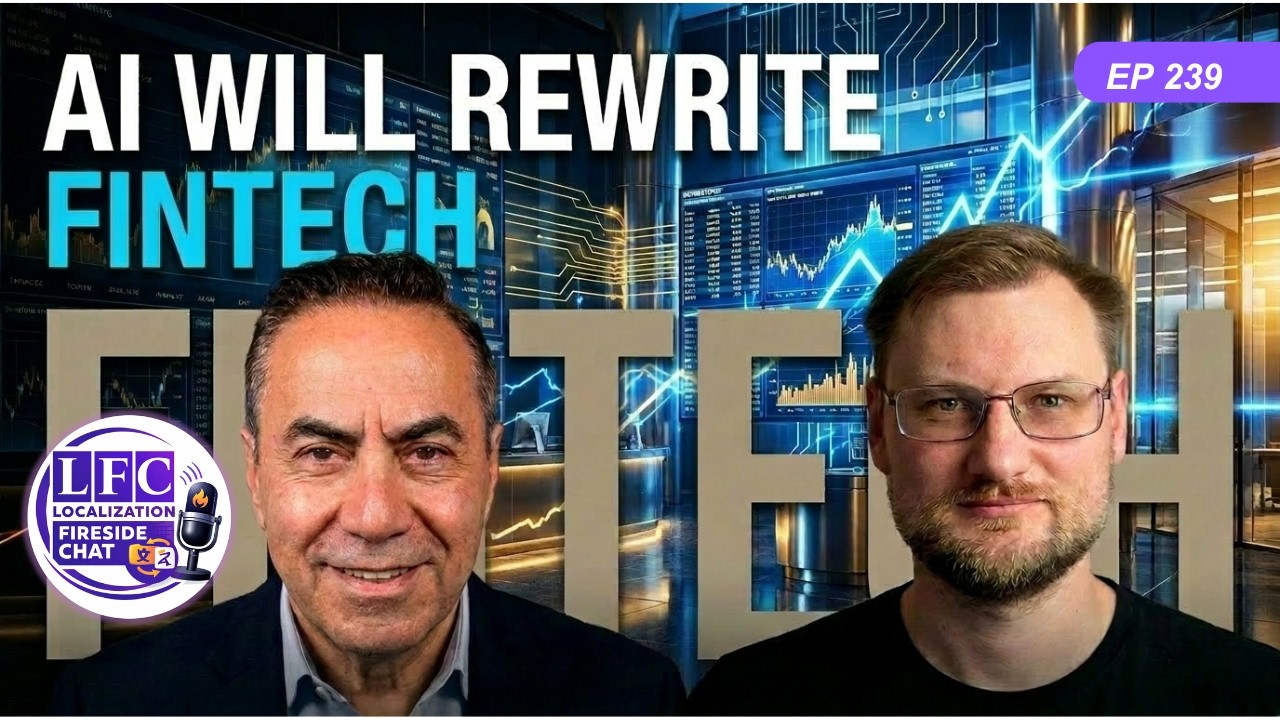
Vasyl “Vince Solo” Soloshchuk has spent thirty years at the intersection of fintech, engineering, and global scale. As CEO and Founder of INSART, a Fintech Business Accelerator based in Boca Raton, Florida, Vince has worked hands-on with 20+ fintech companies, cutting over $30 million in engineering costs and pushing their collective valuation past $100 million. His client list includes AdvisorEngine (Franklin Templeton), Mirador (acquired by iCapital), and Salsa Labs (backed by Accel-KKR).
In Episode 240 of the Localization Fireside Chat, Vince joined Robin Ayoub for a wide-ranging conversation on what it actually takes to build, modernize, and scale a fintech product in 2026. Here are the key takeaways.
1. Legacy Modernization Has a New Answer
For years, Vince advised clients against full platform rewrites. The conventional wisdom was clear: modernize incrementally, migrate clients gradually, avoid the cost and risk of rebuilding from scratch.
That advice has changed.
AI-native software development lifecycles have fundamentally shifted the economics. A full platform rebuild that would have taken years and millions two or three years ago can now be completed in months at a fraction of the cost. Vince shared the example of a client who had been struggling to keep up with competitors for years. Within six months, using AI engineering tools, they fully rebuilt and relaunched their platform.
The new question is no longer whether to rebuild. It’s whether your team is implementing AI across every layer of the software development lifecycle. According to Vince, that is no longer optional. Companies that aren’t doing it risk being out of the market within a year.
2. The Offshore Model Is Under Pressure
The traditional playbook for early-stage startups was straightforward: go offshore to build your MVP cheaply and quickly. That model is being disrupted.
Vince is seeing it on the ground. One or two AI-enabled engineers can now build in two months what previously required a team of five over six months. The capitalization of major offshore development companies reflects this shift, with some losing between 25% and 80% of their value.
For founders, this means a US-based senior engineer with strong AI tool fluency is increasingly competitive with an offshore team on both cost and speed. The landscape for MVP development has already changed. The question for offshore companies is how they adapt.
3. AI in Fintech: Real Value vs. Narrative
Not all AI in fintech is equal. Vince draws a clear line between startups building genuine defensibility and those building LLM wrappers at risk of being absorbed as a feature by a larger platform.
The questions every VC is now asking: Is this startup defensible? Does it own its code, its data, its model? What are the open source dependencies? What is the margin profile if it relies on LLM token costs?
The areas where AI is genuinely earning its valuation in fintech are those that require precision, domain depth, and data complexity: regtech, fraud detection, risk assessment, predictive analytics, and high-frequency trading. These are hard to commoditize. Generic AI features are not.
Vince also introduced the frame that is reshaping VC investment theses: the shift from Software as a Service to Service as a Software. Instead of selling seats, AI-enabled companies are delivering completed outcomes, autonomous customer support, bookkeeping handled end to end, compliance processes fully automated. You pay for results, not users. This is where Vince sees the next wave of fintech value creation.
4. Compliance Is a Product Feature, Not an Afterthought
For fintech founders going global, Vince introduced a concept most overlook until it’s too late: procurement readiness.
Fintech companies selling into banks, credit unions, wealth management firms, and insurance underwriters face complex institutional procurement processes. These processes exist to verify that every solution meets every compliance requirement in every jurisdiction. Founders who treat compliance as a layer to add after product-market fit often find themselves stuck, unable to advance past the pilot stage because of a single data privacy gap or a missing security certification.
The message is simple: compliance must be baked into the architecture from day one. It speeds up fundraising, builds credibility with enterprise partners, and future-proofs the product roadmap. In Vince’s words, it should be treated as a core product feature, not a tax.
5. The Founder Blueprint: Validate Before You Sell
Vince is direct on what most early-stage founders get wrong. They try to sell before they validate. They build before they confirm the pain exists.
His advice: before writing a single line of code or building an MVP, go talk to ten potential clients. Not to pitch them. Not to ask if they would buy. Ask them whether they have the problem. Ask them why they would not buy a solution like yours. That conversation opens up the real intelligence that shapes a product worth building.
The other signal Vince looks for is speed. He shared a story of a VC who, during a thirty-minute introductory call, watched one founder on the call build and present an updated product version in real time based on feedback given mid-conversation. The VC invested on the spot. Speed of iteration, not perfection, is the defensibility that matters most at the early stage.
6. The Soft Skills That Will Define the AI Era
The conversation closed on a point that cuts across fintech, technology, and every industry navigating AI: the human skills that remain irreplaceable.
Vince’s list: concentration of attention, logical and systems thinking, and above all, judgment. Someone still needs to take ultimate ownership of outcomes. Someone still needs to evaluate what the AI produced and decide whether it is right. Someone still needs to be responsible when things go wrong.
AI can automate workflows. It can eliminate roles. It can run entire business processes in the background. But the human capacity to judge, to own, and to be accountable for results is not something AI will replace anytime soon. That is the skill to develop.
Connect with Vince Solo
LinkedIn: linkedin.com/in/vsolo
INSART: insart.com
Monday Signals Newsletter: insart.com
Fintech Startups Demo Days: insart.com
Connect with Robin Ayoub
Podcast: l10nfiresidechat.com
Blog: robinayoub.blog
LinkedIn: linkedin.com/in/robinayoub
AI Exchange (Fridays 9am ET): luma.com/o3lvll4i


Leave a comment