The Problem Nobody Was Solving
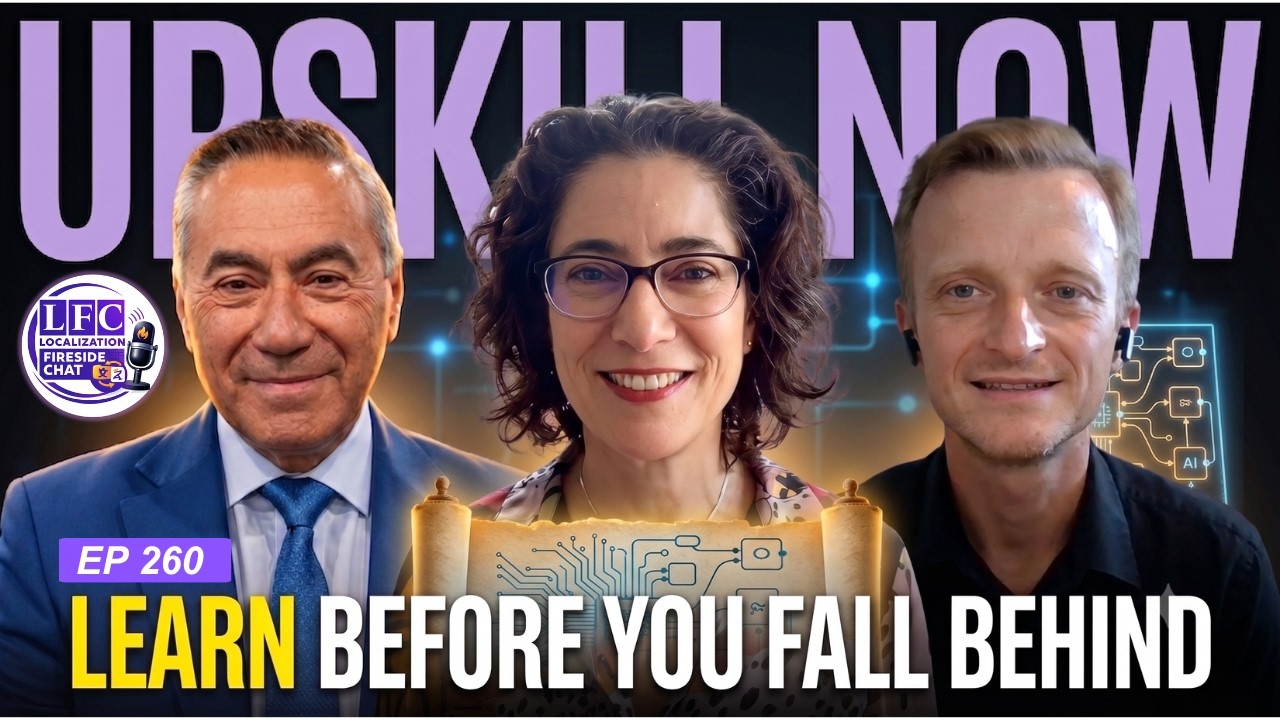
For roughly twenty years, Talia Zur Baruch watched the localization industry operate on the same fundamental assumption: build in English first, adapt for everyone else later. She preached global-first thinking from her days running international product at LinkedIn and SurveyMonkey, through adjunct professorships in San Francisco and Mexico City, and into the founding of Global Sake and the LocLearn Upskill School in 2023. The industry nodded along and then went back to its spreadsheets. What changed everything, she argues, is not that companies finally listened. It is that agentic AI made the old linear model structurally impossible to defend. The cost and time-to-market arguments that kept global-first deployment on the shelf for two decades are dissolving fast, and the professionals who understand that shift before their employers do are the ones who will define what the localization function looks like in five years.
Dr. Rafal Jaworski brings a different kind of credibility to that argument. He is simultaneously a researcher at Adam Mickiewicz University with a PhD in natural language processing, a technical lead at PwC building AI systems that land in actual production environments, and now the lead trainer inside LocLearn’s vibe coding course. When Robin pressed him on what it means to teach production-grade AI concepts to people with no software background, Rafal’s answer cut through the usual no-code marketing language. He described vibe coding not as a shortcut around software development but as a genuine shift in what layer of the problem requires human expertise. The planning, the iteration, the judgment about whether the output is actually correct, none of that disappears. What disappears is the requirement that the human in the room be the one writing the instructions for the machine. That distinction matters enormously for localization professionals who have spent careers developing deep cultural and market expertise that AI simply cannot replicate from a prompt.
What the Course Actually Builds
The practical architecture of the LocLearn vibe coding course is worth understanding in concrete terms because the details are where the real argument lives. Participants work inside n8n, a workflow automation platform that Talia and Rafal introduced in an earlier LocLearn cohort precisely because its visual interface makes it accessible without an engineering background. On top of that, Claude Code handles the front-end generation through a prompted, iterative process. Anthropic API access and the n8n subscription are both included in the registration, which is not a small decision. Talia made the point directly: applied learning only works if students are actually building something, and building something requires access to the tools. Previous cohorts produced functioning AI workflows that participants took back into their daily localization work, not just course projects that lived in a shared folder and were never opened again.
Rafal’s explanation of recursive LLM calls and deep agents gave the technical backbone to why this approach is more powerful than simply sending a text string to a language model and waiting for an answer. In a localization workflow, a deep agent structure means you can route initial data processing through faster, cheaper models and then pass those outputs to a more capable model for the kind of nuanced judgment that actually requires it. The orchestration logic, deciding which model handles which task at which point in the workflow, is exactly the kind of problem that a localization professional with domain expertise is better positioned to design than a software engineer who has never sat with a transcreation brief or a geo-cultural adaptation requirement.
The Bigger Career Argument
Robin asked the question that was sitting underneath the whole conversation: are we asking localization professionals to train themselves out of a job? Talia’s answer drew on the same logic that kept one New York gas company alive through Edison’s invention of the light bulb. The company survived because it was not in the gas business. It was in the light business. Localization professionals who understand their real business, which is making products feel native to humans regardless of where those humans are, are not being replaced by agents. They are being asked to stop doing the parts of the work that agents can handle and start doing more of the parts they were always the most qualified to do: defining geocultural requirements, informing go-to-market strategy, and shaping the adaptive product experience that a blanket global standard deployment has never been able to deliver. Rafal framed it simply and accurately by saying that calculators did not replace mathematicians. They changed which layer of the problem required a mathematician.
The early bird discount on the September 24th cohort runs through August 15th, with team pricing available for groups of three or more, and a lifetime discount for anyone who has already completed two or more LocLearn courses.
Episode 260 is one of the most practically useful conversations this channel has produced on the question of where localization careers actually go from here. You can Watch on YouTube or Listen on Simplecast and choose whichever format fits the next hour of your day.


Leave a Reply