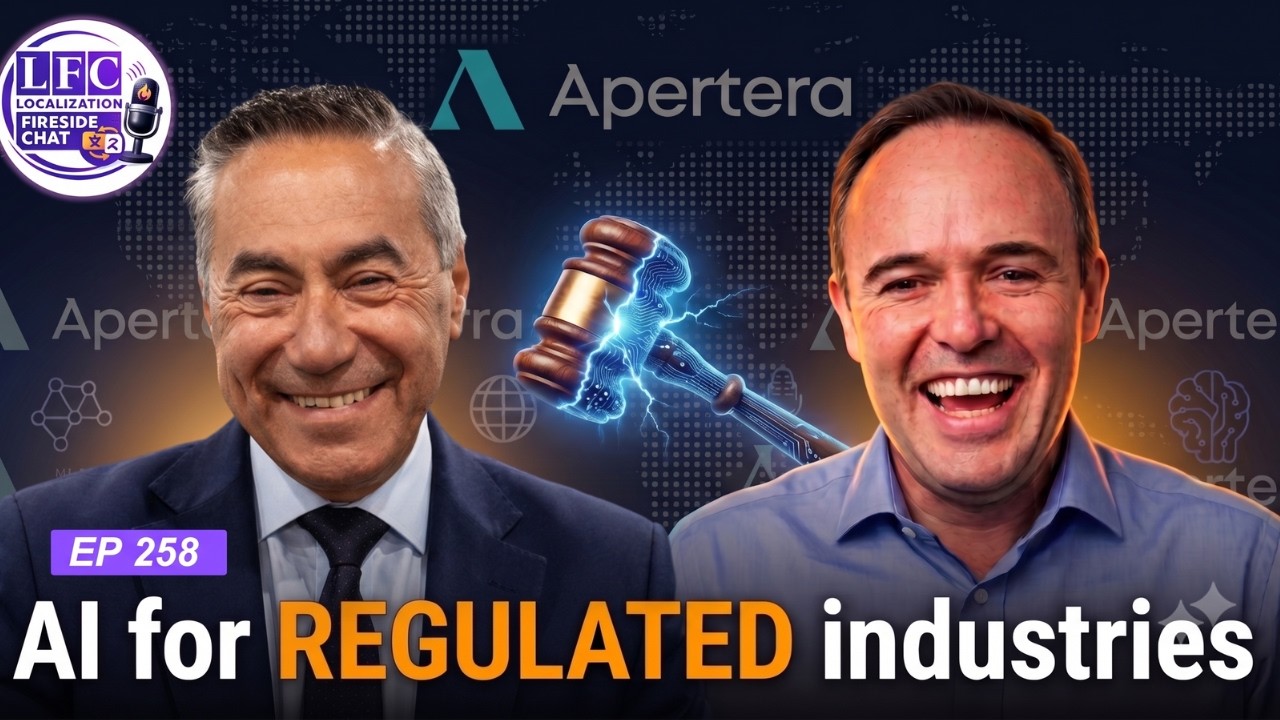
From Albanian Interpreter to AI-First Language Company
Gary Kalaci’s path to founding Apertera is not a straight line, and that is precisely what makes it interesting. He arrived in Canada after volunteering as an interpreter during the 1999 Kosovo crisis, working with UNICEF and Save the Children before eventually doing court and immigration interpreting in Canada. He then pursued a combined law and MBA program, intending to practice law full time. What changed his direction was noticing something that most people in the legal and financial world were content to ignore: the translation industry was growing fast, specialization was rare, and organizations were routinely told that any vendor could handle any language need. As Gary put it, it is hard to be good at everything when you try to do everything. He drew a parallel to elite law firms that deliberately refuse certain practice areas, not because they cannot do the work, but because focus is what makes them exceptional. That logic became the founding principle of what was then Alexa Translation, and what is now Apertera.
Why the Rebrand Signals Something Bigger Than a Name Change
The move from Alexa Translation to Apertera is not a cosmetic update. Gary explained on the episode that the word translation had become a ceiling. The company had spent years building technology that could do far more than translate documents, and a name tied to a single service category was quietly limiting the conversations they could have with clients. Apertera draws on two ideas at once. The first is aperture, as in the opening of a camera lens, representing the precise calibration of AI and human expertise required to produce something worth seeing. The second is the Latin root aperto, pointing toward an era of opening opportunities. Gary was deliberate about one other thing: the company is not calling itself Apertera AI. His reasoning was direct. If you have to put AI in your name to prove you are relevant, you are already behind. Apertera was working with neural machine translation before most of the industry had heard the term, acquiring a Canadian AI company back in 2018 when the mainstream conversation around artificial intelligence was still nascent.
The Organizational Context Advantage That Compounds Over Time
One of the most practically useful ideas Gary shared is what he calls organizational context as a compounding competitive advantage. The technology Apertera builds is not available to individual end users through a public interface. It is only deployed inside organizations, and the reason is fundamental to how value is created. Every correction a translator or bilingual professional makes inside the platform feeds back into the model. The system learns the tone, terminology, formatting preferences, and style guide of that specific client, not language in the abstract, but the way that particular organization uses language. Gary compared it to hiring a junior who will work tirelessly but needs real training time before they become someone you can genuinely rely on. That process cannot be shortcut, but it accelerates meaningfully over time. He also pushed back gently on the assumption that off-the-shelf tools embedded in enterprise software suites can replicate this. His analogy landed cleanly: saying you do not need a purpose-built translation platform because you already have a general AI tool is like saying you do not need a CRM because you already have Excel. The data fits, but the intelligence does not.
Gary also made a point that deserves more attention than it typically gets in conversations about AI adoption. He noted that translators, often treated as the most resistant group in any technology conversation, are actually ahead of most other professions in real AI adoption. Recent statistics suggest that upward of eighty percent of translators are using AI consistently as part of their workflow, a number that most legal and financial professionals have not come close to matching. The industry that people assume is fighting the future is, in practice, already living in it.
Episode 259 is a rich conversation for anyone navigating AI adoption decisions in regulated environments, whether you are a language professional, a legal or compliance leader, or a technology buyer weighing build versus buy. Watch on YouTube if you want the full discussion as it unfolded, or Listen on Simplecast if you prefer audio on the go. Either way, Gary’s perspective on what it actually takes to deploy AI responsibly inside high-stakes industries is worth your full attention.


Leave a Reply