What Language Intelligence Actually Means in Practice
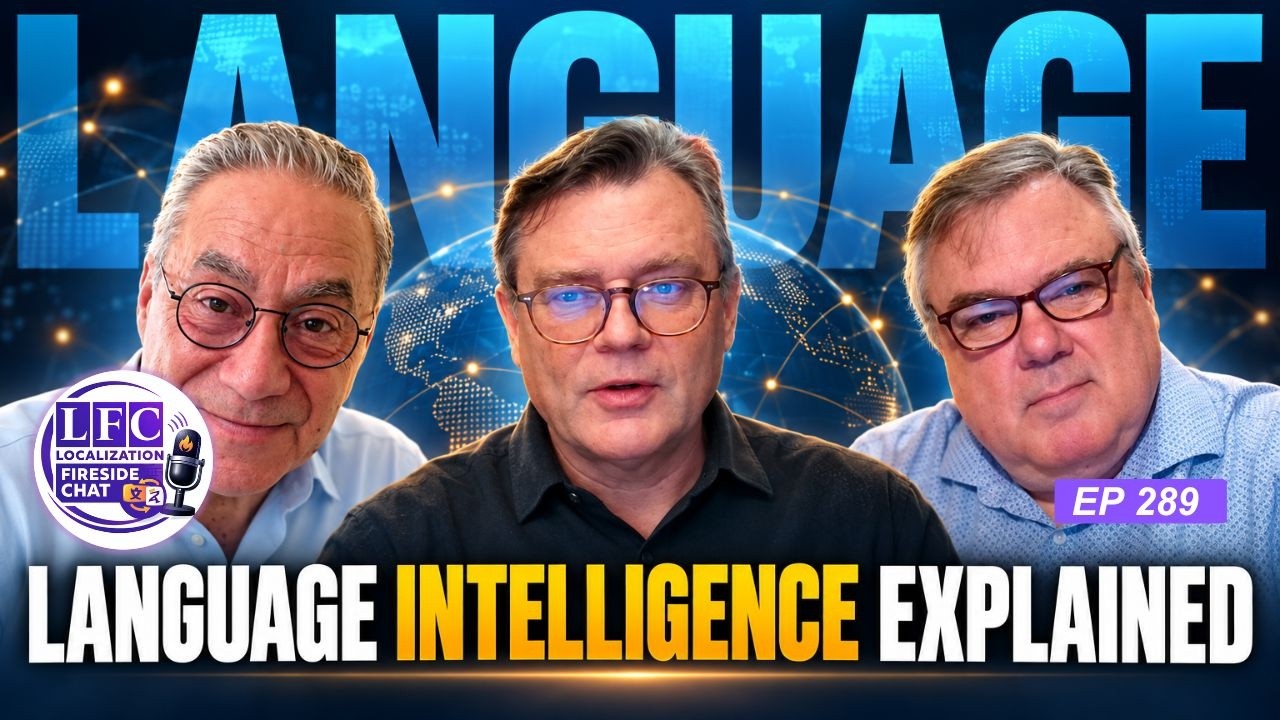
In episode 289 of the Localization Fireside Chat, Robin Ayoub sits down with Philippe Wacker, executive director of LT Innovate, and longtime guest Bruno Herrmann to preview the Language Intelligence Conference 2026, taking place in Vienna from November 17 to 19. The conversation quickly moves past buzzwords and into something more grounded: what does language intelligence actually mean when organizations have to do something with it?
Philippe frames it clearly. Powerful AI models alone do not guarantee reliable results. They need high-quality language data, structured knowledge, multilingual capabilities, domain expertise, and effective governance. Language intelligence is what brings all these elements together, turning AI capability into something organizations can actually trust and measure. Bruno builds on that by pointing to operations as the real proving ground. The focus, he argues, has to shift from outputs to outcomes, and that shift requires connecting people, processes, and technology in ways that most organizations have not yet managed. He is direct about where the friction tends to live: it is human alignment, far more than technology, that determines whether a language intelligence initiative succeeds or disappoints.
The Upstream Problem Nobody Wants to Acknowledge
One of the sharper exchanges in this episode centers on data and where problems actually originate. Robin raises something practitioners know but rarely say aloud: organizations are pointing AI systems at inherited data that may contain errors, outdated content, or content that was never relevant to begin with, and then wondering why the outputs fall short. Bruno’s response is precise. The challenge is not just cleaning data downstream. It is embedding language intelligence upstream, before content is created, before workflows are locked in, before the decisions that shape everything else have already been made.
This upstream framing matters because language management in most organizations is fragmented. Parts of it live in marketing, parts in corporate communications, parts in IT. Nobody owns the full picture, and that fragmentation is exactly what language intelligence as a discipline is designed to address. The European Commission is among the institutions presenting at LI 2026, and their presence signals that this conversation is no longer confined to the localization industry. Public sector bodies, financial institutions, and manufacturing organizations are all grappling with the same underlying challenge: how to make language a strategic asset rather than an afterthought.
What Makes LI 2026 Different From Other Conferences
Philippe is candid when Robin pushes on what distinguishes LI 2026 from the crowded field of AI and language technology events. The answer is not the speaker lineup or the venue, though the Austrian Parliament in central Vienna is a striking setting. The distinguishing feature is the emphasis on implementation, real-world value, and shared learning. This year, for the first time, the conference opens with three workshops designed to move participants beyond listening and into active engagement. One workshop examines the future of localization through the lens of AI governance and ethics. A second digs into terminology and language resources as foundational data infrastructure for generative AI. A third focuses on language intelligence for security and crisis management, with the potential to produce a joint position paper and collaborative projects.
Bruno adds something worth holding onto from previous editions of the conference. The moments that resonated most with attendees happened during coffee breaks and dinners, when a localization leader found themselves talking to someone from UX or content development, people they had never met inside their own company, because language management is so fragmented that even colleagues rarely see the full picture together. LI 2026 is designed to create exactly that kind of cross-pollination, and the attendee mix reflects it: participants are traveling from North America and Asia alongside the European majority, bringing perspectives that prevent the event from becoming a regional echo chamber.
Registration is open at http://www.language.com, and listeners of the Localization Fireside Chat can use the promo code Promo15 for fifteen percent off. Philippe and Bruno have also committed to returning after the conference for a recap episode, so the conversation will continue.
This is a conversation worth sitting with whether you are planning to attend or just trying to understand where the language intelligence discipline is heading. Watch on YouTube if you want the full discussion with the energy of a live conversation, or Listen on Simplecast if you prefer to take it in on your own schedule. Either way, episode 289 is one of the more practically grounded previews you will find of what LI 2026 is actually trying to accomplish.


Leave a Reply