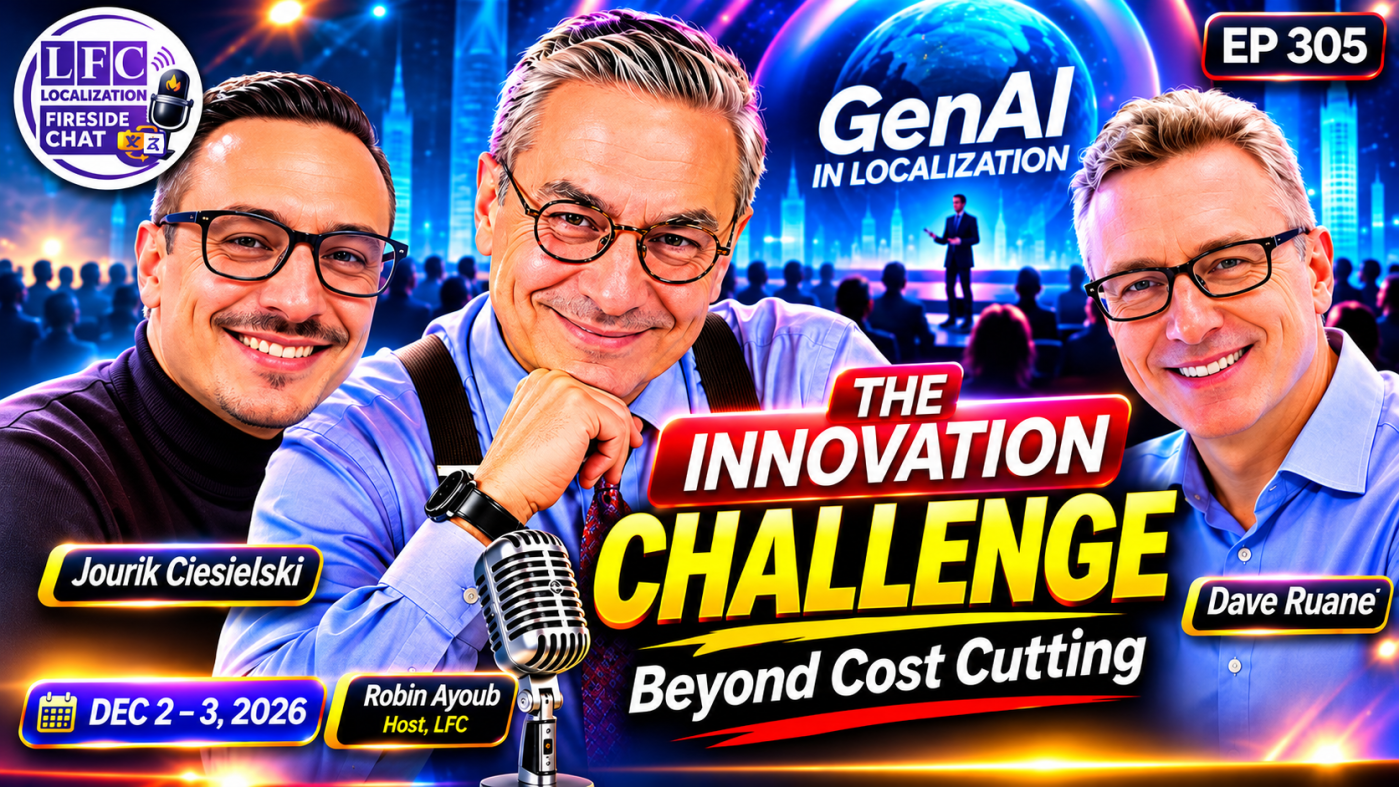
The Innovation Challenge Is a Stage, Not a Scoreboard
Episode 305 of the Localization Fireside Chat brings together two people who have spent serious time thinking about what real innovation actually looks like inside the language industry. Dave Ruane, Global Director of Client Solutions at Lion People Global and co-founder of the Process Innovation Challenge at LocWorld, and Jourik Ciesielski, CTO at ELAN Languages, joined Robin Ayoub ahead of the GenAI in Localization conference running December 2nd through 4th. The two are co-hosting an Innovation Challenge session at that event, and the conversation on this episode is essentially the clearest possible preview of what they are building and why.
Dave is deliberate about framing the Process Innovation Challenge as a showcase rather than a pure competition, though he is honest that the line between the two keeps shifting. His reasoning is straightforward: a competition framing filters out exactly the innovators you most want to see. The goal is a stage where someone who built something genuinely useful, whether a freelance translator with a vibe-coded workflow tool or a small LSP owner who decided to build her own TMS from scratch, feels as welcome as an enterprise vendor with a polished deck. Jourik adds that the format itself enforces this. Presenters get four minutes total, and they are coached hard to spend three of those four minutes on the problem. The solution comes after. The tough questions from Dave and Jourik come after that. If a pitch starts drifting toward flat marketing, the audience finds out quickly because a pointed question from the hosts lands fast.
Survival Innovation Versus Genuine Invention
One of the sharpest moments in this conversation comes when Robin introduces the term survival innovation to describe what he sees driving most of the industry right now. His observation, backed by roughly 305 episodes worth of conversations, is that the overwhelming majority of innovation happening in localization is concentrated on cost reduction rather than top-line revenue growth. Dave connects that directly to what he calls the echo chamber problem. Technologists, himself included in an earlier career phase, fall in love with what they have built and skip the foundational question of whether anyone else will care. His coaching for presenters always circles back to the same test: what is the problem, who does it affect, and what changes if it gets solved? If you cannot answer those three things before you open your demo, the demo does not matter.
Jourik reframes the larger shift happening in the industry with real precision. For years, he argues, every piece of innovation was incremental and constrained by whatever the TMS provider decided to build next. Terminology tools, MT customization, quality metrics, all of it was sprinkled on top of a status quo nobody questioned. What has changed is not just that AI makes building easier. What has changed is that the starting point is now the problem rather than the available technology. You can identify something that is genuinely broken, build directly toward solving it, and get it into production without waiting for a vendor roadmap. That inversion is what the Innovation Challenge at the GenAI event is designed to surface, and both Dave and Jourik are clear that the range of submissions they are seeing reflects exactly that shift. Job market platforms, subtitle segmentation tools, speech-to-speech translation experiments, workflow automations built by people who would not have called themselves developers two years ago.
What First-Time Presenters Actually Need to Get Right
Dave is an introvert who built these platforms partly to give other introverts a safe place to be heard, and that shapes the practical advice he gives people who have never presented at a conference before. Preparation is eighty to ninety percent of the outcome. The tennis ball effect he describes is a simple and effective tool: open with a question, move the energy to the audience immediately, and your own nerves become secondary. Jourik’s framing is equally useful. The Innovation Challenge is not a pitch to investors. It is a conversation with peers who share the same problems, the same frustrations, and the same wish list. That reframe takes the pressure off considerably.
Dave closes with a point about serial innovators, the people who show up every single cycle with something new, and notes that some of the most committed participants have mapped their internal development timelines to the call for papers schedule. That is not a trick. That is what a continuous innovation mindset looks like in practice. Jourik’s one problem he would love to see someone walk on stage and solve is speech-to-speech translation at the quality level that genuinely opens the interpreting space. Dave’s is connectivity, the persistent failure of the industry to build real standards that let systems talk to each other without reinventing the wheel every time.
This is an episode worth sitting with twice because the ideas compound. If you want the full conversation, you can Watch on YouTube or Listen on Simplecast, whichever format fits your day. And if you want every episode of the Localization Fireside Chat in one place, download the free LFC app on the App Store or Google Play.


Leave a Reply