The Body Keeps Score Before the Meeting Even Starts
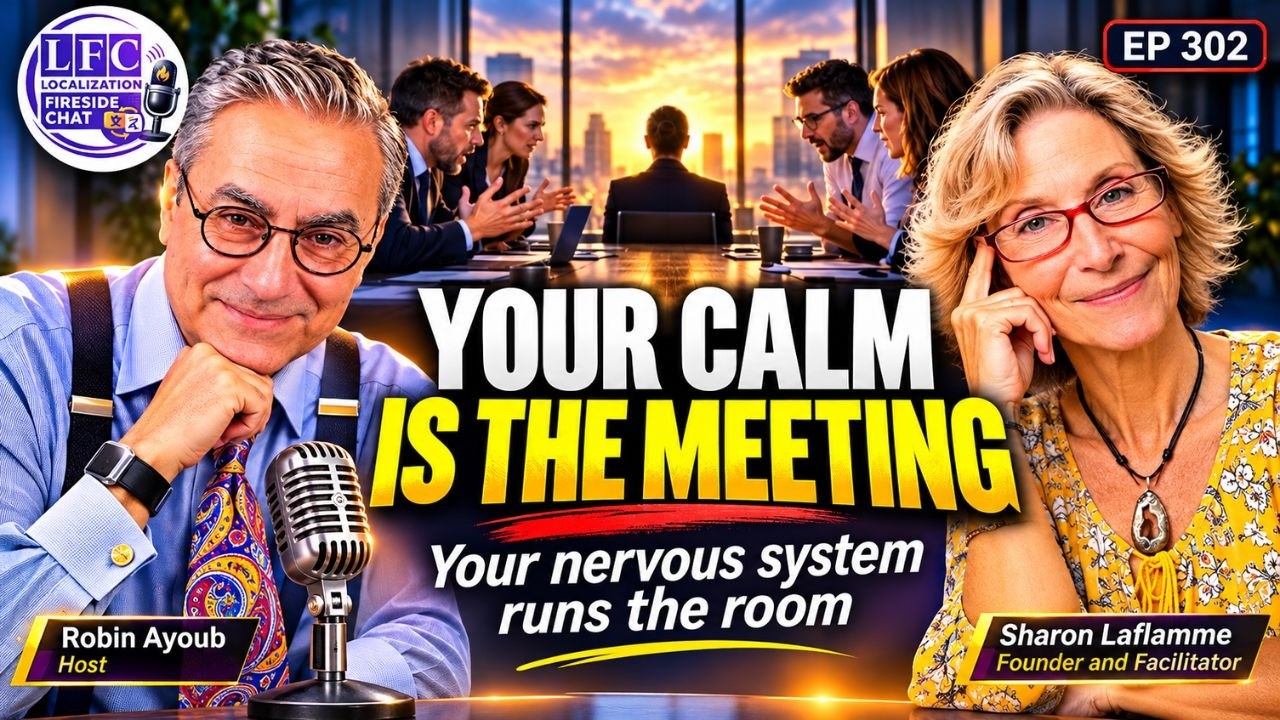
Sometimes the most useful conversation you can have about leadership has nothing to do with strategy or execution. Episode 302 of the Localization Fireside Chat is one of those conversations. Sharon Laflamme, founder of Creating Serenity Now and a Certified Somatic Experiencing Practitioner, joined Robin Ayoub to talk about something most founders never examine directly: the nervous system running underneath every high-stakes decision they make. Sharon’s entry point into this work was not academic. She grew up with two alcoholic parents in a military household where the conditions required to build a regulated nervous system, attentive caregiving, predictability, co-regulation, were simply not there. What emerged instead was a body that learned to survive rather than settle. The ulcers she developed in first grade were not a mystery, they were a signal. She spent decades reading that signal before she learned to respond to it, and that journey became the foundation of everything she now teaches.
What Actually Happens When a Client Call Goes Sideways
Robin posed the scenario that sits at the center of this episode: a founder is on a call, a major client signals a threat to the contract, and within seconds the chest tightens, thinking narrows, and the voice changes. Sharon’s explanation of that moment is worth sitting with. The autonomic nervous system does not wait for permission. The moment it registers a threat, every system in the body shifts toward defense. Heart rate climbs, the prefrontal cortex goes partially offline, and the body prepares to fight rather than think. The challenge for high-performing professionals is that many of them have spent careers in exactly this state and have mistaken that activation for competence. Sharon named it directly: survival energy can look a lot like drive. It kept her teaching aerobics, working relentlessly, and excelling academically. What she eventually discovered is that there is a completely different quality of energy available when the body stops treating the world as a threat, and that energy is both more sustainable and more creative than anything the stress response can generate. The practical implication for leaders is uncomfortable but important. If your nervous system was shaped in an environment where staying hyperalert was how you stayed safe, then calm can register as danger. Relaxing the guard does not feel like relief, it feels like exposure. Sharon works with people to build what she calls ventral vagal capacity, the neurological pathway that allows the body to actually experience safety rather than just think about it.
Why Forgiveness Is a Selfish Act and Why That Matters
Sharon’s online course is called Making Friends With Forgiveness, and Robin pressed her on that specific word choice. The framing is deliberate. For most people carrying unresolved anger or resentment, forgiveness sounds like a concession, like the other person wins. Sharon reframes it entirely. Forgiveness is not something you do for the person who hurt you. It is the release of energy that has been locked in your body, sometimes for decades, keeping your nervous system on guard against a threat that no longer exists in the room. The course pairs that reframe with daily somatic practice, affirmations, and relational skill-building, because Sharon’s argument is that you cannot genuinely open toward others until you have built a safe relationship with yourself first. Robin acknowledged during the conversation that this kind of language, love yourself, pay attention to your body, can sound indulgent or even suspicious to a professional audience trained to push through. Sharon’s response was direct: if you are a founder and you are your own primary resource, neglecting that resource is not discipline, it is a liability.
Robin also offered something rare in this episode, a genuine personal disclosure. He described leaving a large corporate role, coming off blood pressure medication, and finding that he could now work long hours without dread, something that felt impossible when his work environment was not aligned with who he was. Sharon received that honestly and reflected it back without turning it into a testimonial. She noted that the absence of threat in work you love does not mean the nervous system requires no attention, it means you are finally operating closer to the state you were always meant to inhabit. That exchange is the most human moment in the episode and the one most worth returning to.
If this conversation opened something for you, do not let it close again before you do anything with it. Watch the full episode on YouTube or take it with you on Simplecast, whichever format fits how you move through your day. You can also find Sharon at creatingserenitynow.com and makingfriendswithforgiveness.com, and if you have trouble tracking her down, reach out to Robin directly and he will make the introduction. Get every episode, video, article, and audio in one place by downloading the free LFC app on the App Store or Google Play.


Leave a Reply