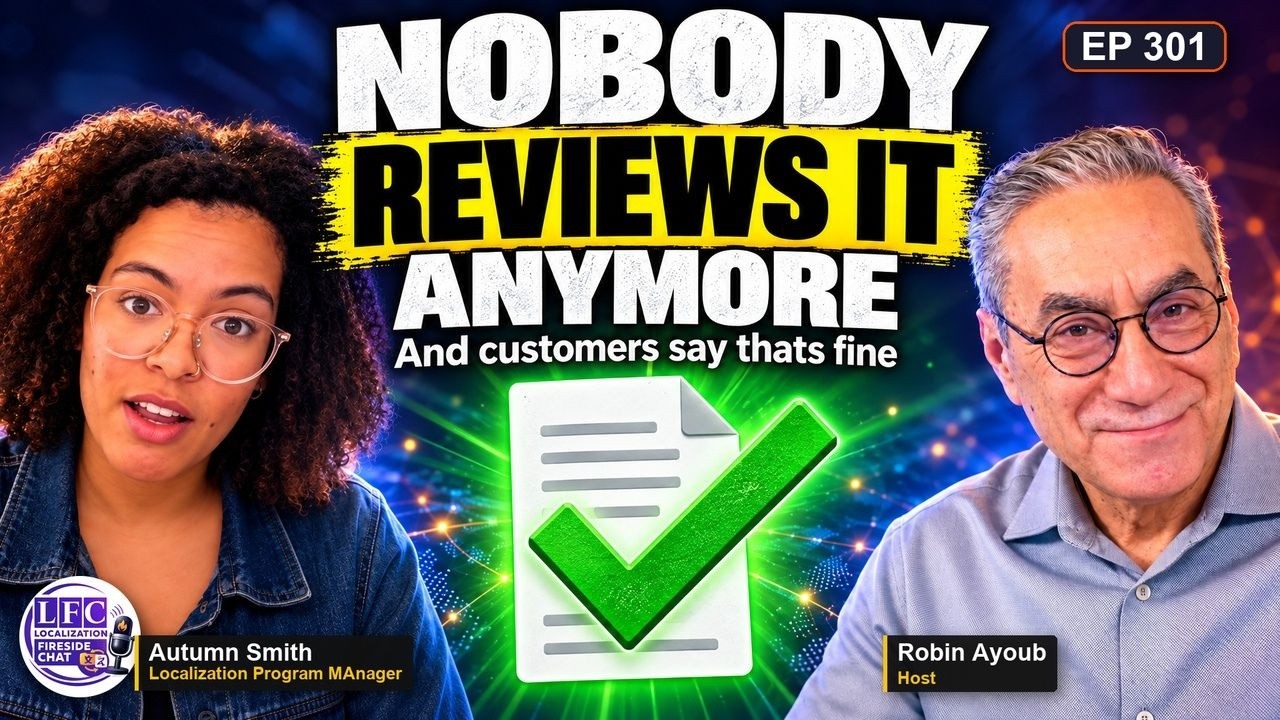
From Japan to Datadog: A Career Built on Language as Infrastructure
Autumn Smith did not arrive at enterprise localization through a traditional route. She spent years living and working in Japan, taught English, managed events for a Japanese hospitality company, and quietly built a team of forty freelancers translating audio guides for temples and cultural heritage sites before she ever heard the word TMS. That experience, she told Robin Ayoub on Episode 301 of the Localization Fireside Chat, gave her something a degree could not fully replicate: a deep understanding that language goes far beyond the spoken word. When she eventually enrolled at the Middlebury Institute of International Studies, the program did not teach her how to manage people or run a complex operation. She already knew how to do that. What it gave her was the technological literacy to talk to engineers, read code, and build a bridge between the creative side of language and the systems side of product delivery. That combination turned out to be exactly what Datadog needed when they reached out with no job description and simply asked whether she wanted the job.
The $200K Question: What AI-First Actually Costs
The number in Autumn’s bio is real, but the story behind it is more instructive than the headline. When she arrived at Datadog, the documentation localization budget was sitting around seven hundred thousand dollars a year, and the output was unreliable because the tooling had never been properly configured for markdown. Translators would deliver files, the documentation team would spend eight hours a week fixing broken builds, and the feedback loop never closed cleanly. Autumn’s first move was not to find a cheaper vendor. It was to ask what kind of AI she could actually train and own over time, rather than simply renting a black box. She ran RFPs, evaluated TMS systems against that north star, and worked through a JSON conversion process that eliminated the build-breaking problem entirely. By August of this year, after opening the API, translation coverage had increased by twenty percent and the documentation budget had been cut roughly in half. The hidden cost she is candid about is time. Cleaning up broken translation memories, rewriting style guides so a machine can follow rules rather than interpret suggestions, and fine-tuning LQA scripts in Claude over two weeks of iteration, none of that shows up in the savings line. It is the foundation the savings are built on, and skipping it is exactly why most AI localization promises do not pay out.
Making Localization Invisible Without Making It Irrelevant
The phrase Autumn uses, replacing the magic button, is not about removing human judgment from the process. It is about replacing the rogue behavior that happens when the official process is too slow or too complicated to bother with. When internal teams are using Google Translate on legal documents or generating AI copy that bypasses terminology and brand standards entirely, the localization program has already lost. Her answer is to bring her trained model, her glossaries, and her style guides into the interfaces people are already using, so that choosing the right tool and choosing the convenient tool become the same choice. She is doing this with one vendor for marketing content right now, building a transcreation portal because existing TMS systems have never handled marketing copy well and probably never will. The broader argument she is making, and the one worth sitting with, is that the job of a localization program manager in this environment is not to be the control layer at the end of the pipeline. It is to build the guardrails into the pipeline itself, then step back far enough that people use them without noticing. That is a different professional identity than most of the industry was trained for, and Autumn’s advice to anyone still operating from a review-layer model is direct: learn MCP, learn how Claude connects to your TMS, and start doing automated LQA scripting now, because the alternative is watching your program get routed around.
This is a conversation worth hearing in full, and you can do that in whichever format works for you. Watch on YouTube if you want the full visual conversation, or Listen on Simplecast if you prefer audio. If you want every LFC episode available wherever you are, download the free app on the App Store or Google Play and carry the conversation with you.


Leave a Reply