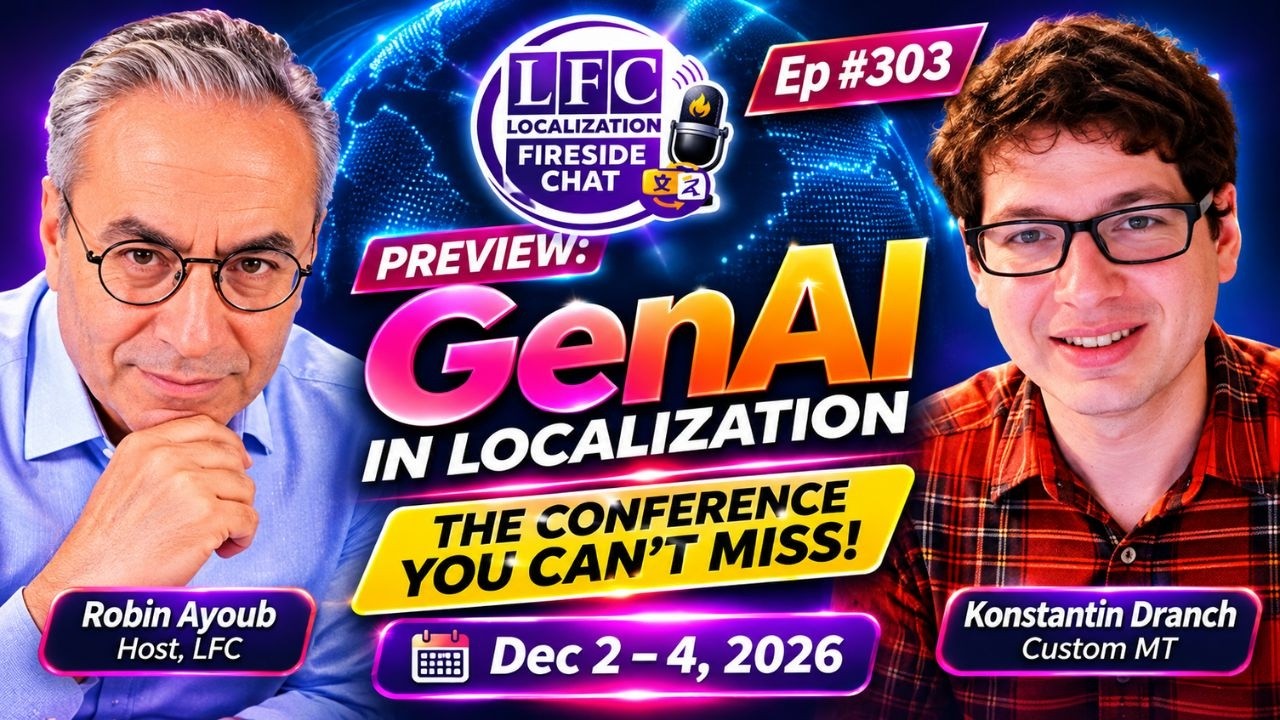
The Conference Built Around Doing, Not Just Watching
Episode 303 of the Localization Fireside Chat marks a milestone, crossing three hundred recorded conversations, and Konstantin Dranch, founder of Custom.MT, joined Robin Ayoub to celebrate it with a conversation that matters deeply to anyone building a career in localization right now. Konstantin runs the GenAI in Localization Winter Edition, an online conference scheduled for December 2 to 4, 2026, and he was direct about why it exists. Most online conferences turn into passive Zoom marathons where people half-listen for hours and walk away with nothing that changes their Monday morning. This one was designed differently from the start, with hands-on workshops, a Slack community for real connection, and in past editions, a full hackathon where localization teams had forty-eight hours to build working apps around themes proposed by industry leaders. The event is online, so there is no travel budget required, and free livestream access is available for the main sessions at the conference page. For those who want the full experience including workshops and recordings, a Full Pass runs €195, with a Team Pass for five people at €725 through the registration form.
Two Roles the Industry Needs Right Now
Konstantin was clear about who the conference is designed to serve, and the framing is worth sitting with. He described two profiles. The first is the engineer, the localization professional who can build workflows, compare models, fine-tune systems, and create RAG pipelines. The second, which he called the diplomat, is just as critical. This is the person inside an organization who can push back when an engineering team says they will just run everything through a large language model and skip the linguists entirely. That pressure is real, and without someone who can articulate the value of terminology control, tone of voice, cultural nuance, and risk management, organizations end up sounding identical and occasionally offensive. As Konstantin put it, if you just give an engineer an API, every company in the world would sound the same. The conference runs three focused tracks across the December edition: using LLMs as a judge for quality control, organizational diplomacy in AI-driven environments, and language equity in AI for low-resource and indigenous languages. You can follow updates and community conversation on the conference LinkedIn page and explore past recordings and webinars as well as the GenAI in Localization YouTube channel to get a feel for the depth this event consistently delivers.
Low-Resource Languages and the Question of Who Owns the Data
One of the most compelling threads in this conversation was the third conference track, the one Robin himself is moderating on December 3rd from 10:35 to 11:30 a.m. Eastern. The session covers low-resource languages, data ownership, and sovereign AI, and it arrives at exactly the right moment. Konstantin noted that while the top twenty to thirty languages now receive reasonably good AI coverage depending on domain and use case, everything beyond that becomes unpredictable fast. Governments across Africa, Central Asia, India, and the Arabic world are launching programs to digitize and protect their languages. The Uzbek government recently open-sourced large corpora to support better model development. Meta’s Paco Guzman, who has been building multilingual Llama models and evaluation datasets across two hundred languages, will deliver a keynote on the subject. Robin brought his own perspective here, drawing on his work with an indigenous language practice covering close to ninety languages across Canada, a country where Statistics Canada counts roughly two hundred and forty-three thousand people identifying as indigenous speakers spread across those ninety languages. Some of those languages have no keyboard, no Unicode standard, and no written corpus to feed a model. The stakes are preservation, not just efficiency. And the question of who owns the data generated during these collection and training exercises sits right at the center of the work. These are the conversations that the broader industry needs to be having, and this is the room where they will happen.
This is one of those episodes worth more than a single listen. You can Watch on YouTube or Listen on Simplecast depending on how you like to take in a conversation. And if you want all LFC episodes in one place without fighting the algorithms, download the free app on the App Store or Google Play.


Leave a Reply