The Job Nobody Talks About, But Everyone Needs
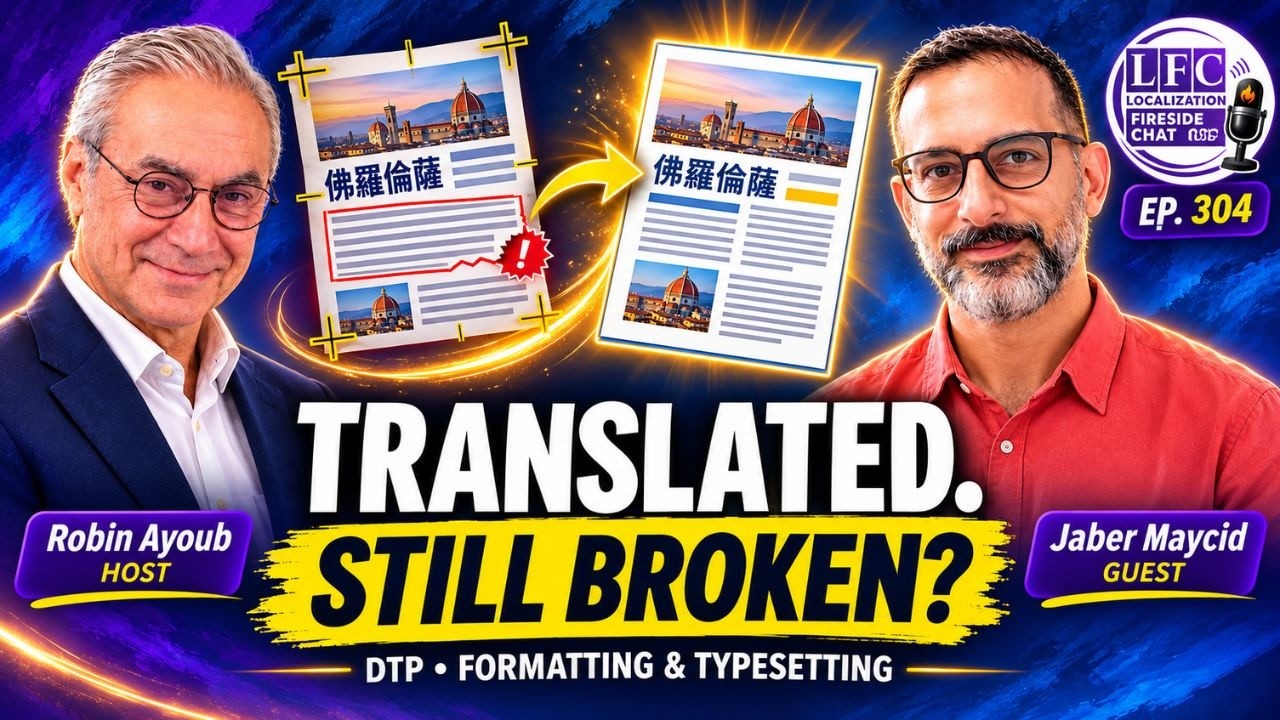
In over 300 episodes of the Localization Fireside Chat, desktop publishing had never been the main topic. That gap is exactly the problem Jaber Maycid has spent 20 years trying to close. A multilingual typesetter and desktop publisher based in Ottawa, Jaber has typeset content in over 130 languages for clients like the UN, the City of New York, and the Government of Canada. His specialty is the work most DTP operators quietly avoid: right-to-left scripts like Arabic, Farsi, and Urdu, and complex scripts like Thai and Sinhalese where InDesign itself will break a word in the wrong place if you do not know the language well enough to catch it. His path in started the way a lot of localization careers do, with a favor for a relative and a Japanese brochure that turned into squares on screen the moment he pasted the translation in. That first lesson about font support set the tone for everything that followed.
What Actually Breaks When a Specialist Is Not in the Room
Jaber came to the conversation with real examples, not hypotheticals. He bought a smart door lock in Jordan whose Arabic manual had every letter disjointed and reading left to right. He boarded an Air Canada flight and found Montreal spelled backwards in Arabic on the in-seat display, while the Hebrew version of the same word rendered correctly in the same system. These are not small companies cutting corners. These are organizations with resources, and they still shipped broken multilingual content because nobody with the right eyes reviewed the final file. The most common failure Jaber describes is numbers. In Arabic, text reads right to left but numbers read left to right, and a typesetter without that feel for the language will flip a phone number or a measurement without realizing it. In French and Italian, prepositional words cannot end a line, and Jaber has learned which words those are across multiple Latin-based languages simply from years of repetition. In Thai, there are no spaces between words, only between sentences, which means every line break has to be validated by a linguist because Jaber, by his own admission, does not speak Thai and will not guess.
Where the Workflow Squeezes DTP the Hardest
The structural problem Jaber names is one that Robin has watched from the buyer side for 25 years. A marketing team spends a year building a brochure. Two weeks before launch someone realizes it needs to exist in six languages. Translation gets compressed, and typesetting, sitting at the very end of the chain, gets whatever time is left. Some LSPs absorb DTP into the project price without calling it out as a separate line item, which makes the work invisible to buyers and impossible to price correctly. Jaber’s response to this has been methodical. He created what he believes is the first formal designation for the profession, launching October 1st as International Multilingual Typesetters Day, the day after International Translation Day. He pitched localization conference organizers on speaking slots for years before finding traction through the Localization Academy, where his beginner DTP course is now a recorded program with strong reviews and a planned advanced follow-up. His advice for localization project managers is direct: learn the scripts you are sending files into. Understand what a right-to-left layout actually requires. Know which fonts support which accents before a designer locks in a custom typeface that will not render Romanian correctly, let alone Arabic. Involve a typesetter before the design is finalized, not after the translation comes back, because fixing it upstream takes a fraction of the time it takes to fix it in post.
If this conversation made you rethink how DTP fits into your localization workflow, the full episode is worth your time in either format. Watch on YouTube to see Jaber walk through the visual side of what goes wrong, or Listen on Simplecast if you prefer audio on the go. You can also get every LFC episode in one place by downloading the free app on the App Store or Google Play.


Leave a Reply